Why Best Society Registration in Delhi Matters for NGOs and RWAs
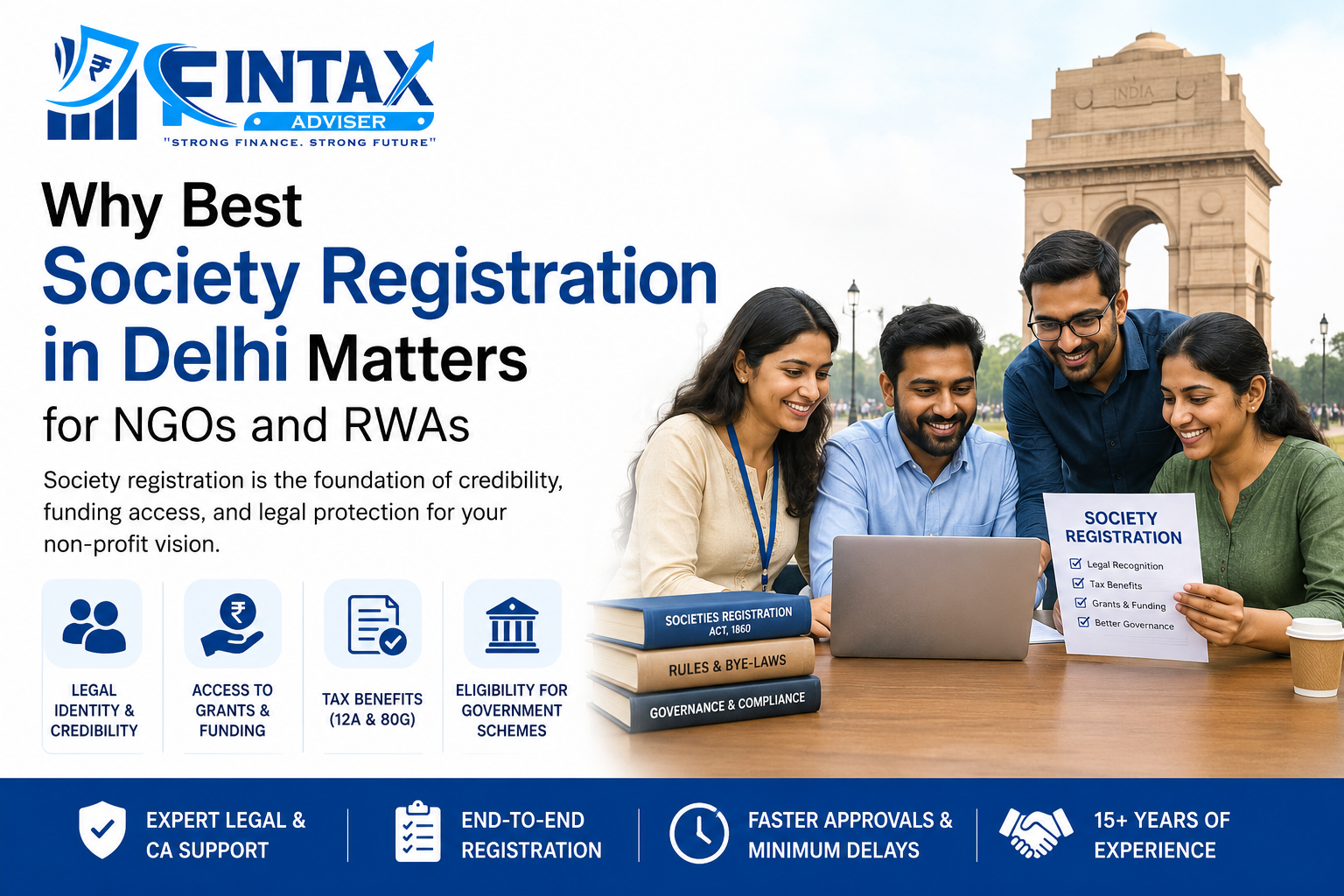
At Fintax Adviser, we've spent over 15 years guiding NGOs, Resident Welfare Associations (RWAs), and community groups through the legal and financial complexities of best society registration in Delhi. Many founders start with a powerful vision—education for underprivileged children, better living conditions in a housing society, or cultural preservation—but underestimate how much best society registration in Delhi, India, can shape their long-term success. Registration isn't just a bureaucratic step; it's the foundation of credibility, funding access, and legal protection.
Delhi, as India's capital, hosts thousands of non-profits and RWAs. Yet, a significant number operate informally or face compliance issues because they didn't prioritize best society registration in Delhi early on. This guide explains why society registration matters deeply for NGOs and RWAs, how the process works under the Societies Registration Act, 1860, and how partnering with experienced advisers like Fintax Adviser can turn your vision into a legally sound, impactful organization.
What Is Society Registration Under the Societies Registration Act, 1860?
A society is a voluntary association of individuals united for a common, nonprofit purpose—such as education, charity, cultural promotion, sports, or community welfare. The Societies Registration Act, 1860, provides the legal framework for registering such organizations in India, including Delhi.
Key features of a registered society:
- Non-profit nature: The primary goal is not profit-making but promoting a charitable, educational, cultural, or social cause.
- Legal entity: Once registered, the society becomes a distinct legal entity. It can own property, enter contracts, open bank accounts, and sue or be sued in its own name.
- Governance structure: Managed by a governing body (e.g., president, secretary, treasurer) elected by members.
- Perpetual succession: The society continues to exist regardless of changes in membership.
For NGOs and RWAs in Delhi, opting for Best Society Registration in Delhi under this Act ensures credibility, eligibility for government grants, and access to tax exemptions—making it a preferred choice for many organizations.
Why Society Registration Is Crucial for NGOs in Delhi
NGOs in Delhi work across diverse sectors: education, healthcare, women's empowerment, environmental conservation, and more. Best Society Registration in Delhi provides them with several strategic advantages:
1. Legal Identity and Credibility
A registered society gains formal legal recognition. This:
- Allows the NGO to enter into contracts (eg, with donors, vendors, or government agencies) in its own name.
- Enhances credibility in the eyes of donors, beneficiaries, and partners.
- Provides a structured framework for governance, reducing internal disputes.
Without registration, an NGO remains an informal group, limiting its ability to scale and attract serious funding.
2. Access to Tax Exemptions
Registered societies can apply for:
- 12A registration: Exempts the NGO's income from tax, provided the income is applied solely for charitable purposes.
- 80G registration: Enables donors to claim tax deductions on contributions, boosting fundraising appeal.
- FCRA registration (for eligible NGOs): Allows receipt of foreign contributions.
These benefits are central to the financial sustainability of NGOs—a key reason why Best Society Registration in Delhi is so important.
3. Eligibility for Government Grants and CSR Funds
Many government schemes and corporate CSR programs require organizations to be registered under a recognized act. Best Society Registration in Delhi, India, opens doors to:
- Central and state government grants.
- Corporate CSR (Corporate Social Responsibility) funding.
- International donor programs (subject to FCRA compliance).
Registration acts as a gateway to formal funding channels.
4. Asset Holding and Bank Accounts
A registered town can:
- Own property (land, buildings, equipment) in its name.
- Open dedicated bank accounts.
- Receive donations via bank transfers, checks, or online platforms.
This simplifies financial management and ensures transparency.
5. Limited Liability for Members
Provided members act in good faith and within the society's rules, their personal liability is limited. This protects individuals from being personally liable for the society's debts or legal issues.
For NGOs dealing with sensitive or high-risk issues, this protection is invaluable.
Why Society Registration Matters for Resident Welfare Associations (RWAs) in Delhi
RWAs play a vital role in Delhi's urban landscape, common facilities, security, maintenance, and community welfare in housing societies. Best Society Registration in Delhi offers managing RWAs several critical benefits:
1. Formal Legal Status for Collective Action
A Registered RWA:
- Can represent residents in dealings with builders, municipal authorities, and utility providers.
- Has the authority to enforce bylaws, collect maintenance charges, and manage common areas.
- Can enter into contracts for services like security, cleaning, or repairs.
Without registration, an RWA may lack the legal standing to take effective collective action.
2. Better Management of Common Funds
Registered RWAs can:
- Open a society bank account for maintenance funds.
- Maintain transparent accounts and conduct audits.
- Ensure proper utilization of funds for the benefit of all residents.
This builds trust among residents and reduces disputes over financial matters.
3. Eligibility for Government Schemes and Grants
Many municipal and state government schemes for infrastructure upgrades, green initiatives, or community development require RWAs to be registered. Best Society Registration in Delhi enables RWAs to:
- Apply for grants or subsidies for water harvesting, solar installations, or park development.
- Participate in government-led community programs.
4. Dispute Resolution and Bylaw Enforcement
A register RWA can:
- Frame and enforce bylaws regarding parking, noise, pets, and common area usage.
- Resolve disputes through structured mechanisms (committees and general body meetings).
- Seek legal recourse if necessary in the society's name.
This promotes harmony and orderly living in residential complexes.
5. Long-Term Sustainability
Registration ensures the RWA's continuity even as residents change. It provides a stable structure for elections, record-keeping, and handover processes.
For RWAs aiming to improve quality of life and property values, Best Society Registration in Delhi is a foundational step.
Key Requirements for Society Registration in Delhi
To achieve best society registration in Delhi, NGOs and RWAs must meet specific legal requirements under the Societies Registration Act, 1860:
1. Minimum Number of Members
- At least seven members are required to form a society.
- These individuals will be the founding members and initial governing body.
- They should be competent to contract (generally adults of sound mind).
2. Memorandum of Association (MOA)
The MOA is the charter document of the society. It typically includes:
- Name of the society: Must be unique and not similar to existing registered names.
- Registered office address: Full address in Delhi.
- Objectives: Clear, specific, and lawful non-profit objectives.
- Names, addresses, and occupations of the founding members.
- Details of the governing body (president, secretary, treasurer, etc.).
The MOA must be signed by all founding members appropriately.
3. Rules and Beans
The society must have a set of rules governing its internal management. Common clauses cover:
- Membership criteria and admission process.
- Rights and duties of members.
- Procedure for meetings (general body, managing committee).
- Election and removal of office bearers.
- Financial management, audit, and accounting.
- Amendment of MOA and rules.
- Dissolution of the society.
These rules should be consistent with the Act and practical for day-to-day operations.
4. Registered Office in Manual
- The society must have a registered office in Delhi.
- Proof of address (ownership deed, rent agreement, NOC from owner) is required.
- The office address will be used for official correspondence.
5. Documentation
Key documents generally required for best society registration in Delhi include the following:
- Identity proof of all members (PAN, Aadhaar, passport, voter ID, etc.).
- Address proof of members (utility bills, bank statements, etc.).
- Proof of registered office (rent agreement, NOC, electricity bill, etc.).
- Draft MOA and rules.
- Covering letter requesting registration.
- Any additional affidavits or declarations as per the Registrar's requirements.
Proper documentation is critical to avoid delays or rejections.
Step-by-Step Process for Society Registration in Delhi
At Fintax Adviser, we follow a structured, six-step lifecycle for the best society registration in Delhi. This approach minimizes errors and speeds up approval.
Step 1: Initial Consultation and Objective Clarification
- We begin with a detailed discussion to understand your vision, objectives, and target beneficiaries.
- We assess whether a society is the most suitable legal structure (vs. trust, Section 8 company, etc.).
- We explain the legal implications, compliance requirements, and long-term strategy.
This foundational step ensures alignment between your goals and the legal framework.
Step 2: Name Selection and Availability Check
- You propose 2–3 potential names for the society.
- We check name availability and uniqueness to avoid conflicts with existing registered societies.
- The name should reflect the society's purpose and comply with naming guidelines (no offensive or misleading terms).
Choosing the right name is part of building a strong brand identity—an important aspect of best society registration in Delhi.
Step 3: Drafting the Memorandum of Association (MOA) and Rules
- Our legal team drafts a customized MOA tailored to your objectives.
- We ensure the objectives are clear, lawful, and aligned with non-profit principles.
- Simultaneously, we draft the rules and regulations, incorporating best practices for governance and transparency.
- The drafts are shared with you for review and approval before finalization.
Well-drafted documents reduce future disputes and compliance issues.
Step 4: Preparation and Attestation of Documents
- We prepare the final MOA and rules for signing.
- All founding members sign the documents in the presence of witnesses.
- We help collate identity proofs, address proofs, office proofs, and other required documents.
- Where necessary, we assist with notarization or attestation.
Attention to detail here is crucial for best society registration in Delhi.
Step 5: Filing with the Registrar of Societies, Delhi
- The signed MOA, rules, and supporting documents are filed with the office of the Registrar of Societies in Delhi.
- We handle the submission, follow-up, and liaison with the registrar's office.
- If clarifications or additional documents are requested, we respond promptly.
Our experience helps navigate bureaucratic hurdles and expedite the process.
Step 6: Issuance of Registration Certificate and Post-Registration Formalities
- Once satisfied, the registrar issues the Certificate of Registration.
- We assist with:
- Opening a bank account in the society's name.
- Applying for PAN.
- Initiating applications for 12A, 80G, and other registrations as needed.
- Guidance on maintaining books, financial records, and annual compliances.
This end-to-end support makes Fintax Adviser a reliable partner for best society registration in Delhi, India.
Benefits of Choosing Fintax Adviser for Society Registration
When you partner with Fintax Adviser for the best society registration in Delhi, you gain:
- Expert Legal Drafting: MOA and rules drafted by professionals familiar with Delhi's regulatory environment.
- End-to-End Handling: From name search to post-registration compliances.
- CA and Legal Support: Combined expertise in law, taxation, and NGO governance.
- Time and Cost Efficiency: Reduced chances of rejection or re-filing.
- Ongoing Compliance Support: Guidance on annual returns, FCRA, tax filings, and audits.
Our goal is not just to get you registered but to set you up for long-term success.
Common Types of Societies Registered in Delhi
Delhi sees a diverse range of societies. Some common categories include:
- Educational Societies: Schools, coaching institutes, and skill development centers.
- Charitable and Welfare Societies: NGOs working in health, poverty, women empowerment, and child welfare.
- Resident Welfare Associations (RWAs): Community bodies for housing societies.
- Cultural and Art Societies: Promoting music, dance, theater, and literature.
- Sports Clubs and Associations: Promoting sports and fitness.
- Religious and Spiritual Societies: Temples, trusts, and spiritual centers (with specific compliance).
Regardless of the sector, Best Society Registration in Delhi follows the same core process under the Societies Registration Act, 1860.
Tax Benefits and Exemptions for Registered Societies
One of the biggest advantages of best society registration in Delhi is access to tax benefits:
12A Registration
- Exempts the society's income from tax, provided the income is applied solely for charitable purposes.
- Application is made to the Commissioner of Income Tax.
- Valid for an initial period and subject to renewal.
80G Registration
- Enables donors to claim a deduction on donations made to the society.
- Enhances fundraising appeal.
- Requires compliance with specific conditions regarding utilization of funds.
FCRA registration
- Allows receipt of foreign contributions (for eligible NGOs).
- Involves stricter scrutiny and compliance.
At Fintax Adviser, we help you understand eligibility, prepare applications, and maintain compliance—key to maximizing the benefits of Best Society Registration in Delhi, India.
Compliance and Annual Requirements for Registered Societies
Registration is just the beginning. To maintain legal standing and tax benefits, societies must comply with:
- Maintenance of Books of Accounts: Proper accounting records as per applicable laws.
- Annual General Meeting (AGM): Conducted once a year to approve accounts and discuss important matters.
- Filing of Annual Returns: Submission of annual statements with the Registrar of Societies.
- Income Tax Returns: Filing ITR even if income is exempt.
- Audit Requirements: Statutory audit if turnover exceeds specified limits.
- Updates to MOA/Rules: Any amendments must be filed with the Registrar.
Non-compliance can lead to penalties, loss of tax benefits, or even cancellation of registration. Hence, the best society registration in Delhi should be followed by disciplined compliance.
Why Delhi Is a Hub for Society Registrations
Delhi's status as the national capital, coupled with its large population and active civil society, makes it a hotspot for non-profit formations. Key factors:
- Proximity to Government Bodies: Easier access to ministries, regulators, and funding agencies.
- Diverse Population: Wide range of social issues and community needs.
- Legal and Professional Ecosystem: Availability of experienced CAs, lawyers, and consultants specializing in NGO laws.
- CSR and Funding Opportunities: Many corporations and foundations are headquartered in or around Delhi.
These factors make Best Society Registration in Delhi a strategic choice for many organizations.
Challenges in Society Registration and How to Overcome Them
Common challenges faced during best society registration in Delhi include the following:
- Name Rejection: Due to similarity with existing societies or non-compliance with guidelines.
- Solution: Conduct a thorough name search and have backup options.
- Documentation Errors: Incomplete or incorrect documents leading to delays.
- Solution: Use a checklist and professional review.
- Regulatory Delays: Backlog at the Registrar's office.
- Solution: Regular follow-up and organized filing.
- Unclear Objectives: Vague MOA objectives causing scrutiny.
- Solution: Precise, lawful, and well-drafted objectives.
- Post-Registration Non-Compliance: Ignoring annual filings and audits.
- Solution: Set up a compliance calendar and seek professional support.
By anticipating these issues, Fintax Adviser helps clients achieve the best society registration in Delhi with minimal friction.
Role of Professional Advisers in Society Registration
While it's possible to attempt society registration independently, professional advisers like Fintax Adviser add significant value:
- Legal Accuracy: Ensuring MOA and rules comply with the Act and practical realities.
- Time Savings: Handling paperwork, filings, and follow-ups.
- Risk Mitigation: Reducing chances of rejection or future legal disputes.
- Strategic Advice: Guidance on structure, funding, and growth strategy.
- Ongoing Support: Compliance, tax filings, and governance improvements.
For serious founders, investing in professional support is a smart step toward the best society registration in Delhi, India.
Frequently Asked Questions (FAQs) – Short Answers
What is the minimum number of members required for society registration in Delhi?
At least seven members are required under the Societies Registration Act, 1860.
Can foreigners be members of a society in Delhi?
Yes, but additional compliance and documentation may be required, especially if foreign funding is involved.
How long does society registration take in Delhi?
Typically 4–8 weeks, depending on documentation quality and the registrar's workload.
What is the difference between a society and a trust?
A society is governed by the Societies Registration Act and has a membership-based structure; a trust is governed by the Indian Trusts Act and revolves around a settlor, trustees, and beneficiaries.
Is a registered office mandatory in Delhi?
Yes, a registered office address in Delhi is mandatory for society registration.
Can a society change its registered office later?
Yes, by following the amendment procedure and filing the change with the Registrar.
What are 12A and 80G registrations?
12A provides income tax exemption to the society; 80G allows donors to claim tax deductions on donations.
Is an audit compulsory for societies?
An audit is mandatory if the society's income or receipts exceed specified limits under the Income Tax Act.
Can a society run business activities?
Only if the business is incidental to the charitable object and profits are used for the object—not for distribution among members.
What happens if a society does not file annual returns?
It may face penalties, loss of tax benefits, and potential removal from the Registrar's records.
Can an existing unregistered group convert into a registered society?
Yes, by formally adopting the required structure, MOA, and rules and applying for registration.
Why choose Fintax Adviser for society registration backed by Delhi?
We offer end-to-end legal and CA support, from drafting to post-registration compliance, with 15+ years of experience.
Conclusion
In one jagah, we can summarize: Best Society Registration in Delhi is more than a legal formality—it's the foundation of credibility, funding access, and long-term impact for your nonprofit vision. By understanding the requirements, following a structured process, and partnering with experienced advisers like Fintax Adviser, you can navigate the complexities with confidence. Whether you aim to educate, empower, or enrich communities, a properly registered society in Delhi positions you for sustainable growth and meaningful change. If you're ready to begin your journey toward best society registration in Delhi, India, we invite you to consult with us and turn your vision into a legally sound, impactful reality.