
What Documents Are Required for GST Registration in Delhi? Complete Checklist for Businesses (2026)
Understanding GST Registration Before Collecting Documents
Before gathering the documents required for GST Registration in Delhi, it's important to understand who needs GST registration, when it becomes mandatory, and why accurate documentation plays a crucial role in the approval process. Having a clear understanding of these basics helps businesses avoid common mistakes, speeds up verification, and ensures compliance with GST regulations. Whether you're applying independently or seeking GST Registration Services in Delhi, India, knowing the requirements beforehand can save both time and effort.
What is GST Registration?
GST Registration is the process of obtaining a unique Goods and Services Tax Identification Number (GSTIN) from the Government of India. This registration allows businesses to legally collect GST from customers, claim input tax credit, issue GST-compliant invoices, and file GST returns.
For many businesses, GST Registration in Delhi is a legal requirement, while others may choose voluntary registration to improve credibility and expand business opportunities. Once registered, businesses must comply with GST regulations by maintaining proper records and filing returns within the prescribed timelines.
Who Must Register for GST in Delhi?
GST registration is mandatory for several categories of businesses operating in Delhi. You may need GST Registration Services in Delhi, India if you fall into any of the following categories:
- Startups and new businesses crossing the prescribed turnover limit.
- Freelancers and consultants providing taxable services.
- Sole Proprietorships, Partnership Firms, LLPs, and Private Limited Companies.
- E-commerce sellers selling through platforms like Amazon or Flipkart.
- Importers and exporters dealing in international trade.
- Businesses making inter-state taxable supplies.
- Persons required to deduct or collect tax under GST provisions.
Even if your business does not fall under mandatory registration criteria, voluntary registration can offer several operational and tax-related advantages.
When Can You Apply Voluntarily?
Many business owners believe GST registration is only required after crossing the turnover threshold. However, businesses can also opt for voluntary GST Registration in Delhi.
Voluntary registration may be beneficial if you:
- Want to claim Input Tax Credit (ITC).
- Work with corporate clients who prefer GST-registered vendors.
- Sell products or services across different states.
- Plan to expand your business in the future.
- Want to improve business credibility with customers and financial institutions.
Applying voluntarily allows businesses to establish compliance from the beginning and avoid registration delays as they grow.
Why Proper Documentation Matters
Preparing the correct documents required for GST registration is just as important as filling out the application form. Incomplete, outdated, or incorrect documents are among the most common reasons for application delays and notices from GST authorities.
For example:
- If the business address proof does not match the address mentioned in the application, the GST officer may request additional clarification.
- Uploading a blurred PAN Card or Aadhaar Card can result in document rejection and require resubmission.
- Businesses operating from rented premises often face delays because they forget to upload the Rent Agreement or No Objection Certificate (NOC) from the property owner.
- Companies submitting incorrect business constitution documents may receive a notice requesting revised documentation before approval.
Taking time to verify your documents before submission helps ensure a faster approval process and minimizes unnecessary delays. This is why experienced professionals offering GST Registration Services in Delhi, India recommend reviewing every document carefully before applying, ensuring that all details are accurate, up to date, and consistent across the application.
Complete GST Registration Document Checklist (Updated 2026)
Submitting the correct documents required for GST Registration in Delhi is one of the most important steps in obtaining your GST Identification Number (GSTIN) without delays. The required documents may vary depending on your business structure, but some documents are mandatory for almost every applicant. Below is a complete checklist explaining why each document is required, who needs it, common mistakes to avoid, and expert tips to help you complete your GST Registration in Delhi successfully.
PAN Card
The Permanent Account Number (PAN) is the primary document required for every GST application. It helps verify the identity of the business owner or legal entity and links your GST registration with the Income Tax Department.
Why it is required
- Serves as the primary tax identification document.
- Mandatory for generating your GSTIN.
- Helps verify the applicant's identity.
Who needs it?
- Sole Proprietors
- Partnership Firms
- LLPs
- Private Limited Companies
- OPCs
- Trusts and Societies
Common mistakes
- Uploading an unclear or cropped PAN card.
- Name mismatch between PAN and Aadhaar.
- Using an incorrect PAN for the business entity.
Expert Tip: Always ensure the PAN details exactly match the information entered in your GST application to avoid verification delays.
Aadhaar Card
The Aadhaar Card is used for identity verification and Aadhaar authentication during the GST registration process.
Why it is required
- Verifies the applicant's identity.
- Speeds up online authentication.
- Reduces manual verification in many cases.
Who needs it?
- Proprietors
- Partners
- Directors
- Authorized Signatories
Common mistakes
- Incorrect Aadhaar number.
- Name mismatch with PAN.
- Mobile number not linked with Aadhaar.
Expert Tip: Keep your Aadhaar-linked mobile number active, as OTP verification may be required during the registration process.
Passport Size Photograph
A recent passport-size photograph is required for identification purposes during the application process.
Why it is required
- Confirms the identity of the applicant or authorized signatory.
- Forms part of the official GST registration record.
Who needs it?
- Proprietors
- Partners
- Directors
- Authorized Signatories
Common mistakes
- Low-resolution photographs.
- Incorrect file format.
- Old or unclear images.
Expert Tip: Upload a clear, recent colour photograph that meets the file size and format requirements specified on the GST portal.
Mobile Number & Email Verification
An active mobile number and email address are required for communication and verification.
Why it is required
- OTP verification during application.
- Receive GST registration updates.
- Important notices and future GST communications.
Who needs it?
Every GST applicant.
Common mistakes
- Incorrect mobile number.
- Inactive email address.
- Delayed OTP verification.
Expert Tip: Use a business email address whenever possible to keep all GST-related communications organized.
Business Address Proof
Every applicant must provide proof of the business location where operations are carried out.
Accepted documents may include:
- Electricity Bill
- Property Tax Receipt
- Municipal Tax Receipt
- Rent Agreement
- No Objection Certificate (NOC)
- Ownership Documents
Why it is required
- Confirms the existence of the business location.
- Verifies the principal place of business.
Who needs it?
All businesses applying for GST Registration in Delhi.
Common mistakes
- Address mismatch.
- Expired rent agreement.
- Missing NOC for rented premises.
- Blurred utility bills.
Expert Tip: Ensure the business address entered in your application matches exactly with the supporting documents.
Bank Account Proof
Bank details are required to verify the business's financial identity.
Accepted documents include:
- Cancelled Cheque
- Bank Statement
- Passbook (where applicable)
Why it is required
- Confirms the business bank account.
- Verifies account ownership.
Who needs it?
Most business entities applying for GST registration.
Common mistakes
- Uploading personal bank details instead of business account details.
- Blurred bank statements.
- Incorrect account number.
Expert Tip: Ensure the account holder's name matches the business details submitted in the application.
Business Constitution Documents
The documents required depend on the type of business entity.
Examples include:
- Proprietorship: Basic business proof where applicable.
- Partnership Firm: Partnership Deed.
- LLP: LLP Incorporation Certificate.
- Private Limited Company: Certificate of Incorporation, PAN, and Memorandum & Articles of Association.
- Trust or Society: Registration Certificate.
Why it is required
- Confirms the legal structure of the business.
- Establishes ownership and authorized persons.
Who needs it?
All registered business entities other than individual proprietors.
Common mistakes
- Uploading outdated certificates.
- Missing incorporation documents.
- Incorrect business type selected during registration.
Expert Tip: Verify that all incorporation documents are complete, legible, and consistent with the details entered on the GST application.
Digital Signature Certificate (DSC) (Where Applicable)
A Digital Signature Certificate (DSC) is required for certain business entities to authenticate their GST application electronically.
Why it is required
- Provides secure electronic authentication.
- Confirms the identity of the authorized signatory.
Who needs it?
- Private Limited Companies
- LLPs
- Certain registered organizations where DSC is mandatory
Common mistakes
- Expired DSC.
- Incorrect installation of DSC software.
- Using an unauthorized signatory's DSC.
Expert Tip: Before submitting your application, ensure your DSC is valid, registered correctly, and functioning properly to avoid submission errors.
Final Checklist Before Uploading Your Documents
Before applying for GST Registration Services in Delhi, India, verify the following:
✔ PAN and Aadhaar details match exactly.
✔ Business address is consistent across all documents.
✔ Scanned copies are clear, complete, and easy to read.
✔ Documents are uploaded in the correct format and file size.
✔ Business constitution documents match your selected business type.
✔ Mobile number and email address are active for OTP verification.
Preparing these documents correctly before submitting your application significantly reduces the chances of delays, notices, or rejection and helps ensure a smoother GST Registration in Delhi process.
Documents Required for Different Business Structures
The documents required for GST Registration in Delhi vary depending on the legal structure of your business. While documents such as the PAN Card, Aadhaar Card, address proof, bank account proof, and passport-size photograph are commonly required, each business type must also submit entity-specific documents to verify its legal status.
Understanding these requirements before applying for GST Registration Services in Delhi, India can help reduce delays, prevent document-related objections, and ensure a smoother approval process.
Sole Proprietorship
A sole proprietorship is owned and managed by a single individual. Since there is no separate legal entity, the owner's documents are primarily used for GST Registration in Delhi.
Documents Required:
- PAN Card of the proprietor
- Aadhaar Card
- Passport-size photograph
- Business address proof
- Bank account proof
- Mobile number and email ID
- Business registration proof (if applicable)
Expert Tip: Ensure your PAN, Aadhaar, and bank account details belong to the same individual to avoid verification issues.
Partnership Firm
Partnership firms require both business-related documents and identification documents for all partners.
Documents Required:
- Partnership Deed
- PAN Card of the Partnership Firm
- PAN & Aadhaar of all partners
- Passport-size photographs of partners
- Business address proof
- Bank account proof
- Authorization Letter for the authorized signatory
Expert Tip: Make sure the Partnership Deed clearly mentions the names of all partners and is properly executed before submission.
Limited Liability Partnership (LLP)
An LLP is a separate legal entity and requires incorporation-related documents along with partner identification.
Documents Required:
- LLP Incorporation Certificate
- LLP Agreement
- PAN Card of LLP
- PAN & Aadhaar of designated partners
- Passport-size photographs
- Business address proof
- Bank account proof
- Digital Signature Certificate (where applicable)
Expert Tip: Verify that the LLP details entered in the GST application match the information recorded with the Ministry of Corporate Affairs (MCA).
Private Limited Company
Private Limited Companies have additional compliance requirements because they are separate legal entities.
Documents Required:
- Certificate of Incorporation
- PAN Card of the Company
- Memorandum of Association (MOA)
- Articles of Association (AOA)
- PAN & Aadhaar of Directors
- Passport-size photographs
- Business address proof
- Bank account proof
- Board Resolution or Authorization Letter
- Digital Signature Certificate (DSC)
Expert Tip: Ensure the authorized signatory is correctly appointed and their DSC is active before submitting the application.
One Person Company (OPC)
An OPC combines the advantages of a company structure with a single owner.
Documents Required:
- Certificate of Incorporation
- PAN Card of the Company
- MOA & AOA
- PAN & Aadhaar of the Director
- Passport-size photograph
- Business address proof
- Bank account proof
- Digital Signature Certificate
Expert Tip: Double-check that the nominee and director details are consistent across all incorporation documents.
Trust / NGO
Trusts and NGOs must establish their legal existence before obtaining GST registration.
Documents Required:
- Trust Deed or Registration Certificate
- PAN Card of the Trust/NGO
- PAN & Aadhaar of Trustees
- Passport-size photographs
- Business address proof
- Bank account proof
- Authorization Letter for the authorized signatory
Expert Tip: Keep all registration certificates updated and ensure trustee information matches the submitted records.
Society
Registered societies applying for GST Registration in Delhi must submit organization-specific documents.
Documents Required:
- Society Registration Certificate
- PAN Card of the Society
- PAN & Aadhaar of office bearers
- Passport-size photographs
- Business address proof
- Bank account proof
- Resolution authorizing the signatory
Expert Tip: Submit the latest governing body resolution to avoid requests for additional clarification during verification.
Comparison Table: GST Registration Documents by Business Structure
| PAN Card | ✅ | ✅ | ✅ | ✅ | ✅ | ✅ | ✅ |
| Aadhaar Card | ✅ | ✅ | ✅ | ✅ | ✅ | ✅ | ✅ |
| Passport-size Photograph | ✅ | ✅ | ✅ | ✅ | ✅ | ✅ | ✅ |
| Business Address Proof | ✅ | ✅ | ✅ | ✅ | ✅ | ✅ | ✅ |
| Bank Account Proof | ✅ | ✅ | ✅ | ✅ | ✅ | ✅ | ✅ |
| Mobile Number & Email | ✅ | ✅ | ✅ | ✅ | ✅ | ✅ | ✅ |
| Partnership Deed | — | ✅ | — | — | — | — | — |
| LLP Agreement | — | — | ✅ | — | — | — | — |
| Certificate of Incorporation | — | — | ✅ | ✅ | ✅ | — | — |
| MOA & AOA | — | — | — | ✅ | ✅ | — | — |
| Trust Deed / Registration Certificate | — | — | — | — | — | ✅ | — |
| Society Registration Certificate | — | — | — | — | — | — | ✅ |
| Authorization Letter / Board Resolution | — | ✅ | ✅ | ✅ | ✅ | ✅ | ✅ |
| Digital Signature Certificate (DSC) | Optional | Optional | ✅ | ✅ | ✅ | As Applicable | As Applicable |
Key Takeaway
Although some documents are common across all businesses, each business structure has unique documentation requirements for GST Registration in Delhi. Preparing the correct documents in advance can help you avoid delays, reduce the chances of receiving notices, and complete your GST Registration Services in Delhi, India smoothly. Before submitting your application, review every document carefully to ensure that all information is accurate, up to date, and consistent with your business records.
Special Cases That Require Additional Documents
While the standard GST registration document checklist is sufficient for many businesses, certain business models require additional supporting documents during the application process. If you're applying for GST Registration in Delhi, understanding these special requirements in advance can help prevent unnecessary queries from the GST department and speed up the approval process.
Below are the most common situations where extra documentation may be required.
H3: Home-Based Businesses
Many freelancers, consultants, online sellers, and service providers operate their businesses from home. If you're applying for GST Registration in Delhi using your residential address, you must prove that the location can legally be used as your principal place of business.
Additional Documents Required
- Latest electricity bill, water bill, or property tax receipt
- Ownership proof if the property belongs to you
- Rent Agreement if the property is rented
- No Objection Certificate (NOC) from the property owner (where applicable)
Why These Documents Are Required
The GST department needs proof that the declared business address is genuine and can be verified.
Common Mistakes
- Uploading outdated utility bills
- Address mismatch between documents
- Missing NOC for rented residential properties
Expert Tip
Before uploading, ensure the address mentioned in every document exactly matches your GST application.
Online Businesses
Businesses selling digital products or providing services through websites, social media, or online platforms also need GST Registration Services in Delhi, India if they meet the applicable GST rules.
Additional Documents Required
- Business address proof
- Bank account proof
- Website or online business details (if available)
- Authorization letter (if filing through an authorized representative)
Why These Documents Are Required
These documents help establish the identity and operational legitimacy of an online business.
Common Mistakes
- Using an inactive email or mobile number
- Incorrect business activity selection
- Inconsistent business name across documents
Expert Tip
Use a professional business email address and ensure your contact information remains active throughout the verification process.
E-commerce Sellers
Businesses selling through marketplaces such as Amazon, Flipkart, Meesho, Myntra, or other e-commerce platforms generally require GST registration regardless of turnover in many cases, subject to current GST provisions.
Additional Documents Required
- PAN Card
- Aadhaar Card
- Bank account proof
- Business address proof
- Marketplace seller details (if requested)
Why These Documents Are Required
E-commerce operators must comply with GST regulations applicable to online marketplace sellers.
Common Mistakes
- Registering under the wrong business category
- Incorrect bank account details
- Address proof that doesn't match PAN records
Expert Tip
Keep all seller account details consistent with your GST registration records to avoid future compliance issues.
Import & Export Businesses
Businesses involved in international trade should complete GST Registration in Delhi before applying for an Import Export Code (IEC) or undertaking taxable import/export activities.
Additional Documents Required
- Standard GST registration documents
- Business constitution documents
- Bank account proof
- IEC-related information (where applicable)
Why These Documents Are Required
International trade businesses require additional verification for tax compliance and customs-related processes.
Common Mistakes
- Applying before business documents are finalized
- Incorrect business constitution details
- Mismatch in company name across government records
Expert Tip
Ensure your business name, PAN details, and banking records are identical across all registrations.
Shared Office Spaces
Many startups and small businesses use shared office facilities. These addresses are acceptable if proper supporting documents are provided.
Additional Documents Required
- Co-working or office usage agreement
- No Objection Certificate (NOC)
- Utility bill of the premises (if required)
- Address proof issued by the workspace provider
Why These Documents Are Required
The GST department must verify that the applicant has legal permission to use the business address.
Common Mistakes
- Uploading expired agreements
- Missing NOC
- Incomplete office address
Expert Tip
Ask your workspace provider for GST-compliant address documents before submitting your application.
Co-working Offices
Businesses operating from co-working spaces can successfully obtain GST Registration Services in Delhi, India, provided they submit complete documentation.
Additional Documents Required
- Membership agreement
- NOC from the co-working operator
- Address proof issued by the facility
- Utility bill (if requested)
Why These Documents Are Required
These documents establish that the applicant has authorized access to the registered business premises.
Common Mistakes
- Using temporary booking confirmations instead of formal agreements
- Missing authorization letters
- Incorrect office suite numbers
Expert Tip
Ensure your registered office details exactly match the documents provided by the co-working provider.
Multiple Business Locations
Businesses operating from more than one location may need additional documentation depending on the nature of their operations.
Additional Documents Required
- Address proof for every additional location
- Ownership or rent agreement
- Utility bills
- NOC (where applicable)
Why These Documents Are Required
Every business location declared under GST must be properly verified.
Common Mistakes
- Declaring additional premises without supporting documents
- Different addresses across agreements and utility bills
- Forgetting to update additional places of business
Expert Tip
Maintain organized records for every branch, warehouse, office, or business location to simplify future GST compliance and departmental verification.
Practical Insight from Our Experience
While assisting businesses with GST Registration Services in Delhi, India, we've found that many registration delays occur not because applicants lack the required documents, but because the uploaded documents contain address mismatches, unreadable scans, expired agreements, or missing supporting proofs. Preparing these documents carefully before submitting your application can significantly improve the chances of faster GST approval and reduce the likelihood of receiving clarification notices from the GST department.
Common Reasons GST Applications Get Rejected
Applying for GST Registration in Delhi is a straightforward process when all required information is accurate and complete. However, many applications are delayed, placed on hold, or rejected because of simple documentation errors that could have been avoided. Understanding these common mistakes can help you prepare your application correctly and improve the chances of quick approval.
Below are some of the most common reasons why GST registration applications get rejected and the practical steps you can take to avoid them.
1. Name Mismatch Across Documents
Why It Happens
One of the most common reasons for rejection is when the applicant's name differs across documents such as the PAN Card, Aadhaar Card, bank account, or business registration records.
Example
- PAN Card shows Rahul Kumar Sharma
- Aadhaar Card shows Rahul K. Sharma
Even minor differences can trigger verification issues.
Practical Solution
- Verify that your name is identical across all documents before applying.
- Update incorrect records with the relevant authority if necessary.
- Double-check spelling, initials, and punctuation.
2. Incorrect or Invalid Business Address Proof
Why It Happens
Your business address must match the supporting documents submitted during the GST Registration in Delhi application.
Common Mistakes
- Utility bills with an old address
- Incomplete property details
- Incorrect PIN code
- Address mismatch between rent agreement and utility bill
Practical Solution
- Upload a recent address proof with the correct business address.
- Ensure every supporting document displays the same address.
- Verify the PIN code and property details before submission.
Unclear or Poor-Quality Scanned Documents
Why It Happens
Blurred photographs, cropped documents, low-resolution scans, or unreadable files make it difficult for the GST officer to verify your application.
Common Mistakes
- Mobile photos with shadows
- Cropped PAN or Aadhaar cards
- Low-resolution PDF files
- Password-protected documents
Practical Solution
- Scan documents in high resolution.
- Ensure every page is complete and clearly readable.
- Upload files in the accepted format and size.
- Review every file before submission.
4. Missing No Objection Certificate (NOC)
Why It Happens
If you're operating from a rented property, family-owned property, shared office, or co-working space, an NOC may be required to prove you have permission to use the premises for business purposes.
Common Mistakes
- Uploading only the rent agreement
- Forgetting to attach the NOC
- Using an unsigned authorization letter
Practical Solution
- Obtain a properly signed No Objection Certificate from the property owner whenever applicable.
- Make sure the owner's name matches the ownership documents.
5. Expired or Invalid Rent Agreement
Why It Happens
A rent agreement that has expired or contains outdated business details may not be accepted during verification.
Common Mistakes
- Expired lease agreement
- Missing signatures
- Incorrect property address
- Unregistered agreement where legally required
Practical Solution
- Submit a valid and current rent agreement.
- Ensure all pages are signed and contain accurate business details.
- Renew the agreement before filing if it has expired.
6. Incorrect Business Details
Why It Happens
Providing inconsistent business information is another major reason for rejection during GST Registration Services in Delhi, India.
Common Mistakes
- Wrong business activity selection
- Incorrect legal business name
- Wrong constitution type
- Incorrect date of business commencement
- Invalid bank account information
Practical Solution
- Cross-check every business detail before submitting the application.
- Use the exact information mentioned in your official business registration documents.
- Verify your bank account details carefully.
7. Uploading Documents in the Wrong Format
Why It Happens
The GST portal accepts specific file formats and size limits. Incorrect uploads can prevent successful verification.
Common Mistakes
- Unsupported file formats
- Oversized files
- Password-protected PDFs
- Corrupted documents
Practical Solution
- Convert files into the accepted format before uploading.
- Keep file sizes within the prescribed limits.
- Open every document after saving to ensure it is readable and not corrupted.
Expert Checklist Before Submitting Your GST Application
Before applying for GST Registration in Delhi, take a few minutes to verify the following:
✔️ Name matches across all documents
✔️ Business address is consistent everywhere
✔️ PAN, Aadhaar, and bank details are accurate
✔️ Utility bills and rent agreements are current
✔️ NOC is attached where required
✔️ All scanned documents are clear and readable
✔️ Files are uploaded in the correct format and size
✔️ Mobile number and email ID are active for OTP verification
Practical Insight from Our Experience
Based on our experience providing GST Registration Services in Delhi, India, most application delays are caused by small documentation errors rather than eligibility issues. In many cases, simple problems such as mismatched names, outdated address proofs, missing NOCs, or unreadable document scans result in clarification notices and extended processing times. Taking the time to review every document carefully before submission can significantly improve your chances of receiving your GST Registration in Delhi without unnecessary delays or rejections.
Preparing Your Documents Before Applying Online
Applying for GST Registration in Delhi becomes much easier when all your documents are organized and verified before you start the online application. Many applicants experience delays not because they are ineligible, but because of avoidable documentation errors such as mismatched information, poor-quality scans, or incorrect file formats.
Whether you're a sole proprietor, startup, freelancer, LLP, private limited company, or e-commerce seller, following a simple pre-submission checklist can help you complete your application smoothly and reduce the chances of receiving clarification notices from the GST department.
Your GST Registration Document Preparation Checklist
✅ 1. Verify PAN & Aadhaar Details
Before submitting your application, ensure that the name, date of birth, and other personal details on your PAN Card and Aadhaar Card are accurate and consistent. Even a minor mismatch can delay the verification process.
Quick Tip: Compare both documents carefully and update any incorrect information before applying.
✅ 2. Match the Business Address Across All Documents
Your business address should be identical on every supporting document, including utility bills, rent agreements, ownership documents, bank records (if applicable), and the GST application form.
Quick Tip: Check the building number, street name, locality, city, state, and PIN code for consistency.
✅ 3. Scan Documents in High Quality
Upload clear, readable, and complete scans of all required documents. Blurred images, cropped files, or low-resolution photographs are common reasons for application delays.
Quick Tip: Use a document scanner or a reliable mobile scanning app to create sharp, high-quality copies.
✅ 4. Keep PDF or JPEG Copies Ready
Before beginning your GST Registration in Delhi, organize all required documents in the accepted file formats, such as PDF or JPEG, and ensure they meet the GST portal's file size requirements.
Quick Tip: Rename each file clearly (for example, PAN Card.pdf, Address Proof.pdf, or Bank Statement.pdf) so they are easy to identify during the upload process.
✅ 5. Verify Your Bank Account Details
Ensure that your bank account number, IFSC code, account holder's name, and supporting bank proof (such as a cancelled cheque, passbook, or recent bank statement) are accurate and up to date.
Quick Tip: Use a bank account that is active and registered in the business or proprietor's name, as applicable.
✅ 6. Double-Check Contact Information
Your mobile number and email address are essential for receiving OTPs, application updates, notices, and future GST-related communications.
Quick Tip: Use an active mobile number and professional email address that you can access easily throughout the registration process.
Final Pre-Submission Checklist
Before clicking Submit, confirm the following:
✔️ PAN and Aadhaar details match perfectly.
✔️ Business address is consistent across all documents.
✔️ Utility bills, rent agreements, or ownership proofs are valid and up to date.
✔️ All documents are scanned clearly and completely.
✔️ Files are saved in the correct PDF or JPEG format.
✔️ Bank account details have been verified.
✔️ Mobile number and email address are active for OTP verification.
✔️ Every document has been reviewed one final time for accuracy.
Practical Insight from Our Experience
From our experience providing GST Registration Services in Delhi, India, applicants who prepare and verify their documents before starting the online application generally experience faster processing, fewer clarification notices, and smoother approval. Spending a few extra minutes reviewing your paperwork can save several days of delays and help ensure a hassle-free GST Registration in Delhi.
GST Registration Process After Document Collection
Once you've gathered and verified all the required documents, the next step is completing the GST Registration in Delhi process. Understanding each stage of the application helps you know what to expect, avoid unnecessary delays, and ensure your registration is completed smoothly.
Below is a step-by-step guide to the GST registration workflow after document collection.
Organize All Required Documents
Before starting the online application, ensure that every required document is complete, valid, and easy to upload.
Documents to Keep Ready
- PAN Card
- Aadhaar Card
- Passport-size photograph
- Business address proof
- Bank account proof
- Business constitution documents (if applicable)
- Digital Signature Certificate (for entities where required)
- Additional supporting documents such as a Rent Agreement or No Objection Certificate (NOC), if applicable
Expert Tip: Save all documents in PDF or JPEG format with clear file names to make the upload process faster and more organized.
Submit the Online GST Application
After organizing your documents, complete the online GST registration application by entering accurate business and personal details.
During this step, you will provide information such as:
- Legal business name
- PAN details
- Business constitution
- Principal place of business
- Bank account information
- Authorized signatory details
- Nature of business activities
Expert Tip: Review every field carefully before submission to avoid correction requests later.
Complete Aadhaar Authentication
Most applicants are required to complete Aadhaar Authentication as part of the registration process.
This helps verify the identity of the applicant through OTP-based authentication or other approved verification methods.
Why It Matters
- Speeds up verification
- Reduces manual processing
- Helps minimize document-related queries
Expert Tip: Ensure the registered mobile number linked to your Aadhaar is active before starting the application.
Document Verification
After successful submission, the GST authorities review all uploaded documents to verify the information provided.
They typically check:
- Identity documents
- Business address proof
- Bank account details
- Business registration documents
- Supporting declarations and authorizations
If any document is unclear or incomplete, the department may request additional clarification.
Expert Tip: Upload clear and readable documents to reduce the likelihood of receiving a notice for additional information.
Application Reference Number (ARN) Generation
Once your application is successfully submitted, an Application Reference Number (ARN) is generated.
The ARN allows you to:
- Track your application status
- Respond to departmental queries
- Monitor registration progress
- Download future acknowledgements
Expert Tip: Save your ARN safely, as it will be required for all future communication related to your application.
GST Officer Review
A GST officer examines your application and supporting documents to confirm that all legal and documentation requirements have been met.
During this stage, the officer may:
- Approve the application
- Request clarification or additional documents
- Seek corrections if discrepancies are found
Responding promptly to any notice helps avoid unnecessary processing delays.
Expert Tip: Regularly monitor your application status and respond to departmental notices within the prescribed timeline.
GSTIN Allotment
Once your application is approved, the GST department issues your Goods and Services Tax Identification Number (GSTIN).
Your GSTIN becomes your official tax identification number for:
- Issuing GST-compliant invoices
- Collecting GST from customers
- Filing GST returns
- Claiming eligible Input Tax Credit (ITC)
- Meeting ongoing GST compliance requirements
Expert Tip: Verify that your business details and GSTIN are correct immediately after allotment.
Download Your GST Registration Certificate
After the GSTIN is issued, you can download your GST Registration Certificate from the GST portal.
The certificate includes:
- GSTIN
- Legal business name
- Trade name (if applicable)
- Principal place of business
- Date of registration
- Type of taxpayer
You should keep both a digital and printed copy of the certificate for business records and compliance purposes.
Expert Tip: Display your GST Registration Certificate at your principal place of business, where applicable, and maintain a secure digital backup for future reference.
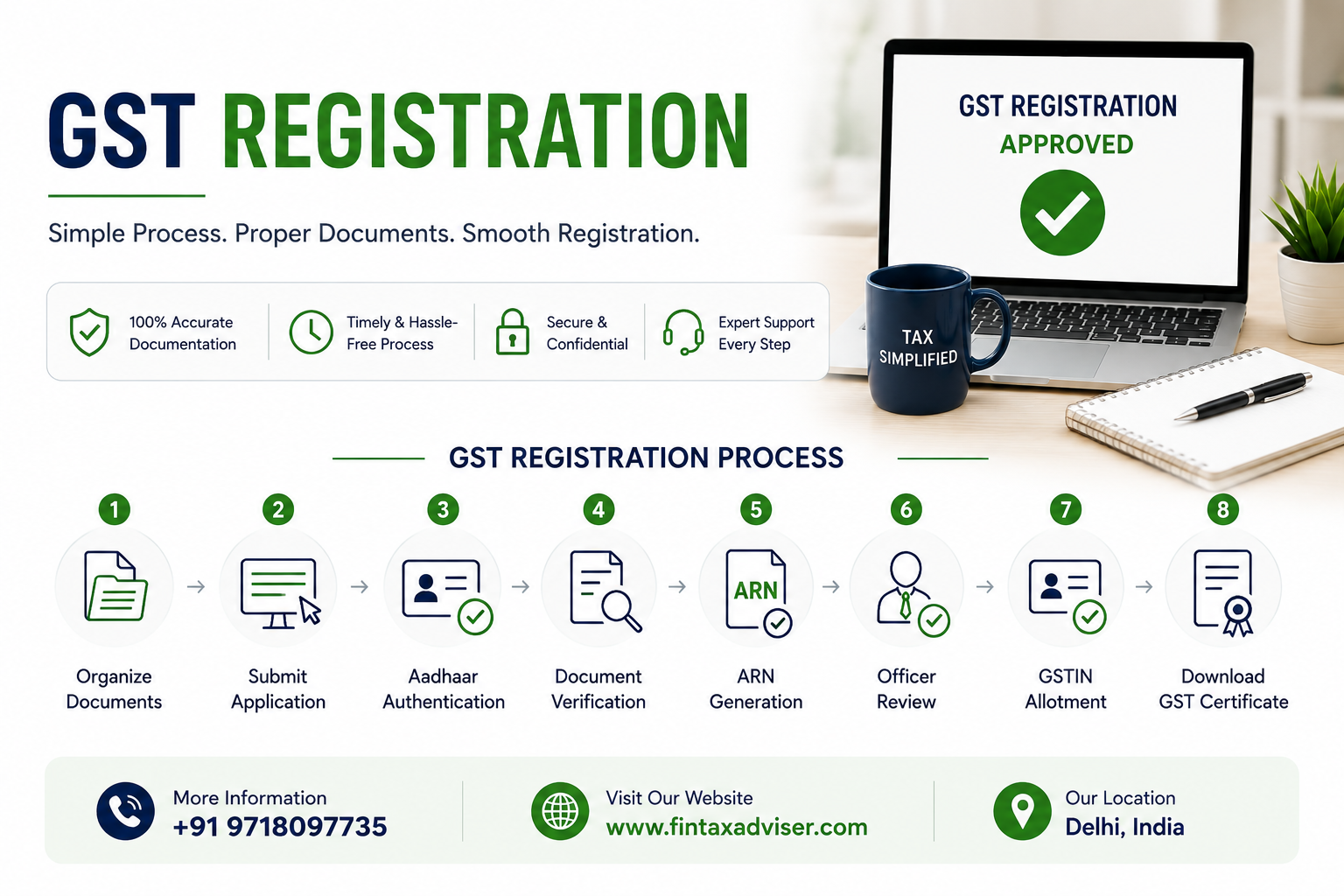
Quick Workflow Summary
1. Organize all required documents
2. Submit the online GST registration application
3. Complete Aadhaar authentication
4. Undergo document verification
5. Receive your Application Reference Number (ARN)
6. GST officer reviews the application
7. GSTIN is allotted upon approval
8. Download and save your GST Registration Certificate
Practical Insight from Our Experience
Through our experience providing GST Registration Services in Delhi, India, we have observed that businesses that prepare their documents carefully, verify every detail before submission, and respond promptly to any departmental queries generally receive their GST Registration in Delhi more efficiently. A well-prepared application not only reduces the chances of rejection but also ensures a smoother registration process and helps businesses begin their GST compliance journey with confidence.
H2: Practical Insights from GST Registration Cases
Over time, certain document-related issues appear repeatedly during the GST registration process. While the official requirements are generally straightforward, many delays and clarification notices arise from small mistakes that applicants overlook. Understanding these common patterns can help businesses prepare more effectively and avoid unnecessary complications when applying for GST Registration in Delhi.
Many First-Time Applicants Upload Incorrect Address Proof
One of the most common issues involves business address verification. Applicants often submit utility bills, rent agreements, or ownership documents that contain outdated addresses or information that does not match the address entered in the GST application.
In some cases, the address proof belongs to a different property, while in others, the PIN code or building details are inconsistent across documents.
Practical Observation
Before submitting an application, it is advisable to compare the business address on every supporting document and ensure it matches the address entered in the GST registration form exactly.
Startups Often Forget Business Constitution Documents
Newly incorporated businesses frequently focus on identity and address documents but overlook entity-specific documents required for their business structure.
For example:
- Private Limited Companies may forget to upload the Certificate of Incorporation or authorization documents.
- LLPs may omit the LLP Agreement.
- Partnership Firms sometimes fail to provide a properly executed Partnership Deed.
Practical Observation
Applicants should first identify their business structure and then prepare both the standard GST documents and the additional documents required for that specific entity type.
Home-Based Businesses Frequently Ask Whether Residential Addresses Are Accepted
A common question from freelancers, consultants, online sellers, and service providers is whether they can use their residential address for GST registration.
In many cases, residential premises can be used as the principal place of business, provided suitable address proof and supporting documents are available.
Practical Observation
Home-based business owners should ensure they have valid residential address proof and, where applicable, a rent agreement or No Objection Certificate (NOC) before starting the application process.
Businesses Changing Office Locations Often Use Outdated Documents
Businesses that recently shifted offices sometimes submit documents from their previous location while entering the new address in the application.
This mismatch frequently results in verification delays and requests for clarification.
Practical Observation
Before applying for GST registration, businesses should update and organize all address-related documents to reflect the current operating location.
Bank Account Details Are Commonly Overlooked
Applicants occasionally upload bank documents with unclear account information or use bank accounts that do not correspond with the applicant or business entity.
Issues may also arise when account holder names differ from the legal name used in the GST application.
Practical Observation
Review bank statements, cancelled cheques, or passbook copies carefully to ensure that account details are visible, accurate, and consistent with the registration documents.
Poor Document Quality Causes Avoidable Delays
A surprising number of applications encounter verification issues simply because uploaded documents are blurred, cropped, incomplete, or difficult to read.
Low-quality scans often make it impossible for the reviewing officer to verify important details.
Practical Observation
Applicants should review every uploaded document before submission and confirm that all information is clearly visible and legible.
Applicants Often Ignore Small Name Differences
Even minor inconsistencies between PAN, Aadhaar, bank records, and business documents can trigger verification concerns.
Examples include:
- Missing middle names
- Spelling variations
- Different use of initials
- Name abbreviations
Practical Observation
Review names across all documents carefully and resolve discrepancies before starting the GST registration process.
Additional Places of Business Are Sometimes Not Properly Documented
Businesses with warehouses, branch offices, storage units, or multiple operating locations occasionally provide documents only for the principal place of business.
This can create issues if additional locations need to be declared during registration.
Practical Observation
Prepare address proof and supporting documentation for every location that may need to be reported under GST.
Key Takeaway
A review of common GST registration cases shows that most delays are not caused by complex legal issues but by simple documentation mistakes such as address mismatches, missing business constitution documents, outdated agreements, poor-quality scans, or incomplete supporting records. Taking time to verify documents before submission can significantly improve the likelihood of a smooth and timely GST Registration in Delhi process while reducing the risk of clarification notices and application resubmissions.
Keeping Your GST Registration Process Smooth
Successfully completing GST Registration in Delhi is not just about submitting the required documents—it's also about preparing them carefully and maintaining accurate records throughout the process. A well-organized approach can reduce the chances of delays, clarification notices, and future compliance issues.
Whether you're registering as a freelancer, startup, sole proprietor, partnership firm, LLP, or private limited company, following these best practices can help make your GST registration journey smoother and more efficient.
Organize Your Documents Before You Apply
Before accessing the GST portal, collect and arrange all the required documents in one secure location. This includes identity proofs, address proofs, bank account documents, business constitution records, and any additional documents applicable to your business type.
Best Practice: Create a dedicated digital folder with clearly named files so you can quickly locate and upload each document during the application process.
Review Every Document Carefully
Even small inconsistencies—such as spelling errors, outdated addresses, or incorrect business details—can lead to verification delays.
Before submitting your application, confirm that:
- Names match across all documents
- Business addresses are consistent
- PAN and Aadhaar details are accurate
- Bank account information is correct
- Supporting documents are valid and up to date
Best Practice: Take a few extra minutes to review every document before uploading. Preventing errors is often much easier than correcting them later.
Keep Digital Copies Safe and Organized
After preparing your documents, store digital copies securely for future reference. These files may be needed not only during registration but also for return filing, departmental notices, audits, business updates, or other compliance-related activities.
Best Practice: Maintain backup copies on a secure computer or trusted cloud storage and organize them into clearly labeled folders.
Respond Promptly to Clarification Requests
If the GST department requests additional information or supporting documents, respond within the specified timeframe. Delayed responses may extend the registration process or require additional follow-up.
Best Practice: Regularly monitor your registered email address and the GST portal for application updates and official communications.
Keep Your Business Records Updated
Business information may change over time due to relocation, expansion, changes in ownership, or updates to banking details. Maintaining current records helps simplify future GST-related processes.
Important records to keep updated include:
- Business address
- Bank account details
- Contact information
- Authorized signatory details
- Business constitution documents
- Additional places of business, if applicable
Best Practice: Review your business records periodically and update them whenever significant changes occur.
Maintain Proper Documentation for Ongoing GST Compliance
GST registration is the beginning of an ongoing compliance journey. Maintaining organized documentation throughout the year can make future obligations much easier to manage.
Well-maintained records support activities such as:
- GST return filing
- Input Tax Credit (ITC) reconciliation
- Business audits
- Company registration updates
- Tax assessments
- Business expansion or structural changes
Keeping documents accurate and accessible also helps reduce administrative effort when additional information is requested by tax authorities.
Practical Industry Observation
Businesses that regularly manage GST compliance, GST return filing, company registrations, and tax documentation often find it easier to maintain accurate records throughout the year. Establishing a consistent documentation process minimizes errors, supports smoother compliance, and simplifies future business updates. This record-management approach is commonly followed by professional tax and compliance advisory firms, including Fintax Adviser, as part of maintaining organized business documentation rather than only preparing records at the time of registration.
Key Takeaway
A smooth GST Registration in Delhi process starts with careful preparation and continues with good record-keeping. Organizing your documents, verifying every detail, storing secure digital copies, responding promptly to official communications, and maintaining updated business records can help reduce delays and support long-term GST compliance. These practical habits not only improve the registration experience but also make future tax filings and business compliance significantly easier.
Frequently Asked Questions
Is Aadhaar mandatory for GST registration?
Aadhaar authentication is not mandatory in every case, but it is highly recommended as it can speed up the GST registration process. If Aadhaar authentication is not completed, the GST department may require additional verification or physical document verification before approving the application.
Can I register GST using my home address?
Yes. You can use your residential address as your business address if you operate your business from home. You must provide valid address proof, such as an electricity bill, property tax receipt, rent agreement, or other acceptable supporting documents.
Is a rent agreement compulsory?
A rent agreement is generally required when the business premises are rented. In many cases, it should be supported by a recent utility bill and, if applicable, a No Objection Certificate (NOC) from the property owner.
Can I apply without a current account?
Yes. A current account is not mandatory for GST registration. Applicants can generally provide the required bank account details after obtaining GST registration, subject to the latest GST compliance requirements.
Which documents differ for LLPs and Private Limited Companies?
LLPs typically need documents such as the LLP Agreement, Certificate of Incorporation, PAN of the LLP, and identity proof of designated partners. Private Limited Companies generally require the Certificate of Incorporation, PAN, Memorandum of Association (MOA), Articles of Association (AOA), Board Resolution or authorization letter, and identity documents of directors and the authorized signatory.
How long does GST registration take?
If all documents are accurate and no additional verification is required, GST registration is generally processed within 7 to 15 working days. However, the timeline may vary depending on document verification and departmental requirements.
What if my application is rejected?
If your GST registration application is rejected, the GST department usually provides the reason for rejection. You can correct the identified issues and submit a fresh application with the required information and supporting documents.
Can I edit documents after submitting my application?
Once the GST registration application is submitted, documents cannot usually be edited directly. If the GST officer issues a clarification notice, you can upload corrected documents or provide additional information through the GST portal.
Do freelancers need GST registration?
Freelancers may need GST registration if their annual turnover exceeds the prescribed threshold or if they are required to register under specific GST provisions, such as interstate taxable supplies or certain notified services. Eligibility depends on the nature of the business and applicable GST regulations.
Can startups complete GST registration completely online?
Yes. The GST registration process is designed to be completed online through the GST portal. Startups can upload documents, verify details, respond to notices, and track the application status digitally without visiting a tax office in most cases.
Conclusion
Summarize the importance of submitting accurate documents and preparing them before beginning the application process.
End with a helpful note explaining that GST registration is only the first step in maintaining tax compliance. Businesses should also keep their records updated for GST return filing, amendments, annual compliance, and future registrations as they grow. This reflects the broader compliance approach used by firms that provide GST and business registration support, such as Fintax Adviser, without turning the conclusion into a sales pitch.