
The Complete 2026 Guide to Registering Your LLP Online
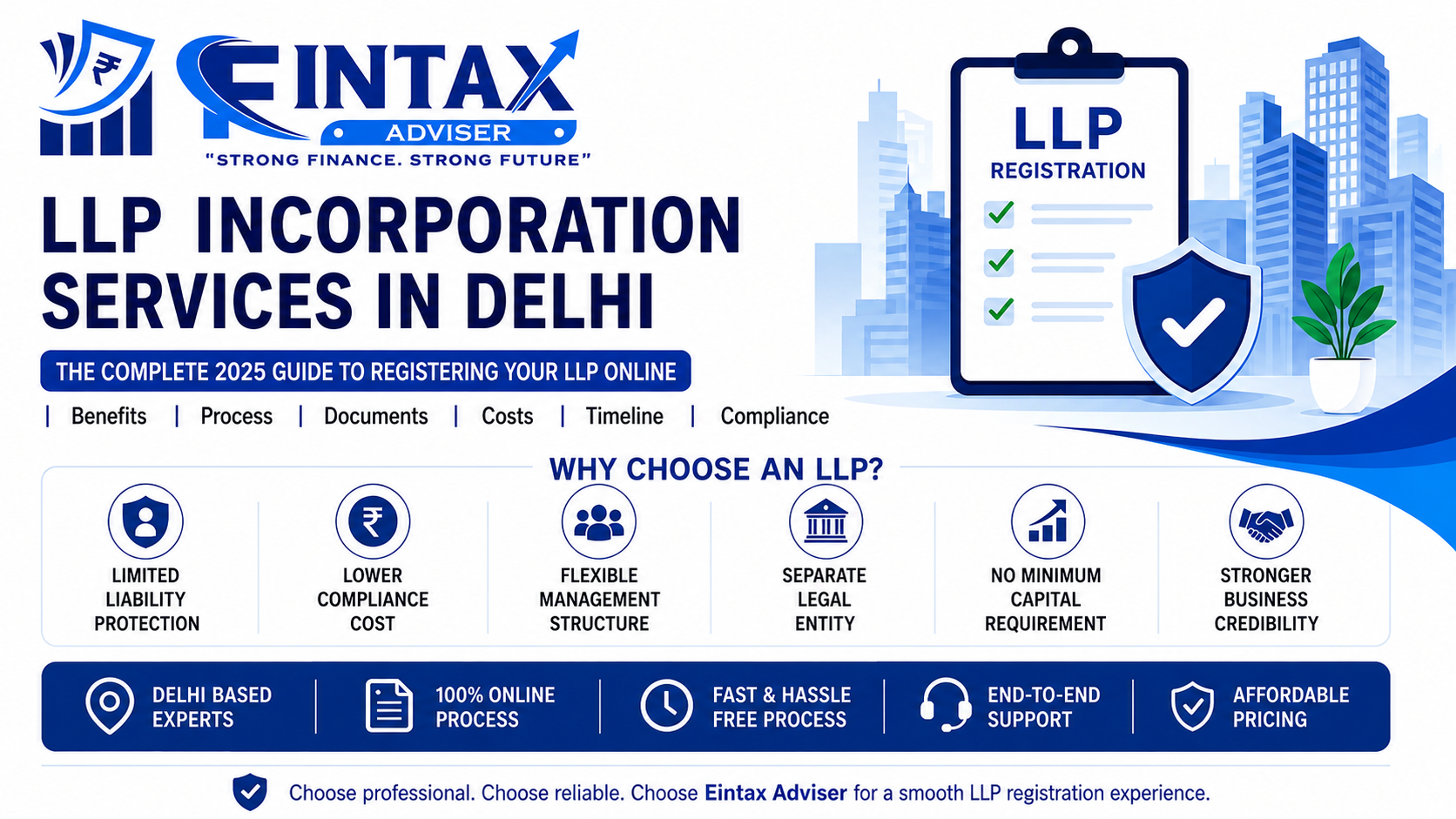
What Is an LLP and Why Does It Matter for Your Business?
A Limited Liability Partnership (LLP) is a hybrid business structure governed by the LLP Act, 2008. It combines the operational simplicity of a traditional partnership with the legal protection of a private company. Each partner's liability is limited to their agreed-upon contribution, which means personal assets—your home, savings, or vehicle—stay protected if the business runs into debt or litigation.
Unlike a sole proprietorship or a general partnership, an LLP is registered with the Ministry of Corporate Affairs (MCA) and exists as a separate legal entity. It can own property, enter contracts, sue, and be sued in its own name, independent of its partners.
This is precisely why professional LLP incorporation services have become essential—the registration involves multiple government forms, digital certificates, and legal drafting that are easy to get wrong without guidance.
LLP vs. Private Limited Company vs. Partnership Firm
Before booking an LLP incorporation service in Delhi, it helps to see how an LLP actually compares to the alternatives.
| Feature | LLP | Private Limited Company | Partnership Firm |
| Legal status | Separate legal entity | Separate legal entity | Not separate from partners |
| Liability protection | Limited to contribution | Limited to shares held | Unlimited personal liability |
| Minimum capital | None required | None required (but share capital needed) | None required |
| Compliance burden | Low to moderate | High (board meetings, audits, ROC filings) | Minimal, but no legal protection |
| Funding from investors | Difficult (no share structure) | Easy (preferred by VCs) | Very difficult |
| Ideal for | Consultants, professional firms, service businesses | Startups planning to raise equity funding | Very small, low-risk local businesses |
If your business won't be raising venture capital but still needs legal protection and credibility, an LLP is usually the most cost-efficient structure—and that's the gap that quality LLP incorporation services are built to fill.
Key Benefits of LLP Incorporation Services in India
Professional LLP incorporation services exist because the benefits of this structure only materialize when the registration is done correctly and completely. Here's what you actually gain:
1. Separate Legal Entity The LLP holds assets, debts, and contracts under its own name. Your personal finances remain insulated from business obligations.
2. Limited Liability Protection Partners are not personally liable for business debts beyond their agreed-upon capital contribution, and they are not liable for the misconduct of other partners—a major upgrade over a traditional partnership firm.
3. Lower Compliance Cost Compared to a private limited company, an LLP has fewer mandatory filings, no requirement for statutory board meetings, and simpler annual return formats (Form 11 and Form 8), which keeps ongoing costs down.
4. No Minimum Capital Requirement You can register an LLP with a nominal capital contribution — there's no regulatory floor, which makes it accessible for early-stage founders and freelancers scaling into a formal entity.
5. Flexible Management Structure Partners can directly manage day-to-day operations without the corporate formalities (resolutions, director rotations) that a private limited company requires.
6. Stronger Market Credibility Banks, vendors, and larger clients generally extend more trust and better commercial terms to a registered LLP than to an unregistered partnership or sole proprietorship.
Who Should Choose LLP Incorporation Service in Delhi?
An LLP structure fits a wide range of professionals and growing businesses, particularly the following:
- Startups not currently planning to raise institutional/VC funding — an LLP avoids the share-structure complexity that investors expect from a private limited company.
- Management, IT, and financial consultants — limited liability protects personal assets while keeping compliance light.
- Freelancers transitioning into a formal business entity — useful once client contracts or invoicing volumes require a registered entity name.
- Chartered Accountancy, Company Secretary, and Law firms—LLPs are the preferred structure for professional partnerships under most regulatory bodies.
- Digital marketing and creative agencies — multiple founders can share decision-making without rigid board procedures.
- Healthcare and wellness practices — partners get liability protection for the business while retaining hands-on operational control.
- Import-export businesses — a registered entity improves credibility with overseas buyers, banks, and customs authorities.
- Small and medium enterprises (SMEs) seeking liability protection without heavy compliance—an ideal middle ground between a sole proprietorship and a full corporate structure.
If your business model involves recurring B2B contracts, client trust, or multiple founders sharing responsibility, an LLP—set up correctly through reliable LLP incorporation services—gives you legal protection without the overhead of a full corporate structure.
Documents Required for LLP Incorporation Services
A clean, complete document set is the single biggest factor in avoiding MCA rejection. Most LLP incorporation service providers in Delhi will request the following.
Documents From Each Partner
- PAN Card (mandatory for all Indian partners)
- Aadhaar Card, linked to PAN for OTP-based e-verification
- Passport-size photograph
- Address proof (bank statement, utility bill, not older than two months)
- Passport (mandatory for NRI or foreign national partners)
- Active mobile number and email ID for OTP verification
Documents for the Registered Office
- Latest electricity or utility bill of the premises
- Rent agreement (if the premises is rented)
- No Objection Certificate (NOC) from the property owner
Tip: Ensure the name and address on every document match exactly. Mismatches between PAN, Aadhaar, and utility bills are one of the most common causes of resubmission on the MCA V3 portal.
Step-by-Step LLP Incorporation Process
Here is how a complete LLP incorporation services engagement actually unfolds on the MCA portal, from first consultation to final certificate.
- Initial Business Consultation — A consultant reviews your business model, number of partners, and capital structure to recommend the right setup.
- Digital Signature Certificate (DSC) — Every designated partner needs a Class 3 DSC to sign forms electronically. This typically takes 1–2 working days to issue.
- Name Reservation via RUN-LLP — Two proposed names are submitted through the RUN-LLP web service. Approved names are reserved for 90 days.
- DIN/DPIN Allotment—Designated Partner Identification Numbers for up to two partners are issued automatically along with the Form FiLLiP filing, with no separate application needed.
- Filing Form FiLLiP—This single consolidated form captures partner details, registered office proof, and capital contribution and is submitted to the Registrar of Companies (RoC).
- LLP Agreement Drafting — The agreement defines profit-sharing ratios, partner roles, decision-making rights, and exit clauses. It must be executed on the correct stamp paper for your state.
- Filing Form 3 — The signed LLP Agreement is filed with the MCA within 30 days of incorporation, as required under Section 23 of the LLP Act, 2008. Missing this deadline triggers a daily late fee.
- Certificate of Incorporation (COI) — Once the RoC verifies everything, it issues the COI along with your LLPIN, PAN, and TAN.
Most established LLP incorporation services complete this entire cycle in 10–15 working days, assuming documents are submitted correctly the first time.
What Should Your LLP Agreement Include?
The LLP Agreement is the internal rulebook of your business, and it deserves as much attention as the registration filing itself. A well-drafted agreement, prepared as part of your LLP incorporation services engagement, should clearly spell out the following:
- Profit and loss sharing ratio between partners
- Capital contribution of each partner and how additional capital will be infused later
- Roles and decision-making authority, including which decisions need unanimous partner consent
- Admission, retirement, or expulsion of partners and the process to follow
- Dispute resolution mechanism—arbitration clauses are common to avoid costly litigation
- Exit and dissolution terms, including how the LLP's assets will be valued and distributed
A generic, template-only agreement is one of the most overlooked risks in low-cost incorporation packages. Disputes between partners months or years later are far harder — and more expensive — to resolve than getting the agreement right at formation.
Cost and Government Fees for LLP Incorporation Services in Delhi
Pricing is one of the most searched questions around any LLP incorporation service in Delhi, and the total cost is made up of four components rather than a single flat fee.
| Cost Component | Approximate Range |
| RUN-LLP name reservation | ₹200 (fixed) |
| Form FiLLiP government fee | ₹500–₹5,000 (based on capital slab) |
| Digital Signature Certificate (per partner) | ₹800–₹1,500 |
| Stamp duty on LLP Agreement | Varies by state; Delhi is comparatively lower than states like Maharashtra |
| Professional/consultancy fees | ₹3,000–₹15,000 |
| Typical total cost in Delhi | ₹6,000–₹9,000 for most small LLPs |
A few factors push the cost up or down: the declared capital contribution (higher capital increases the FiLLiP fee), the number of designated partners (more DSCs needed), and whether you opt for a basic filing-only service versus a full-service package that includes agreement drafting and post-incorporation support.
Important: Always ask your LLP incorporation services provider for a written, itemized quote before paying—government fees and professional fees should never be bundled without a breakdown.
Hidden costs to watch for: A handful of small charges are easy to miss in an initial quote—courier or notarization charges for documents, charges for a second RUN-LLP attempt if your first name choice is rejected, and renewal fees once your digital signature certificate expires after 1–2 years. None of these are large individually, but together they can add a few thousand rupees to your final outlay if they aren't flagged upfront.
How Long Does LLP Registration Actually Take?
Under normal conditions, with all documents in order, the full process—DSC issuance, name approval, FiLLiP filing, certificate issuance, and LLP Agreement registration—takes approximately 10 to 15 working days. Name rejections, incomplete address proof, or PAN-Aadhaar mismatches are the most common reasons this timeline stretches to 3–4 weeks.
Post-Incorporation Compliance Every LLP Must Follow
Registration is just the starting point. Reliable LLP incorporation services also guide you through the recurring filings that keep your LLP in good legal standing:
- Form 11 (Annual Return) — Filed every year by 30th May, summarizing partner details and contributions.
- Form 8 (Statement of Accounts & Solvency) — Filed every year by 30th October, certifying the LLP's financial position.
- Income Tax Return Filing — Mandatory annually, regardless of turnover or profit.
- GST Registration—Required once turnover crosses the prescribed threshold or if you supply across state lines.
- Audit Requirement — Applicable only if turnover exceeds ₹40 lakh or capital contribution exceeds ₹25 lakh in a financial year.
- DIN KYC (DIR-3 KYC) — Annual KYC update for every designated partner holding a DIN.
Missing Form 11 or Form 8 deadlines attracts a penalty of ₹100 per day, per form, with no upper cap under the current LLP (Amendment) Rules—making ongoing compliance support just as important as the initial registration.
How Are LLPs Taxed in India?
Tax treatment is a common reason founders choose LLP incorporation services over setting up a private limited company, so it's worth understanding upfront:
- Flat tax rate: LLPs are taxed at a flat rate on net profit, regardless of profit level, unlike individuals who are taxed on a slab basis.
- No dividend distribution tax: Profit withdrawn by partners is not taxed again as dividend income, unlike a private limited company where shareholders face additional tax on dividends.
- Alternate Minimum Tax (AMT): LLPs with adjusted total income above the prescribed threshold are subject to AMT, with credit available for set-off in later years.
- Interest and remuneration to partners: Subject to specified limits under the Income Tax Act, interest and working partner remuneration are allowed as deductible business expenses, reducing the LLP's overall tax outgo.
- No requirement for statutory audit below threshold: Unlike companies, LLPs only need a tax audit once turnover or contribution crosses the prescribed limits.
This relatively simple, single-layer tax structure is a major reason why service-based businesses and professional firms continue to prefer LLPs over private limited companies when external equity funding isn't a near-term goal.
Why Delhi Is a Strategic Location for LLP Registration
Delhi consistently ranks among India's top cities for new business registrations. According to the Ministry of Corporate Affairs' Corporate Data Management portal, Maharashtra, Delhi, and Uttar Pradesh together account for over 40% of all active registered companies in India — underlining just how concentrated business activity is in the capital region. An LLP incorporation service in Delhi benefits from several structural advantages tied to this scale:
- A dense startup and SME ecosystem with strong peer networks
- Proximity to investor communities, accelerators, and industry bodies
- Easier access to chartered accountants, company secretaries, and legal consultants
- Comparatively lower stamp duty on the LLP Agreement than several other states
- A skilled, English-speaking workforce across consulting, IT, and professional services
- Central connectivity that supports clients and vendors across North India
Common Mistakes to Avoid With LLP Incorporation Services
Even with professional help, founders sometimes run into avoidable friction. Watch for these:
- Choosing a name too similar to an existing company, LLP, or trademark — this is the single most common reason for RUN-LLP rejection.
- Mismatched documents — address or spelling differences between PAN, Aadhaar, and utility bills.
- Delaying the LLP Agreement filing — Form 3 must be filed within 30 days; many founders only remember after the late fee starts accruing.
- Underestimating ongoing compliance — assuming an LLP has "no filings" once incorporated, then missing Form 11 and Form 8.
- Choosing the cheapest quote without checking inclusions—some quotes exclude DSC, stamp duty, or agreement drafting, which surface as add-ons later.
- Declaring an unrealistic capital contribution—overstating capital just to "look credible" increases the FiLLiP government fee and the stamp duty payable with no real business benefit.
- Skipping professional review of the LLP Agreement—using a downloaded template without adapting it to your actual partnership terms often causes disputes later that are far costlier than the drafting fee would have been.
How to Choose the Right LLP Incorporation Service in Delhi
When comparing providers, look beyond price and check for the following:
- Transparent, itemized pricing that separates government fees from professional fees.
- In-house company secretaries or chartered accountants, not just sales agents.
- Post-incorporation support for Form 11, Form 8, GST, and ITR — not just the registration itself.
- Clear timelines with written commitments, not vague promises.
- Verifiable track record — client reviews, years of operation, and sector experience relevant to your business.
A provider that explains the why behind each step — not just the what — is usually a stronger signal of genuine expertise than marketing claims alone. Before signing on, it's reasonable to ask a prospective firm how many LLP incorporations they've personally handled in the past year, whether a qualified company secretary will review your specific LLP agreement, and what their standard turnaround time has been across recent clients—answers a genuinely experienced LLP incorporation service in Delhi should give without hesitation.
Quick Pre-Hiring Checklist
Use this short checklist before signing an engagement letter with any LLP incorporation services provider:
- [ ] Written quote separating government fees, DSC charges, stamp duty, and professional fees
- [ ] Named point of contact who is a qualified CA/CS, not only a sales representative
- [ ] Sample LLP Agreement clause structure shared for your review before drafting
- [ ] Clear written timeline with milestones (DSC, name approval, FiLLiP, COI)
- [ ] Confirmation of post-incorporation support for Form 11, Form 8, and ITR filing
- [ ] No pressure to overstate capital contribution "for credibility."
Frequently Asked Questions
1. What is LLP incorporation?
LLP incorporation is the legal process of registering a limited liability partnership with the Ministry of Corporate Affairs, giving the business a separate legal identity and limiting partners' liability to their agreed capital contribution.
2. How many partners are required to register an LLP?
A minimum of two partners is required, with no upper limit. At least one designated partner must be a resident of India.
3. Is there a minimum capital requirement for LLP registration?
No. There is no statutory minimum capital requirement, though a nominal contribution amount is usually declared for compliance purposes.
4. How long does LLP registration take in Delhi?
Most LLPs are registered within 10–15 working days when documents are complete and accurate; delays usually stem from name rejection or document mismatches.
5. Can NRIs or foreign nationals register an LLP in India?
Yes, NRIs and foreign nationals can be designated partners, provided at least one resident Indian partner is also on the LLP and the foreign partner submits a valid passport and notarized address proof.
6. What is a Digital Signature Certificate (DSC), and why is it needed?
A DSC is a secure digital key used to sign incorporation forms electronically on the MCA portal. Every designated partner must have a valid Class 3 DSC before filing begins.
7. Is GST registration mandatory for every LLP?
No. GST registration is mandatory only once annual turnover crosses the prescribed threshold or if the LLP supplies goods/services across state borders.
8. Do LLPs have annual compliance requirements?
Yes. Every LLP must file Form 11 (Annual Return) and Form 8 (Statement of Accounts & Solvency) each year, along with income tax returns, regardless of business activity.
9. What happens if Form 3 (LLP Agreement) is filed late?
A penalty of ₹100 per day applies from the due date until the form is actually filed, with no maximum cap under current rules.
10. Can an LLP be converted from an existing partnership firm?
Yes. An existing partnership firm can convert into an LLP through a defined MCA process, transferring assets and liabilities to the new LLP structure.
11. Is hiring a professional LLP incorporation service necessary, or can I file it myself? It's not legally mandatory, but professional help significantly reduces the risk of name rejection, document mismatches, and filing delays, which can otherwise add weeks to the timeline.
12. What is the difference between an LLP and a Private Limited Company?
An LLP has lower compliance costs and no share capital structure, making it simpler to run, while a private limited company is better suited for businesses planning to raise equity funding from investors.
Conclusion
Choosing dependable LLP incorporation services is less about ticking a registration checklist and more about setting up your business on a legally sound foundation from day one—correct documentation, a properly drafted LLP agreement, and a clear view of ongoing compliance. For founders and professionals evaluating an LLP incorporation service in Delhi, the right partner should offer transparent pricing, hands-on MCA filing expertise, and continued support well beyond the Certificate of Incorporation. Get those fundamentals right, and your LLP will be positioned for smooth operations, stronger credibility with banks and clients, and far fewer compliance surprises down the road.
Disclaimer: This article is for general informational purposes and reflects MCA rules and fee structures as of June 2026. Government fees, stamp duty rates, and compliance forms are subject to periodic revision. Please verify current figures on the MCA portal or consult a qualified company secretary or chartered accountant before filing.