
LLP Registration in India: Process, Cost, Benefits & Documents
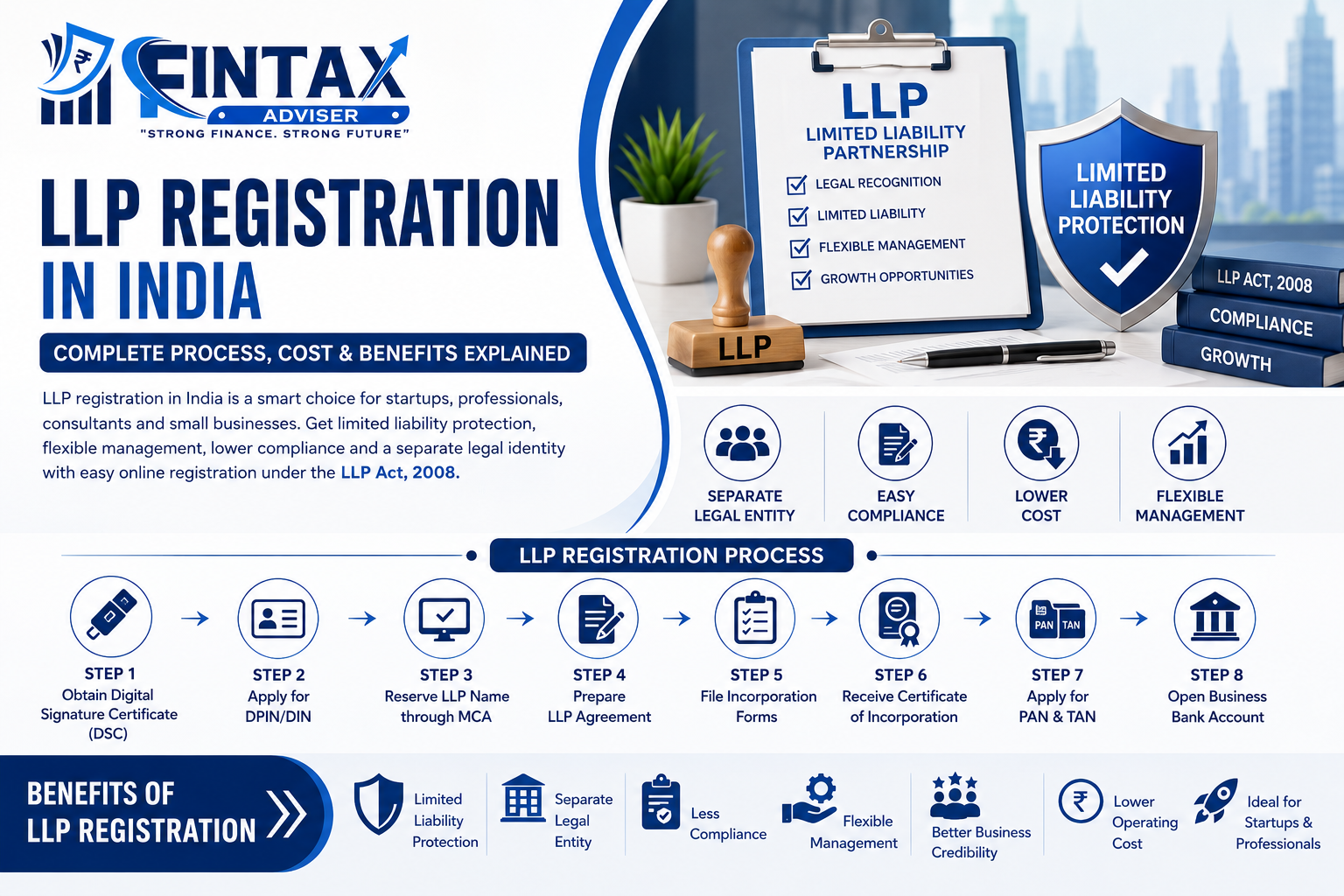
Starting a business with the right legal structure is one of the most important decisions for entrepreneurs, startups, professionals, and small businesses. LLP registration in India has become a preferred choice because it combines the benefits of limited liability with the flexibility of a traditional partnership. Governed by the LLP Act, 2008, a Limited Liability Partnership offers a separate legal identity, protects partners' personal assets, and simplifies business management. Whether you are launching a startup, consultancy, agency, or professional firm, limited liability partnership registration provides a cost-effective and credible foundation for growth. With a streamlined LLP registration process, easy MCA LLP registration, and minimal compliance requirements, an LLP company registration is an ideal option for businesses seeking legal protection, operational flexibility, and long-term success in India.
What is an LLP?
A Limited Liability Partnership (LLP) is a modern business structure that combines the operational flexibility of a traditional partnership with the legal protection of a company. In India, LLP registration in India is governed by the Limited Liability Partnership Act, 2008 (LLP Act, 2008), making it a trusted option for entrepreneurs and professional firms. An LLP has a separate legal identity, allowing it to own assets, enter into contracts, and continue operations independently of its partners through perpetual succession. One of its biggest advantages is limited liability protection, which safeguards the personal assets of partners from business liabilities. With simplified compliance requirements, LLP company registration is an excellent choice for startups, consultants, freelancers, Chartered Accountants, lawyers, architects, and MSMEs seeking a flexible, credible, and legally recognized business registration in India.
Why Choose LLP Registration in India?
Choosing LLP registration in India is an excellent decision for entrepreneurs, startups, consultants, and professional firms looking for a flexible and legally recognized business structure. A Limited Liability Partnership combines the operational ease of a traditional partnership with the legal protection of a corporate entity. Compared to a private limited company, an LLP has fewer compliance requirements, making it easier and more cost-effective to manage. Additionally, LLP company registration enhances business credibility, supports long-term growth, and offers tax efficiency for eligible businesses. Whether you're planning a new venture or expanding an existing business, limited liability partnership registration provides a secure and scalable foundation for success.
Key Benefits of LLP Registration
- Limited Liability Protection: Partners are liable only to the extent of their agreed contribution, protecting personal assets.
- Separate Legal Entity: The LLP can own property, sign contracts, and conduct business independently of its partners.
- Lower Compliance: Fewer statutory filings and regulatory requirements than a private limited company.
- Easy Management: Partners can manage the business with greater operational flexibility and fewer formalities.
- Flexible Ownership: Rights and responsibilities can be customized through the LLP Agreement.
- Better Business Credibility: An LLP improves trust among clients, investors, suppliers, and financial institutions.
- Ideal for Startups and Professionals: Suitable for consultants, freelancers, CA firms, law firms, agencies, and MSMEs.
- Tax Efficiency: LLPs avoid dividend distribution tax and may enjoy tax advantages depending on applicable laws.
Eligibility Criteria for LLP Registration
Before applying for LLP registration in India, applicants must meet the eligibility requirements prescribed under the LLP Act, 2008. These conditions ensure that the LLP registration process is completed smoothly and complies with the guidelines of the Ministry of Corporate Affairs (MCA). Meeting these requirements helps avoid delays in LLP company registration and ensures successful incorporation.
- Minimum 2 Partners: An LLP must have at least two partners to be legally incorporated.
- Minimum 2 Designated Partners: At least two designated partners are mandatory to manage legal and regulatory responsibilities.
- One Indian Resident Partner: At least one designated partner must be an Indian resident as per MCA regulations.
- No Minimum Capital Requirement: You can start an LLP with any amount of capital contribution.
- Registered Office Address: A valid business address in India is required for official communication.
- Valid Identity and Address Proof: All partners must submit KYC documents such as PAN, Aadhaar, passport, and address proof.
- Unique LLP Name: The proposed LLP name must be unique, compliant with MCA naming guidelines, and approved before incorporation.
Documents Required for LLP Registration
To complete LLP registration in India without delays, applicants must submit accurate and valid documents during the incorporation process. Having all the documents required for LLP registration ready ensures faster verification by the Ministry of Corporate Affairs (MCA) and helps streamline the LLP registration process.
Documents Required for Partners
- PAN Card of all designated partners and partners
- Aadhaar Card or other valid identity proof
- Passport (mandatory for NRIs and Foreign Nationals)
- Recent Passport-size Photograph
- Address Proof (such as Voter ID, Driving Licence, Passport, or Bank Statement)
- Valid Email ID for official communication
- Active Mobile Number for OTP verification and MCA updates
Documents Required for Registered Office
- Latest Electricity Bill or utility bill (not older than two months)
- Property Tax Receipt (if applicable)
- Rent Agreement (if the premises are rented)
- No Objection Certificate (NOC) from the property owner permitting the premises to be used as the LLP's registered office
Submitting complete and correct documentation helps ensure a smooth LLP company registration process and minimizes the chances of application rejection or unnecessary delays.
Step-by-Step LLP Registration Process in India
Understanding the LLP registration process helps entrepreneurs complete the incorporation procedure smoothly and in compliance with the Ministry of Corporate Affairs (MCA). Below are the essential steps involved in LLP registration in India:
Step 1: Obtain Digital Signature Certificate (DSC)
All designated partners must obtain a Digital Signature Certificate (DSC) to digitally sign the online incorporation documents filed on the MCA portal.
Step 2: Apply for DPIN/DIN
Apply for a Designated Partner Identification Number (DPIN) or Director Identification Number (DIN) for all designated partners, as required under MCA regulations.
Step 3: Reserve the LLP Name
Choose a unique business name and submit it through the MCA portal for approval. The proposed name must comply with the official LLP naming guidelines.
Step 4: Prepare the LLP Agreement
Draft the LLP Agreement, outlining the rights, duties, capital contribution, profit-sharing ratio, and responsibilities of all partners.
Step 5: File Incorporation Forms
Submit the required incorporation forms along with supporting documents, identity proofs, address proofs, and applicable government fees through the MCA portal.
Step 6: Receive the Certificate of Incorporation
After successful verification, the Registrar of Companies (ROC) issues the Certificate of Incorporation, confirming that your LLP is legally registered.
Step 7: Apply for PAN & TAN
Once incorporated, apply for the LLP's Permanent Account Number (PAN) and Tax Deduction and Collection Account Number (TAN) to meet taxation and banking requirements.
Step 8: Open a Business Bank Account
Finally, open a dedicated business bank account using the incorporation certificate, PAN, and LLP Agreement to manage financial transactions professionally and maintain regulatory compliance.
LLP Registration Cost in India
The LLP registration cost in India depends on several factors, including the partner's capital contribution, government filing charges, professional service fees, and the state in which the LLP is registered. While the Ministry of Corporate Affairs (MCA) prescribes the applicable government fees, additional expenses such as Digital Signature Certificate (DSC) charges, stamp duty, and documentation costs may also apply. Stamp duty varies from state to state, which can affect the overall LLP registration fees.
Key Cost Components
- Government Fees: MCA filing charges based on capital contribution
- DSC Charges: Cost of Digital Signature Certificate for partners
- Professional Fees: Charges for consultancy, documentation, and filing support
- Stamp Duty: Varies depending on the state of registration
- Contribution-Based Cost: Higher capital contribution may increase filing charges
Professional consultancy charges depend on the scope of services, such as name approval, document preparation, MCA filing, and post-registration support. In most cases, the total LLP registration cost in India ranges from ₹5,000 to ₹20,000, depending on the contribution amount, state-specific regulations, and the service provider you choose for a smooth and hassle-free registration process.
Benefits of LLP Registration
Choosing LLP registration in India offers numerous advantages for entrepreneurs, startups, professionals, and MSMEs seeking a flexible and legally secure business structure. A Limited Liability Partnership combines the operational simplicity of a traditional partnership with the legal protection of a corporate entity. Compared to other business structures, an LLP requires fewer compliance formalities, making it a cost-effective and efficient option for growing businesses.
Key Benefits of LLP Registration
- Limited Liability Protection: Partners are liable only up to their agreed capital contribution, protecting their personal assets from business liabilities.
- Separate Legal Identity: An LLP is recognized as a separate legal entity that can own assets, enter into contracts, and sue or be sued in its own name.
- Easy Ownership Transfer: The admission or retirement of partners can be managed with minimal disruption, subject to the LLP Agreement.
- Less Compliance: Compared to a private limited company, an LLP has fewer annual filing and regulatory compliance requirements.
- Better Business Credibility: LLP company registration enhances trust among clients, investors, vendors, and financial institutions.
- Flexible Management: Partners have the freedom to define their roles, responsibilities, and profit-sharing arrangements through the LLP Agreement.
- Perpetual Succession: The LLP continues to exist even if a partner joins, retires, or passes away, ensuring business continuity.
- Lower Operating Cost: Reduced compliance and administrative expenses make LLPs an economical choice for small and medium-sized businesses.
- Ideal for Startups and Professionals: Limited liability partnership registration is well-suited for startups, consultants, freelancers, Chartered Accountants, lawyers, architects, and other professional service firms.
LLP vs Private Limited Company
Choosing between an LLP registration in India and a Private Limited Company depends on your business goals, compliance preferences, and funding requirements. While both structures offer limited liability and a separate legal identity, they differ in ownership, regulatory obligations, and growth potential. The following comparison will help you select the most suitable legal business structure for your venture.
| Feature | LLP (Limited Liability Partnership) | Private Limited Company |
| Ownership | Minimum 2 partners with no limit on maximum partners | Minimum 2 and maximum 200 shareholders |
| Compliance | Lower compliance with fewer annual filings | Higher compliance with regular ROC and MCA filings |
| Liability | Limited to each partner's capital contribution | Limited to each shareholder's investment |
| Funding | Limited fundraising options; cannot issue shares | Easier to raise funds from investors and venture capitalists |
| Taxation | Taxed at the LLP rate with no dividend distribution tax | Subject to corporate tax and other applicable taxes |
| Suitable Businesses | Professionals, consultants, startups, MSMEs, and service-based firms | Startups seeking investment, technology companies, and rapidly growing businesses |
| Legal Requirements | Governed by the LLP Act, 2008 | Governed by the Companies Act, 2013 |
Annual Compliance for LLP
After completing LLP registration in India, every Limited Liability Partnership must comply with the annual filing requirements prescribed under the LLP Act, 2008 and the Ministry of Corporate Affairs (MCA). Timely compliance helps maintain the LLP's legal status, avoids penalties, and ensures smooth business operations.
- Annual Return: File Form 11 with the Registrar of Companies (ROC) every financial year to report the LLP's partner details and other statutory information.
- Statement of Accounts and Solvency: Submit Form 8 to disclose the LLP's financial position, assets, liabilities, and solvency status.
- Income Tax Return: File the LLP's income tax return with the Income Tax Department within the applicable due date.
- LLP Agreement Updates: Any changes in partners, capital contribution, or business terms must be updated by filing the prescribed MCA forms.
- ROC Filing: Ensure all mandatory forms and statutory documents are filed with the Registrar of Companies on time.
- Penalties for Non-Compliance: Delayed or missed filings may result in additional fees, financial penalties, legal consequences, and difficulties in maintaining the LLP's active status.
Common Mistakes During LLP Registration
Many applicants face unnecessary delays in LLP registration in India due to avoidable errors during the incorporation process. Identifying these common mistakes can help ensure a smooth and successful LLP registration process.
- Submitting Incorrect Documents: Incomplete or mismatched identity and address proofs can lead to application rejection.
- Choosing an Unavailable LLP Name: Selecting a name that is already registered or violates MCA naming guidelines may result in name rejection.
- Errors in Partner Details: Incorrect PAN, Aadhaar, or personal information can delay approval.
- Delay in Filing Forms: Missing deadlines or submitting incomplete MCA forms may increase processing time.
- Incorrect Business Activity: Choosing the wrong business objective or activity code can create compliance issues later.
- Ignoring the LLP Agreement: A poorly drafted or delayed LLP Agreement may lead to legal disputes and operational challenges in the future.
Why Choose Fintax Adviser for LLP Registration?
Choosing the right consultancy can make LLP registration in India faster, simpler, and completely hassle-free. At Fintax Adviser, we provide end-to-end support for LLP company registration, from document preparation and MCA filing to post-incorporation compliance. Our experienced professionals ensure every application is accurate, compliant, and processed efficiently, helping you start your business with confidence.
Why Businesses Trust Fintax Adviser
- ✓ 12+ Years of Experience in business registration, legal, tax, and compliance services.
- ✓ 25+ Legal & Tax Professionals dedicated to providing expert guidance at every stage.
- ✓ 200+ Happy Clients who trust our reliable and professional services across various industries.
- ✓ 100% Legal Compliance with the latest MCA and LLP Act, 2008 regulations.
- ✓ End-to-End Documentation support with error-free preparation and verification.
- ✓ Fast Online LLP Registration through a streamlined and efficient registration process.
- ✓ Transparent Pricing with no hidden charges or unexpected costs.
- ✓ MCA Filing Assistance for name reservation, incorporation forms, and statutory filings.
- ✓ PAN, TAN & GST Registration Support to help you start business operations without delays.
- ✓ Annual Compliance Assistance for ROC filings, income tax returns, and ongoing regulatory requirements.
- ✓ Dedicated Customer Support to answer your queries and provide timely updates.
- ✓ Services Across India, helping startups, professionals, MSMEs, and entrepreneurs register their LLP from anywhere in the country.
Partner with Fintax Adviser for a smooth, affordable, and legally compliant LLP registration in India, backed by experienced professionals committed to your business success.
Frequently Asked Questions
1. What is LLP registration in India?
LLP registration in India is the legal process of incorporating a Limited Liability Partnership under the LLP Act, 2008. It provides a separate legal identity, limited liability protection, and operational flexibility for businesses.
2. Who can register an LLP in India?
Any two or more individuals or corporate entities can register an LLP. At least two designated partners are required, and one designated partner must be an Indian resident.
3. How long does LLP registration take?
The LLP registration process generally takes 7 to 10 working days, depending on document verification, name approval, and MCA processing time.
4. What is the cost of LLP registration in India?
The LLP registration cost in India typically ranges from ₹5,000 to ₹20,000, depending on government fees, DSC charges, professional fees, stamp duty, and the partner's capital contribution.
5. What documents are required for LLP registration?
The documents required for LLP registration include PAN Card, Aadhaar Card, passport (for NRIs), address proof, passport-size photographs, email ID, mobile number, and registered office documents such as an electricity bill, rent agreement, and NOC.
6. Is GST mandatory after LLP registration?
GST registration is mandatory only if the LLP exceeds the prescribed turnover threshold or is engaged in businesses where GST registration is compulsory under applicable laws.
7. Can a single person register an LLP?
No. An LLP must have a minimum of two partners. A single individual cannot incorporate a Limited Liability Partnership in India.
8. Is LLP better than a Private Limited Company?
An LLP is ideal for professionals, consultants, and service-based businesses seeking lower compliance and operational flexibility, whereas a Private Limited Company is generally more suitable for businesses planning to raise external investment.
9. What are the annual compliance requirements for an LLP?
An LLP must file Form 11 (Annual Return), Form 8 (Statement of Accounts and Solvency), its Income Tax Return, and any required updates to the LLP Agreement while complying with MCA and ROC regulations.
10. Can NRIs become partners in an LLP?
Yes. NRIs and foreign nationals can become partners in an LLP, subject to the applicable provisions of Indian laws and foreign investment regulations.
11. Is there any minimum capital requirement for LLP registration?
No. There is no minimum capital requirement for LLP registration in India, allowing entrepreneurs to start their business with a contribution that suits their needs.
12. Why should I choose professional LLP registration services?
Professional consultants ensure accurate documentation, faster MCA approvals, legal compliance, expert guidance, and ongoing support for annual compliance, helping you complete the registration process smoothly
Conclusion
LLP registration in India is an excellent choice for startups, professionals, consultants, and small businesses looking for a legally recognized, flexible, and cost-effective business structure. With benefits such as limited liability protection, lower compliance, operational flexibility, and enhanced business credibility, an LLP provides a strong foundation for sustainable growth. Partnering with an experienced consultancy like Fintax Adviser ensures a seamless registration experience, accurate documentation, and ongoing compliance support. Start your entrepreneurial journey today with professional LLP registration in India services and build your business on a secure legal foundation.