
Partnership Firm to LLP Conversion in Delhi: The Complete 2026 Business Owner's Guide
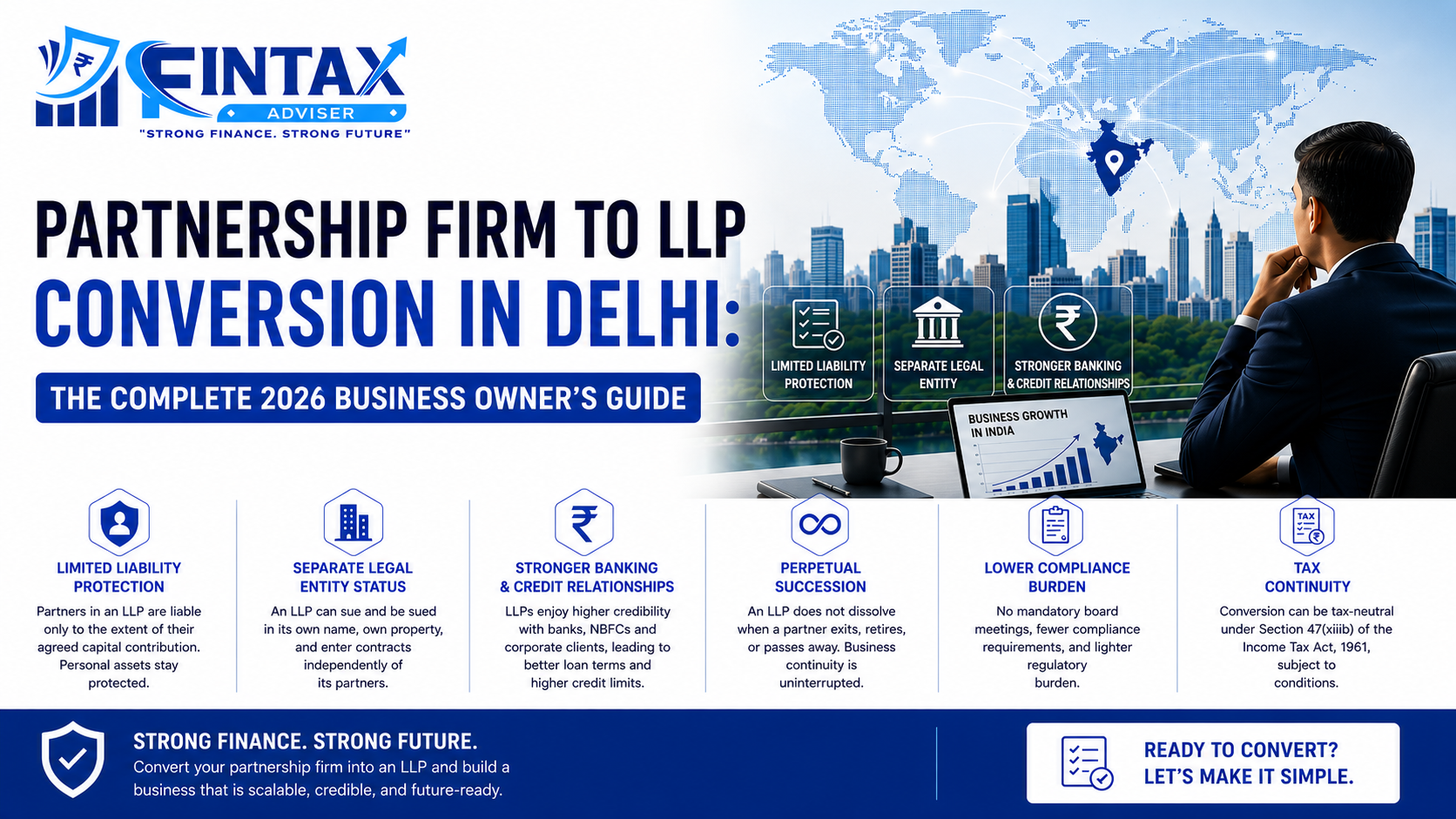
If you are running a partnership firm in Delhi and have started feeling the pinch of unlimited personal liability, shaky bank credibility, or partners who are nervous about signing new contracts in their own name, you are not alone. Thousands of small and mid-sized firms across Delhi NCR are quietly making the same move this year—converting their traditional partnership into a Limited Liability Partnership (LLP). It is one of the simplest structural upgrades a business can make, and it is exactly why so many founders start searching for the best partnership to LLP registration in Delhi.
At Fintax Adviser, we work with partnership firms every week that are ready to graduate into a more credible, more protected, and more scalable legal structure. This guide walks you through everything—the legal basis, the documents, the step-by-step process, the tax angle, the 2026 regulatory changes, and the mistakes that trip up first-time applicants—so you can make an informed decision before you file anything with the Ministry of Corporate Affairs (MCA)
What Does "Partnership to LLP Conversion" Actually Mean?
A partnership firm, registered or unregistered, is governed by the Indian Partnership Act, 1932. Under this act, every partner is personally and jointly liable for the debts of the firm—if the business fails or is sued, a partner's personal house, savings, or car can legally be attached to settle firm liabilities.
An LLP, on the other hand, is governed by the Limited Liability Partnership Act, 2008. It is a separate legal entity, distinct from its partners, which means the LLP itself owns its assets, signs its own contracts, and is liable for its own debts — not the individual partners (barring cases of fraud or personal guarantees).
Converting from a partnership to an LLP is not the same as starting a new company. Legally, the conversion is treated as a continuation of the same business — assets, contracts, employees, and goodwill move across without a fresh sale or transfer, provided the conversion follows the correct legal route. This continuity is one of the biggest reasons founders search for the best partnership to LLP registration in Delhi rather than simply dissolving their firm and starting fresh.
Why Are So Many Delhi Businesses Converting to LLP in 2026?
1. Limited Liability Protection
Partners in an LLP are liable only to the extent of their agreed capital contribution. Personal assets — your home, your fixed deposits, your family's savings — stay outside the reach of business creditors.
2. Separate Legal Entity Status
An LLP can sue and be sued in its own name, own property in its own name, and enter contracts independently of its partners. This single change removes a huge amount of personal exposure.
3. Stronger Banking and Credit Relationships
Banks, NBFCs, and even large corporate clients increasingly prefer to work with LLPs over unregistered or registered partnership firms. An LLP structure signals better governance, cleaner books, and lower default risk — which often translates into better loan terms and higher credit limits.
4. Perpetual Succession
An LLP does not dissolve when a partner exits, retires, or passes away. Operations continue uninterrupted, which protects long-term client relationships and vendor contracts — something a traditional partnership cannot guarantee.
5. Lower Compliance Burden Than a Private Limited Company
Unlike a private limited company, an LLP is not required to hold mandatory board meetings, appoint a statutory auditor below certain thresholds, or comply with as many Companies Act provisions. You get most of the credibility of a company with a fraction of the compliance load.
6. Tax Continuity
Where the conversion is carried out correctly under Section 47(xiiib) of the Income Tax Act, 1961, the transfer of assets from the firm to the LLP can be exempt from capital gains tax, provided specific conditions relating to shareholding, turnover, and asset value are satisfied for five years post-conversion.
For businesses evaluating options, this combination of protection, credibility, and manageable compliance is exactly why the best partnership to LLP registration in Delhi has become such a frequently searched service among small business owners this year.
Legal Framework Governing the Conversion
The conversion process draws from three pieces of legislation working together:
| Law | What It Governs |
| LLP Act, 2008 (Section 55 & Schedule II) | The core provisions and eligibility conditions for converting a partnership firm into an LLP |
| LLP Rules, 2009 | Procedural requirements, prescribed forms, and documentation |
| Income Tax Act, 1961 (Section 47(xiiib)) | Tax-neutral treatment of the conversion, subject to conditions |
Under Schedule II of the LLP Act, an existing partnership firm can convert into an LLP by filing Form 17 (application for conversion) along with Form FiLLiP (incorporation of LLP), provided all partners of the firm become partners of the LLP and no one is left out or added at the point of conversion.
Eligibility Criteria for Conversion
Before you approach any consultant for the Best Partnership to LLP Registration in Delhi, check whether your firm meets these basic conditions:
- The partnership firm must be registered under the Indian Partnership Act, 1932 (unregistered firms need to complete registration first in most practical cases).
- All existing partners of the firm must become partners of the new LLP — no partner can be excluded, and no new partner can be added at the exact point of conversion.
- The firm must not have any pending charges, disputes, or unsatisfied loans registered against its assets that would block the transfer.
- Consent of all partners is mandatory, along with a fresh LLP agreement reflecting the converted structure.
- The firm's PAN and existing income tax filings must be in good standing.
Documents Required for Partnership to LLP Registration in Delhi
Keeping these ready in advance can shave days off your timeline:
Firm-Level Documents
- Registered Partnership Deed
- PAN card of the firm
- Firm's Registration Certificate (if registered with Registrar of Firms)
- Latest income tax returns and financial statements of the firm
Partner-Level Documents
- PAN card and Aadhaar card of every partner
- Passport-size photographs
- Address proof (bank statement, utility bill, or voter ID)
- Digital Signature Certificate (DSC) for at least two designated partners
Registered Office Proof
- Latest electricity or utility bill
- Rent agreement (if the premises is rented)
- No Objection Certificate (NOC) from the property owner
Step-by-Step Partnership to LLP Conversion Process
- Initial Consultation and Document Review — A consultant reviews your partnership deed, partner details, and financials to confirm eligibility and flag any red flags early.
- Obtain DSC and DPIN—Digital Signature Certificates and Designated Partner Identification Numbers are arranged for partners who will act as designated partners in the new LLP.
- Name Reservation via RUN-LLP — A name is reserved through the MCA's RUN-LLP service. It is common practice to retain a name close to the original partnership firm's name to preserve brand recall.
- Drafting the LLP Agreement — This document sets out capital contribution, profit-sharing ratio, partner roles, and decision-making rules for the new entity.
- Filing Form 17 and FiLLiP—Form 17 (conversion application) is filed along with the incorporation form, attaching the partnership deed, NOC of creditors (if applicable), and consent of all partners.
- Certificate of Incorporation — Once the Registrar of Companies (ROC) is satisfied, a Certificate of Incorporation is issued, and the LLP officially comes into existence.
- Post-Incorporation Compliance — PAN, TAN, and GST migration, bank account update, and intimation to existing clients, vendors, and licensing authorities.
Timeline and Approximate Cost
| Stage | Typical Duration |
| Document collection & DSC/DPIN | 2–4 working days |
| Name reservation (RUN-LLP) | 1–3 working days |
| Filing Form 17 & FiLLiP | 5–10 working days (subject to ROC processing) |
| Post-incorporation PAN/TAN/GST updates | 5–7 working days |
| Total estimated timeline | 15–25 working days |
Government fees vary based on the firm's contribution amount and the number of designated partners, while professional fees depend on the complexity of the firm's existing structure and outstanding liabilities.
Common Mistakes Firms Make During Conversion
- Leaving out a partner at conversion—even a silent or dormant partner must be included, or the conversion can be rejected.
- Ignoring outstanding loans or charges—unresolved bank charges against firm assets frequently delay ROC approval.
- Delaying the LLP Agreement — Form 3 (recording the LLP Agreement) must be filed within 30 days of incorporation; missing this attracts escalating late fees with no upper cap.
- Not updating GST and licenses promptly — GST registration, trade licenses, and bank mandates all need to reflect the new LLP entity to avoid invoicing and banking disruptions.
- Choosing a name that clashes with an existing trademark — this can cause objections at the RUN-LLP stage and cost precious time.
Partnership Firm vs. LLP: A Side-by-Side Comparison
| Feature | Partnership Firm | LLP |
| Governing Law | Indian Partnership Act, 1932 | LLP Act, 2008 |
| Liability | Unlimited, personal | Limited to capital contribution |
| Legal Identity | Not separate from partners | Separate legal entity |
| Continuity | Dissolves on partner exit (unless agreed otherwise) | Perpetual succession |
| Compliance Load | Minimal | Moderate (annual filings required) |
| Credibility with Banks | Lower | Higher |
| Minimum Partners | 2 | 2 designated partners |
| Conversion into Company | Not directly possible | Possible at a later stage |
Tax Implications of Converting a Partnership Firm into an LLP
When structured correctly, the conversion is tax-neutral under Section 47(xiiib) of the Income Tax Act. Key conditions to preserve this exemption include the following:
- All partners of the firm become partners of the LLP in the same proportion of capital contribution.
- No consideration other than the share in the LLP is received by any partner.
- The aggregate turnover of the firm does not exceed the prescribed threshold in any of the preceding three years.
- The total value of assets in the books does not exceed the prescribed limit as on the date of conversion.
- Partners do not receive any benefit directly or indirectly from the accumulated profits of the firm, other than by way of share in the LLP, for a period of five years from conversion.
Getting even one of these conditions wrong can trigger capital gains tax on the deemed transfer of assets—which is exactly why professional handling of the best partnership to LLP registration in Delhi, India, matters far more than simply filing forms online.
Recent Regulatory Developments Affecting LLP Conversions in 2026
Business owners planning a conversion this year should be aware of a few structural changes at the Ministry of Corporate Affairs:
- ROC Realignment (effective February 2026): The MCA has reorganized jurisdiction for several Registrar of Companies offices, including Delhi, splitting filings between ROC Delhi I and ROC Delhi II based on district and PIN code. Firms filing conversion applications should confirm the correct jurisdiction before submission to avoid rejection.
- Draft Companies (Incorporation) Amendment Rules, 2026: The MCA has proposed consolidating several incorporation and conversion-related e-forms into simplified, unified forms, reflecting a broader push toward a faster, more digital-first filing experience.
- Continued Migration to MCA V3: LLP filings remain fully web-based on the MCA V3 portal, and stakeholders are advised to keep their V3 login credentials, DSC registrations, and profile details updated to avoid last-minute filing delays.
Staying current with these changes is part of why working with an experienced advisory firm — rather than a generic online filing portal — reduces the risk of rejected applications and resubmissions.
Why Fintax Adviser is Trusted for Partnership to LLP Conversion
Fintax Adviser has spent over a decade handling business incorporation, conversion, and compliance work for firms across Delhi NCR and PAN India. A few reasons founders consistently choose us:
- Experience — 15+ years of hands-on work with partnership deeds, LLP agreements, and ROC filings across multiple industries.
- Expertise—An in-house team of chartered accountants, company secretaries, and legal advisors who personally review every conversion file before submission.
- Authoritativeness — 500+ successful conversions and incorporations, with direct familiarity with ROC Delhi's specific documentation preferences and rejection patterns.
- Trustworthiness—Transparent, upfront pricing with no hidden charges and full disclosure of timelines, risks, and tax implications before you commit.
If you are comparing options for the best partnership to LLP registration in Delhi, it helps to work with a team that has actually filed hundreds of these conversions—not just read about the process.
What the Process Looks Like Working With Fintax Adviser
- Free structural consultation to assess whether conversion is the right move for your firm right now.
- Complete documentation support, including DSC, DPIN, and name reservation, handled end-to-end.
- Drafting and vetting the LLP Agreement to reflect accurate capital contribution and profit-sharing.
- Filing and follow-up with the ROC, including responding to any queries or resubmission requirements.
- Post-incorporation support — PAN, TAN, GST migration, and bank account transition, so your business doesn't lose a single working day.
Who Should Seriously Consider This Conversion?
Not every partnership firm needs to convert immediately, but certain signs make the case for the best partnership to LLP registration in Delhi much stronger:
- You're taking on larger contracts or government tenders — many tenders and corporate vendor empanelments now favor or mandate an LLP or company structure over a plain partnership.
- Your firm is applying for business loans or working capital limits — banks routinely offer better terms and higher limits to LLPs because of the separate legal entity status and cleaner financial disclosure requirements.
- You have partners who are increasingly uncomfortable with unlimited liability—as a firm grows and takes on bigger vendor commitments, unlimited personal exposure becomes harder to justify.
- You're bringing in a new investor or professional partner—an LLP structure makes it far easier to document capital contribution, profit shares, and exit terms cleanly.
- You want to project a more established, credible brand — clients and larger businesses often perceive an LLP as more serious and stable than an unregistered or basic partnership.
- You're planning for international clients or cross-border transactions—a separate legal entity with clear liability boundaries is generally easier for foreign clients and payment processors to work with.
If two or more of these apply to your business today, it's worth booking a consultation rather than waiting for a crisis to force the decision.
Post-Conversion Compliance Checklist
Getting the Certificate of Incorporation is not the finish line — it's the start of a new compliance rhythm. Once your LLP is registered, keep these items on your calendar:
- File Form 3 within 30 days to formally record the LLP Agreement with the MCA; missing this deadline attracts late fees that accumulate with no upper cap.
- Update your GST registration to reflect the new LLP entity, PAN, and constitution—continuing to invoice under the old firm's GST number after conversion can create serious mismatches.
- Migrate bank accounts and payment gateways to the LLP's name and PAN, and update mandates with vendors and clients accordingly.
- Intimate existing licenses and registrations—trade licenses, MSME/Udyam registration, import-export code (IEC), and any sector-specific licenses need to be updated or reapplied for under the LLP.
- File Form 11 (Annual Return) by 30th May each year and Form 8 (Statement of Account & Solvency) by 30th October each year, without fail.
- File the LLP's Income Tax Return — generally due by 31st July (non-audit cases) or 31st October (audit cases), unless extended by the CBDT.
- Maintain proper books of account from day one of the LLP's existence, since LLPs are held to more rigorous documentation standards than a basic partnership.
A single missed filing rarely causes irreversible damage, but a pattern of missed deadlines shows up in MCA records and can quietly erode the credibility benefits you converted to gain in the first place.
How to Choose the Right Consultant for Your Conversion
Since so many firms in Delhi now offer conversion services, it helps to filter based on a few practical questions before you commit:
- Do they review your partnership deed and financials before quoting a price? A firm that quotes without reviewing your documents is likely underestimating complexity—or planning to charge more later.
- Do they explain the Section 47(xiiib) tax conditions upfront? If capital gains tax exposure isn't discussed before filing, you could face an unpleasant surprise later.
- Do they handle post-incorporation compliance, or just the incorporation itself? GST migration, bank updates, and Form 3 filing are just as important as the conversion filing itself.
- Can they show a track record of completed conversions, not just company incorporations? The forms, eligibility checks, and tax treatment for conversions are meaningfully different from fresh incorporations.
- Is pricing transparent, with government fees and professional fees clearly separated? Vague, bundled pricing is one of the most common sources of billing disputes in this industry.
A consultant who can answer all five confidently, with specific examples, is generally a safer bet than one who focuses purely on speed or the lowest quoted price.
Frequently Asked Questions
1. Can an existing partnership firm be converted into an LLP?
Yes. Under Section 55 and Schedule II of the LLP Act, 2008, a registered partnership firm can convert into an LLP by filing Form 17 along with the LLP incorporation form (FiLLiP).
2. Is a new business entity created after conversion, or does the old firm continue?
Legally, it is treated as a continuation of the same business—assets, contracts, and goodwill transfer to the LLP without being treated as a fresh sale, provided the conversion rules are followed correctly.
3. Do all existing partners need to join the new LLP?
Yes. Every partner of the firm at the time of conversion must become a partner in the LLP; no partner can be excluded or added at that exact point.
4. How long does the conversion process usually take?
Most conversions are completed within 15 to 25 working days, depending on document readiness and ROC processing time.
5. Is the partnership firm's PAN valid after conversion?
No. The LLP is a separate legal entity and requires its own fresh PAN, TAN, and GST registration after incorporation.
6. Will the conversion attract capital gains tax?
Not if the conditions under Section 47(xiiib) of the Income Tax Act are satisfied, including turnover limits, asset value limits, and matching profit-sharing ratios.
7. Can I keep the same firm name for my LLP?
In most cases, yes, provided the name is available and compliant with MCA naming guidelines; "LLP" must be added at the end of the name.
8. What happens to existing contracts and licenses after conversion?
Contracts generally continue, but licenses, GST registration, and bank accounts must be formally updated to reflect the new LLP entity.
9. Is a digital signature certificate mandatory for conversion?
Yes, at least two designated partners must hold a valid DSC to sign and file the conversion forms electronically.
10. What is the minimum number of partners required in an LLP?
A minimum of two designated partners is required, with at least one being a resident of India.
11. Can an LLP later be converted into a private limited company?
Yes, an LLP can be converted into a private limited company at a later stage, subject to separate MCA provisions and eligibility conditions.
12. Why should I hire a professional instead of filing the conversion myself?
Errors in partner consent, tax conditions, or ROC jurisdiction are among the most common reasons conversions get rejected or delayed; professional review significantly reduces this risk.
Conclusion
Converting a partnership firm into an LLP is one of the most practical structural upgrades a growing business can make — it protects personal assets, improves credibility with banks and clients, and keeps compliance manageable compared to a private limited company. With ROC jurisdictions, e-forms, and MCA rules evolving through 2026, getting the process right the first time matters more than ever. Whether you're comparing consultants or ready to file, Fintax Adviser offers the Best Partnership to LLP Registration in Delhi, India, backed by 15+ years of hands-on experience, an in-house expert team, and transparent, end-to-end support from consultation to your Certificate of Incorporation.