
Private Limited Company Registration in Delhi 2026: Complete Process, Documents, Cost & New MCA Rules Explained
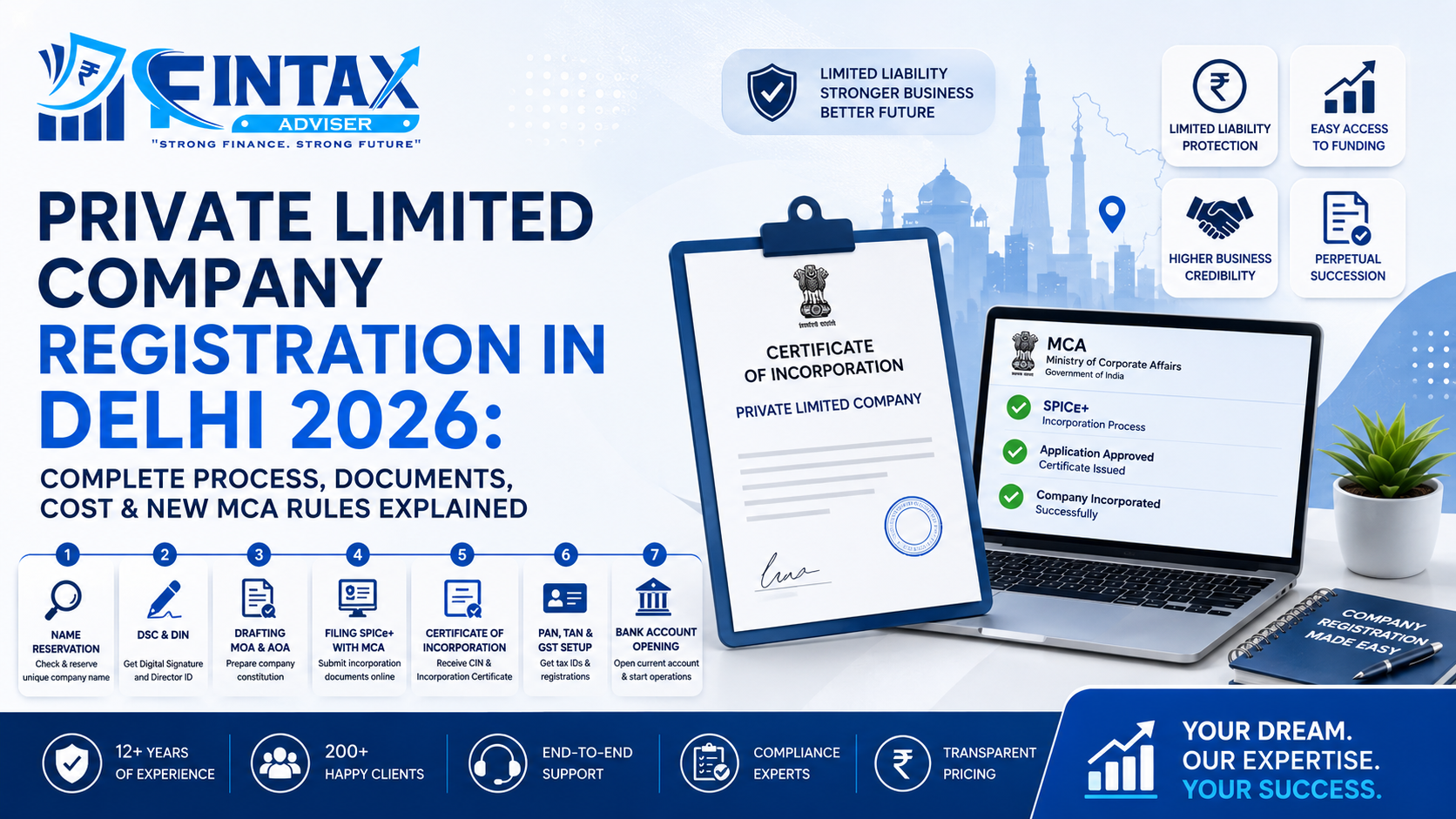
The Delhi Advantage for New Companies
Delhi's position as the National Capital gives newly registered companies a few practical edges that founders in smaller cities don't always get. Government liaison offices, the Registrar of Companies, banking hubs, and a dense network of chartered accountants and legal professionals are all concentrated within the NCR, which means queries get resolved faster and physical verification—where still required—happens without long travel. It's also why the search for the best private limited company registration consultant in Delhi is so competitive: founders here have access to consultants who file dozens of incorporations a month and know exactly how the local ROC bench reviews name approvals, object clauses, and address proofs.
What Is a Private Limited Company?
A private limited company is a business entity registered under the Companies Act, 2013, and regulated by the Ministry of Corporate Affairs (MCA). It is a separate legal person, distinct from its founders, which means the company can own assets, sign contracts, sue, and be sued in its own name. Shares in the company are held privately and cannot be offered to the general public, which distinguishes it from a public limited company.
For most startups, SMEs, and companies planning to raise funding from investors, this is the default structure recommended by chartered accountants and company secretaries across India—and it remains the most searched-for entity type by anyone looking for a best private limited company registration consultant in Delhi in 2026.
Why Register a Private Limited Company in Delhi in 2026
Delhi continues to be one of India's biggest startup and MSME hubs, with easy access to government departments, banks, and a large professional services ecosystem. Registering here in 2026 comes with several practical advantages:
Separate Legal Identity
The company exists independently of its directors and shareholders. Even if a director resigns or passes away, the company continues to exist — a concept known as perpetual succession.
Limited Liability Protection
Shareholders are liable only to the extent of their shareholding, protecting personal assets like homes, savings, and vehicles from business debts and liabilities.
Higher Business Credibility
Vendors, banks, and government departments trust a registered company far more than an unregistered proprietorship. A Certificate of Incorporation issued by the Registrar of Companies (ROC) instantly adds legitimacy.
Easier Access to Funding
Venture capitalists, angel investors, and institutional lenders overwhelmingly prefer to invest in a private limited company because share allotment, ESOPs, and cap table management are far simpler than in an LLP or proprietorship.
Tax Planning & Ownership Transfer
Companies can plan taxation more efficiently and transfer ownership smoothly through share transfer instead of dissolving and re-forming the business.
Key MCA Rules and Compliance Updates Every Founder Should Know in 2026
Company law in India is not static, and 2026 has brought several changes that directly affect anyone registering or running a private limited company. Working with a best private limited company registration consultant in Delhi matters precisely because these updates move fast:
- Abridged Director KYC (effective 31 March 2026): Directors holding a DIN are no longer required to file DIR-3 KYC every single year. Under the revised Rule 12A of the Companies (Appointment and Qualification of Directors) Rules, 2014, directors with no change in details now file a simplified KYC once every three years, reducing the annual compliance burden—though a DIN can still be deactivated and a ₹5,000 late fee applies if the filing is missed when due.
- Companies Compliance Facilitation Scheme, 2026 (CCFS-2026): Notified through General Circular No. 01/2026, this scheme gave companies a facilitation window (15 April 2026 to 15 July 2026) to regularize pending annual return and financial statement filings, which is especially relevant for newly incorporated companies catching up on their first-year compliances.
- Proposed Companies (Incorporation) Amendment Rules, 2026: The MCA has floated draft amendments proposing consolidated forms—E-CHNG for registered office and name changes and E-CON for conversions and approvals—aimed at simplifying post-incorporation filings. These are still in the consultation stage, so founders should track the final notification before relying on the new form numbers.
- DPT-3 Review Deadline: Companies with outstanding director, shareholder, or bank loans should review their books before the DPT-3 filing window to confirm applicability, since this filing is often wrongly assumed to apply only to companies accepting public deposits.
- ROC Restructuring: The MCA re-mapped several ROC jurisdictions in 2026, including a split of ROC Delhi filings between ROC Delhi I and ROC Delhi II based on district and PIN code, which can affect where your incorporation and annual filings are processed.
Staying current with these updates is exactly why founders prefer outsourcing incorporation to an experienced firm rather than filing on their own—a good Best Private Limited Company Registration Consultant in Delhi, India, tracks every notification so you don't have to.
Private Limited Company vs Other Business Structures
One of the first questions we get as a best private limited company registration consultant in Delhi is how a private limited company actually compares to the other structures founders consider. Here's a quick side-by-side view:
| Feature | Private Limited Company | LLP | Sole Proprietorship | OPC |
| Legal Identity | Separate legal entity | Separate legal entity | No separate identity | Separate legal entity |
| Liability | Limited to shareholding | Limited to contribution | Unlimited personal liability | Limited to shareholding |
| Minimum Members | 2 shareholders, 2 directors | 2 partners | 1 owner | 1 member, 1 nominee |
| Fundraising from Investors | Easiest — preferred by VCs | Difficult | Not possible | Restricted |
| Compliance Burden | Moderate to high | Moderate | Minimal | Moderate |
| Ideal For | Startups, scaling businesses | Professional services, consultancies | Small local businesses | Solo founders wanting limited liability |
For most founders planning to raise external funding, hire a team, or build a brand that outlives any single individual, a private limited company remains the clear choice—which is precisely why it is the most commonly registered structure among clients who approach Fintax Adviser as their best private limited company registration consultant in Delhi, India.
Eligibility Criteria for Private Limited Company Registration
Before you begin, make sure your business meets these basic requirements under the Companies Act, 2013:
- A minimum of 2 directors and a maximum of 15 directors.
- Minimum 2 Shareholders (directors and shareholders can be the same people).
- At least one director must be an Indian resident (someone who has stayed in India for 182 days or more in the previous financial year).
- No minimum paid-up capital requirement—you can start with as little as ₹1, though most companies register with ₹1 lakh to ₹5 lakh authorized capital for practical purposes.
- A valid registered office address in India, which can be residential or commercial.
- The proposed company name must be unique and not identical or too similar to an existing company, LLP, or trademark.
Documents Required for Company Registration in Delhi
Getting the paperwork right the first time avoids resubmission delays on the MCA V3 portal. Here is exactly what you need:
Documents for Directors and Shareholders
| Document | Purpose |
| PAN Card | Mandatory identity proof for all Indian directors |
| Aadhaar Card | Address and identity verification |
| Passport-size Photograph | Uploaded with SPICe+ form |
| Address Proof (bank statement/utility bill, not older than 2 months) | Current residence verification |
| Passport (for NRIs/Foreign Nationals) | Mandatory identity document, notarised/apostilled if signed abroad |
| Mobile Number & Email ID | Used for OTP verification during filing |
Documents for Registered Office
| Document | Purpose |
| Electricity/Utility Bill | Proof of address, not older than 2 months |
| Rent Agreement (if rented) | Establishes right to use the premises |
| No Objection Certificate (NOC) | From the property owner, permitting company use |
A missing or mismatched document is the single most common reason applications get sent back by the ROC—one more reason founders lean on a best private limited company registration consultant in Delhi rather than filing solo.
Step-by-Step Private Limited Company Registration Process in 2026
Incorporation in India is fully digital today, filed through the MCA's SPICe+ (INC-32) integrated form. Here's how the process actually works, step by step:
Step 1: Digital Signature Certificate (DSC)
Every proposed director needs a digital signature certificate to sign incorporation documents electronically. This is usually the first document arranged, as nothing else can be filed without it.
Step 2: Name Reservation
Using Part A of SPICe+, you propose up to two company names in order of preference. The ROC checks these against the existing company/LLP register and the trademark database before approval — a step where an experienced consultant significantly increases your first-attempt approval rate.
Step 3: Drafting MOA and AOA
The Memorandum of Association (MOA) defines your company's objectives and scope, while the Articles of Association (AOA) lay out internal governance rules. Both are filed electronically as e-MOA (INC-33) and e-AOA (INC-34).
Step 4: Filing SPICe+ Part B
This single integrated form covers company incorporation, Director Identification Number (DIN) allotment, PAN, TAN, EPFO, ESIC, and professional tax registration (state-dependent)—all in one submission, along with the AGILE-PRO-S linked form for GST registration if required.
Step 5: ROC Verification and Certificate of Incorporation
Once the Registrar of Companies is satisfied that all documents are in order, it issues the Certificate of Incorporation (COI), which includes your Corporate Identification Number (CIN). This is the legal birth certificate of your company.
Step 6: PAN, TAN & Bank Account
PAN and TAN are auto-generated with incorporation. The next step is opening a current bank account in the company's name using the COI, PAN, and board resolution.
Step 7: GST and Other Post-Incorporation Registrations
Depending on your business activity and turnover, you may also need GST registration, shop & establishment registration, MSME/Udyam registration, and professional tax registration—all of which a full-service firm handles alongside incorporation.
Cost of Private Limited Company Registration in Delhi
Costs vary depending on authorised capital, number of directors, and whether add-on registrations like GST or trademark filing are bundled in. Broadly, the components include:
- Government fees for name reservation and SPICe+ filing
- Stamp duty on MOA/AOA (varies by state and authorised capital)
- DSC issuance charges per director
- Professional/consultancy fees
Because government fees and stamp duty change periodically, always confirm the latest fee structure directly with your consultant rather than relying on outdated figures—this is another area where the Best Private Limited Company Registration Consultant in Delhi, India, proves valuable, since fee slabs are updated by the MCA from time to time.
How Long Does Company Registration Take?
With complete documentation and no name objections, a private limited company can typically be incorporated within 7 to 12 working days. Delays usually come from:
- Name resubmission due to similarity with existing entities or trademarks
- Incomplete or mismatched KYC documents
- Errors in MOA/AOA object clauses
- OTP or DSC verification issues, particularly for NRI or foreign directors
Working with a best private limited company registration consultant in Delhi who reviews documents before submission is the single most effective way to avoid these delays.
Post-Incorporation Compliance Checklist
Registration is only the beginning. Directors and companies must stay on top of ongoing statutory obligations, including:
- First Board Meeting within 30 days of incorporation.
- Auditor Appointment within 30 days (Form ADT-1).
- Commencement of Business Declaration (INC-20A) within 180 days of incorporation, before the company starts operations or borrows funds.
- DIR-3 KYC for all directors — now filed on an abridged, once-every-three-years cycle if there is no change in details.
- Annual ROC Filings — AOC-4 (financial statements) and MGT-7/MGT-7A (annual return), which carry steep per-day penalties for delay.
- Income tax return filing for the company, distinct from personal director filings.
- DPT-3 Filing, if applicable, for outstanding loans or deposits.
- Statutory register and minutes book maintenance as required under the Companies Act, 2013.
Missing even one of these can lead to penalties, DIN deactivation, or, in severe cases, the company being marked for strike-off by the ROC—which is why ongoing compliance support matters as much as the initial registration itself.
Common Mistakes Founders Make During Registration
- Choosing a company name too close to an existing brand or trademark, leading to rejection or future legal disputes.
- Drafting vague or overly broad main objects in the MOA that don't match the actual business activity.
- Ignoring the INC-20A commencement declaration, which blocks the company from legally starting operations.
- Treating incorporation as a one-time task instead of the start of an ongoing compliance relationship.
- Using a residential address without proper NOC documentation, which invites ROC queries.
Why Choose Fintax Adviser as Your Registration Partner
If you are comparing options for the best private limited company registration consultant in Delhi, India, here is what sets a genuinely reliable partner apart—and what we bring to the table at Fintax Adviser:
- Over a decade of hands-on experience filing incorporations across industries, from first-time founders to foreign-owned subsidiaries.
- A dedicated team of chartered accountants and company secretaries who track every MCA circular, form update, and compliance deadline in real time.
- Transparent, upfront pricing with no hidden charges on government fees or professional fees.
- End-to-end support—not just incorporation, but GST registration, trademark filing, ROC annual compliance, accounting, and virtual CFO services under one roof.
- A track record of serving startups, e-commerce businesses, healthcare companies, digital agencies, import-export units, and foreign-owned companies across Delhi NCR and beyond.
Choosing the best private limited company registration consultant in Delhi isn't just about getting your Certificate of Incorporation faster—it's about having a partner who stays with you through every filing deadline that follows.
Industries We Help Register in Delhi
Fintax Adviser has incorporated companies across a wide spread of sectors, which means our team already understands the sector-specific nuances—from object clauses to licensing—that a generic Best Private Limited Company Registration Consultant in Delhi might miss:
- Startups & IT/SaaS Firms — structuring for future ESOP pools and investor rounds
- E-commerce Businesses—aligning incorporation with GST and marketplace onboarding requirements
- Consultancy & Professional Services Firms — drafting object clauses that match service offerings precisely
- Healthcare Companies — navigating additional licensing alongside incorporation
- Digital Marketing Agencies — quick-turnaround registration for agency and freelance-to-company transitions
- Import-Export Units — coordinating IEC registration with incorporation
- Manufacturing Businesses — factoring in factory licenses and MSME/Udyam registration
- Foreign-Owned Companies — handling FDI compliance, apostille requirements, and RBI reporting
- Educational Institutes — advising on Section 8 alternatives where applicable
- Freelancers & Independent Professionals — helping solo consultants transition into a formal company structure
Pre-Registration Checklist: What to Prepare Before You Begin
Before reaching out to any consultant — including us — it helps to have the basics ready. This shortens your registration timeline considerably:
- Finalize 2–3 proposed company names, ideally checked informally against the MCA and trademark databases beforehand.
- Decide your authorized and paid-up capital, even though there's no legal minimum, since this affects stamp duty.
- Confirm your registered office address and arrange the NOC from the property owner in advance.
- Collect PAN, Aadhaar, and address proof for every proposed director and shareholder.
- Draft a one-line description of your main business activity, which forms the basis of your MOA's object clause.
- Decide the shareholding split between founders upfront to avoid disputes later.
Frequently Asked Questions
1. How many directors are required to register a private limited company? A minimum of 2 directors is required, with a maximum of 15. At least one director must be a resident of India.
2. Is there a minimum capital requirement for registration? No. The Companies Act, 2013, does not prescribe any minimum paid-up capital, though most founders start with ₹1 lakh to ₹5 lakh as authorized capital.
3. How long does the registration process take? With complete documents, incorporation typically takes 7 to 12 working days through the SPICe+ integrated filing process.
4. Can NRIs or foreign nationals register a company in Delhi? Yes, NRIs and foreign nationals can be directors or shareholders, provided at least one director is an Indian resident and the foreign national's documents are properly notarized or apostilled.
5. What is the DIR-3 KYC requirement in 2026? Directors now file an abridged KYC once every three years if there is no change in their details, following the amendment effective 31 March 2026, instead of the earlier annual requirement.
6. What are DSC and DIN? DSC (Digital Signature Certificate) is used to sign e-forms electronically, while DIN (Director Identification Number) is a unique identifier allotted to every company director.
7. What is the Certificate of Incorporation? It is the official document issued by the Registrar of Companies (ROC) confirming your company's legal existence, containing your unique Corporate Identification Number (CIN).
8. Do I need a commercial address to register my company? No. A residential address can be used as the registered office, provided you submit a valid utility bill and a No Objection Certificate from the property owner.
9. What is INC-20A, and why does it matter? INC-20A is the Commencement of Business declaration, which is mandatory within 180 days of incorporation. Without filing it, the company cannot legally start operations or avail loans.
10. What ongoing compliances apply after registration? Key annual filings include AOC-4, MGT-7/MGT-7A, DIR-3 KYC, and income tax returns, along with maintaining statutory registers and holding board meetings.
11. What happens if annual ROC filings are missed? Missed filings attract per-day penalties with no upper cap in many cases and can eventually lead to director disqualification or the company being struck off by the ROC.
12. Why should I hire a consultant instead of registering myself? A consultant reduces the risk of name rejection, document mismatches, and filing delays and ensures your MOA, AOA, and post-incorporation compliances are handled correctly from day one.
Conclusion
Registering a private limited company in Delhi in 2026 is faster and more digital than ever, but the rules around it—from abridged director KYC to ROC jurisdiction changes and evolving incorporation forms—continue to shift throughout the year. Getting expert guidance isn't just about convenience; it directly affects how quickly your company gets approved and how smoothly it stays compliant afterward. If you're looking for the best private limited company registration consultant in Delhi, Fintax Adviser combines over a decade of incorporation experience with real-time tracking of every MCA update, so your business starts on solid legal ground and stays there. Reach out to Fintax Adviser today for a free consultation and let our team handle your company registration from name approval to your first ROC filing.