
Private Limited Company Registration in India: Process & Cost
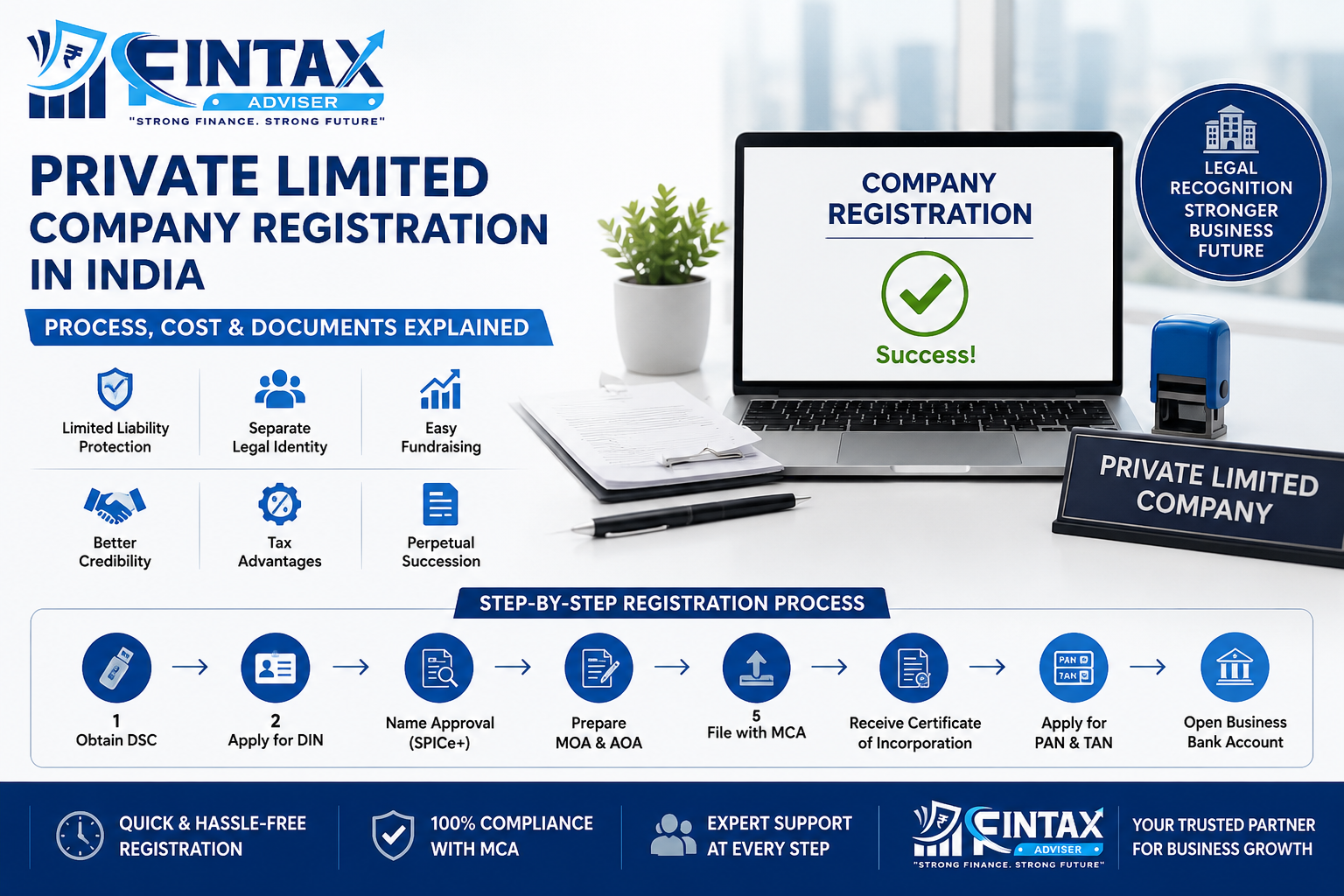
Starting a business in India begins with choosing the right legal structure, and a Private Limited Company is one of the most preferred options for startups, entrepreneurs, and growing businesses. Private limited company registration offers a strong legal foundation by providing limited liability protection, a separate legal identity, and greater credibility among investors, banks, and customers. Whether you are launching a new venture or planning to expand an existing business, completing your company registration in India through the prescribed legal process ensures compliance with the Companies Act, 2013. If you want to register a private limited company successfully, understanding the registration process, required documents, and associated costs is the first step toward building a compliant and scalable business.
What is a Private Limited Company?
A private limited company is a legally recognized business entity incorporated under the Companies Act, 2013. It is one of the most popular business structures in India because it offers a separate legal identity, allowing the company to own assets, enter contracts, and continue operations independently of its owners.
Key Features of a Private Limited Company
One of its key advantages is limited liability, which protects the personal assets of shareholders from business debts. Additionally, a private limited company enjoys perpetual succession, meaning it continues to exist despite changes in ownership or management.
For entrepreneurs planning to register private limited companies, this structure provides greater credibility, simplifies business registration, and supports the smooth incorporation of companies while ensuring compliance with company registration in India regulations.
Benefits of Private Limited Company Registration
Choosing private limited company registration offers several advantages for entrepreneurs, startups, and growing businesses. As a trusted legal business structure, it provides legal protection, enhances business credibility, and supports long-term growth. Whether you're planning a startup registration or expanding an existing venture, this business model is designed to meet modern compliance and funding requirements. Some of the key benefits of private limited company include:
- Limited Liability Protection: Shareholders are liable only up to their investment, protecting their personal assets.
- Easy Fundraising: Investors and venture capital firms generally prefer a company incorporated under a recognized structure.
- Better Credibility: Registered companies build greater trust among customers, suppliers, and financial institutions.
- Tax Advantages: Eligible businesses may benefit from various tax deductions and government incentives.
- Easy Ownership Transfer: Shares can be transferred with minimal disruption to business operations.
- Separate Legal Identity: The company exists independently of its owners after company incorporation, ensuring continuity and legal recognition.
Eligibility Criteria for Private Limited Company Registration
Before applying for private limited company registration, it is important to meet the eligibility conditions prescribed under the Companies Act, 2013. Fulfilling these private limited company eligibility requirements helps ensure a smooth incorporation process and avoids unnecessary delays.
- Minimum 2 Directors: A private limited company must have at least two directors, with one director being an Indian resident.
- Minimum 2 Shareholders: The company must have at least two shareholders, who may also serve as directors.
- Registered Office Address: A valid registered office address in India is mandatory for official communication.
- Resident Director Requirement: At least one director must have stayed in India for the prescribed period under the law.
- Unique Company Name: The proposed company name must be unique and comply with MCA naming guidelines while meeting all director requirements and shareholder requirements.
Documents Required for Private Limited Company Registration
Submitting the correct documents required for private limited company registration is essential for a smooth and hassle-free incorporation process. Keeping all documents for company registration ready in advance helps avoid delays and ensures compliance with the Ministry of Corporate Affairs (MCA) requirements.
For Directors
- PAN Card
- Aadhaar Card
- Passport (mandatory for NRIs and foreign nationals)
- Driving Licence or Voter ID (as identity/address proof, where applicable)
- Recent passport-size photograph
For Registered Office
- Latest Electricity Bill or Utility Bill (not older than two months)
- Rent Agreement (if the premises are rented)
- No Objection Certificate (NOC) from the property owner
These company incorporation documents are verified during the registration process to establish the identity of the directors and the authenticity of the company's registered office address.
Step-by-Step Process of Private Limited Company Registration
The private limited company registration process involves several legal and procedural steps to ensure your business is incorporated in compliance with the Companies Act, 2013. Following the correct company incorporation process helps avoid delays and ensures successful MCA registration.
- Obtain a Digital Signature Certificate (DSC): The proposed directors must obtain a Digital Signature Certificate to digitally sign incorporation documents.
- Apply for Director Identification Number (DIN): Every director must have a valid Director Identification Number (DIN) before incorporation.
- Reserve the Company Name: Submit your preferred company name through the SPICe+ registration portal for MCA approval.
- Prepare MOA & AOA: Draft the Memorandum of Association (MOA) and Articles of Association (AOA), defining the company's objectives and internal rules.
- File the Incorporation Application: Submit the incorporation forms and supporting documents through the MCA portal.
- Receive the Certificate of Incorporation: Once approved, the MCA issues the Certificate of Incorporation, officially establishing the company.
- Apply for PAN & TAN: Obtain PAN and TAN for taxation and regulatory compliance.
- Open a Business Bank Account: Use the incorporation documents to open a current account for business transactions.
Cost of Private Limited Company Registration in India
The private limited company registration cost in India depends on several factors, including the state of incorporation, the number of directors, and the professional service provider you choose. While the exact incorporation cost in India may vary, most businesses can expect to spend between ₹6,000 and ₹20,000 for the complete registration process.
The overall company registration fees generally include:
- Government Fees: Charges payable to the Ministry of Corporate Affairs (MCA) for incorporation.
- DSC Charges: Fees for obtaining a Digital Signature Certificate for directors.
- Professional Fees: Costs for legal, CA, or company secretary services.
- Stamp Duty: State-specific charges applicable on incorporation documents.
- State-wise Variation: Registration costs differ based on the state's stamp duty and regulatory requirements.
Understanding these expenses helps entrepreneurs plan their business registration budget effectively.
Timeline for Private Limited Company Registration
The timeline for private limited company registration in India may vary depending on the accuracy of the submitted documents, the availability of the proposed company name, and the processing time of the Ministry of Corporate Affairs (MCA). If all required information is submitted correctly, the registration process is generally completed within 7–10 working days.
A typical registration timeline is as follows:
- Digital Signature Certificate (DSC): 1 Working Day
- Director Identification Number (DIN): 1 Working Day
- Company Name Approval (SPICe+): 2–3 Working Days
- Company Incorporation and Certificate of Incorporation: 3–5 Working Days
Once the Certificate of Incorporation is issued, the company can proceed with obtaining PAN and TAN, opening a business bank account, and completing other statutory registrations, if applicable. Timely submission of accurate documents and compliance with MCA guidelines can help ensure a faster and smoother incorporation process.
Common Mistakes to Avoid During Company Registration
Avoiding common company registration mistakes can help ensure a smooth and hassle-free incorporation process. Even minor errors may lead to delays, additional costs, or rejection of your application. To stay compliant with MCA compliance requirements, keep the following points in mind:
- Choosing a Rejected Company Name: Ensure the proposed name is unique and follows MCA naming guidelines.
- Incorrect Documentation: Verify that all identity, address, and incorporation documents are accurate and up to date.
- Wrong Business Activity Code: Select the appropriate NIC code that matches your business operations.
- Address Proof Mismatch: The registered office address should match the supporting documents submitted.
- Delay in DSC Verification: Complete the Digital Signature Certificate (DSC) verification promptly to avoid processing delays.
Careful planning and accurate documentation can significantly speed up the company registration process.
Why Choose Professional Assistance for Private Limited Company Registration?
While it is possible to complete the registration process independently, seeking professional assistance can save time, reduce errors, and ensure full legal compliance. Experienced Chartered Accountants, Company Secretaries, or business registration consultants understand the latest Ministry of Corporate Affairs (MCA) requirements and can guide you through every stage of incorporation.
Professional assistance offers several advantages, including:
- Faster Approval: Experts help prepare and file applications accurately, reducing the chances of rejection or delays.
- Error-Free Documentation: All incorporation forms and supporting documents are reviewed to ensure accuracy and completeness.
- Compliance Support: Professionals ensure your company complies with the Companies Act, 2013, and other statutory regulations.
- Post-Incorporation Services: Assistance with PAN, TAN, bank account opening, annual compliance, and ROC filings.
- GST and MSME Registration Assistance: Experts can also help obtain GST registration, MSME/Udyam Registration, and other business licenses required for smooth operations.
Professional guidance allows entrepreneurs to focus on growing their business while ensuring the registration process is completed efficiently and in accordance with applicable laws.
About Us
At FinTax Adviser, we are committed to helping entrepreneurs, startups, and established businesses navigate the complexities of taxation, regulatory compliance, and business registration with confidence. Our experienced team of Chartered Accountants, Company Secretaries, tax professionals, and legal experts provides reliable, practical, and timely solutions tailored to every client's unique business needs. From Private Limited Company Registration, LLP incorporation, GST registration, and income tax compliance to ROC filings and ongoing corporate advisory, we deliver end-to-end support under one roof. Our client-focused approach emphasizes accuracy, transparency, and compliance with Indian laws, enabling businesses to minimize risks and focus on sustainable growth. Whether you are launching a new venture or managing an expanding enterprise, FinTax Adviser is your trusted partner for professional financial, tax, and compliance services across India.
Frequently Asked Questions (FAQs)
1. What is a Private Limited Company?
A Private Limited Company is a business entity registered under the Companies Act, 2013, offering limited liability protection, a separate legal identity, and perpetual succession.
2. Who can register a Private Limited Company in India?
Any individual or group of individuals meeting the eligibility criteria, including at least two directors and two shareholders, can register a Private Limited Company in India.
3. How many directors are required for a Private Limited Company?
A minimum of two directors is required, and at least one director must be a resident of India as per legal requirements.
4. What documents are required for Private Limited Company registration?
Key documents include PAN Card, Aadhaar Card, passport-size photographs, identity and address proof of directors, registered office proof, and NOC from the property owner if applicable.
5. How long does Private Limited Company registration take?
If all documents are correct, the process usually takes 7 to 10 working days, depending on MCA approval timelines.
6. What is the cost of Private Limited Company registration in India?
The cost generally ranges between ₹6,000 and ₹20,000, depending on government fees, professional charges, and state-wise stamp duty.
7. Is GST registration required after incorporation?
GST registration is required only if the business crosses the prescribed turnover limit or falls under mandatory GST categories.
8. Can a single person form a Private Limited Company?
No, a minimum of two shareholders and two directors is required. A single person can instead opt for a One Person Company (OPC).
9. What is the difference between a Private Limited Company and an LLP?
A Private Limited Company is better for fundraising and scaling, while an LLP is more suitable for professionals seeking lower compliance requirements.
10. Can foreign nationals become directors in a Private Limited Company?
Yes, foreign nationals and NRIs can become directors, provided at least one director is a resident of India.
11. Is a registered office mandatory for company registration?
Yes, every company must have a valid registered office address in India for official communication and legal correspondence.
12. Why should I hire a professional for company registration?
Professionals ensure accurate documentation, faster approval, legal compliance, and provide end-to-end support including GST, ROC filings, and post-incorporation services.
Conclusion
Registering a Private Limited Company is one of the most reliable ways to build a strong and legally compliant business in India. It provides entrepreneurs with benefits such as limited liability protection, enhanced credibility, and better opportunities for fundraising and expansion. By understanding the private limited company registration process, preparing the required documents, and meeting all legal requirements, business owners can ensure a smooth incorporation journey. Although the process involves multiple steps, professional assistance can significantly reduce errors, save time, and ensure full compliance with MCA regulations. Whether you are starting a new venture or scaling an existing one, a properly registered Private Limited Company lays the foundation for long-term stability, growth, and success in today’s competitive business environment.