
Pvt Ltd vs LLP vs OPC 2026: Which Structure to Choose?
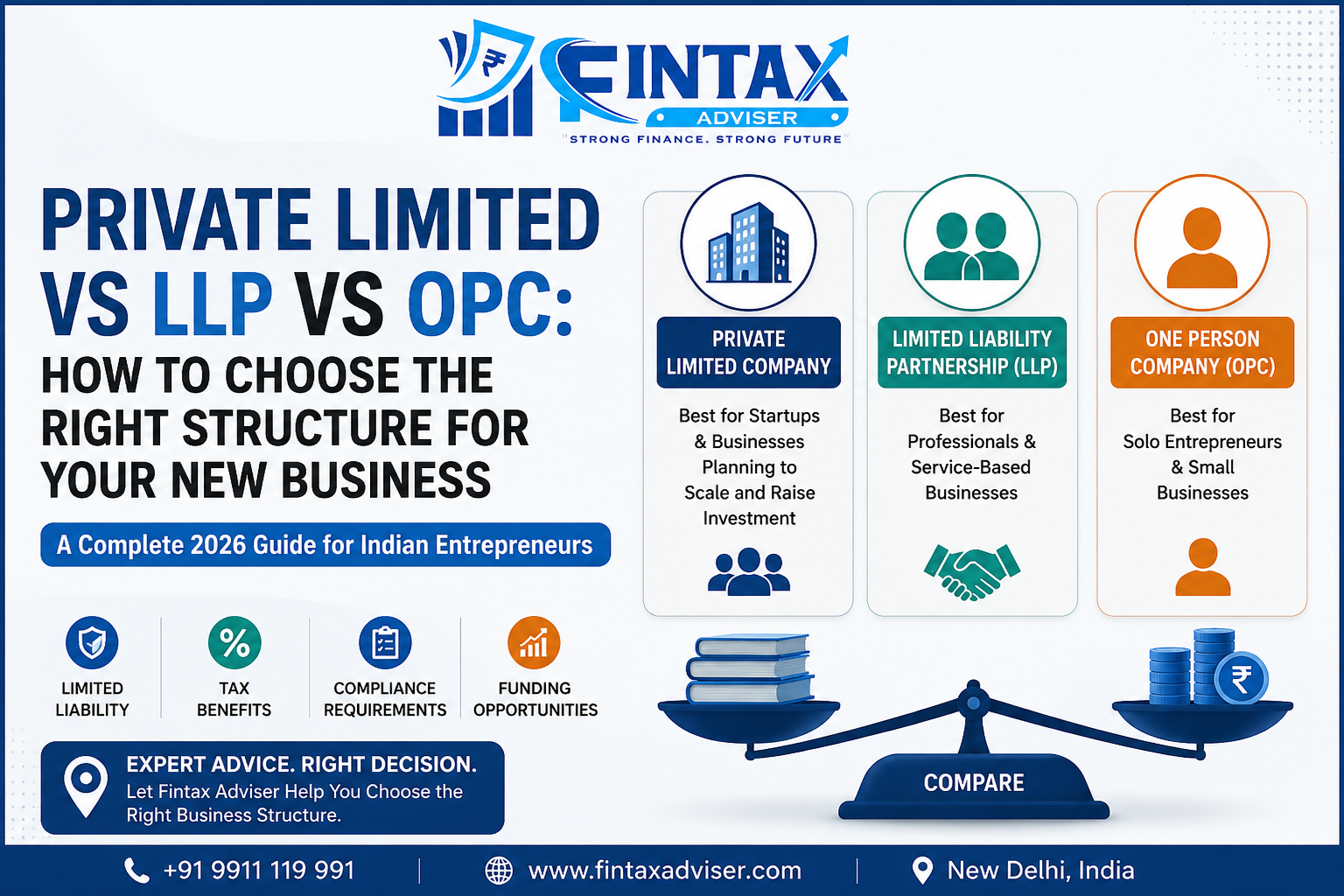
If you plan to raise outside funding, issue ESOPs, or scale fast — register a Private Limited Company. If you're a service professional starting with a co-founder and want low compliance with tax-efficient profit withdrawal — go for an LLP. If you're a solo founder who wants a formal, limited-liability entity without a partner — start with an OPC and convert to Pvt Ltd once you cross ₹2 crore turnover or ₹50 lakh paid-up capital.
There is no single "best" structure — only the structure that's best for your stage, your funding plans, and how much compliance you're ready to handle. This guide breaks it down so you can decide with confidence, and shows exactly where founders go wrong.
Why This Decision Matters More Than Most Founders Realise
Every founder in India eventually asks the same question: Pvt Ltd, LLP, or OPC — which one do I register? It looks like a paperwork decision. It isn't. The structure you pick on day one decides:
- How much personal risk you carry if the business runs into debt or litigation
- What you pay in tax every year, and how that tax changes when you distribute profits
- How much compliance work (and cost) your CA bills you for annually
- Whether investors will even consider funding you
- How painful — or simple — it is to change your mind later
Getting this wrong is one of the most common (and most expensive) mistakes early-stage founders make in India. This guide compares all three structures on the factors that actually matter, based on the law as it stands in 2026 — including a change most other guides haven't updated for yet.
The Three Structures, Explained Simply
1. Private Limited Company (Pvt Ltd)
A Pvt Ltd company is registered under the Companies Act, 2013 and regulated by the Ministry of Corporate Affairs (MCA). It's a separate legal entity from its owners — it can own property, sign contracts, sue and be sued in its own name. Shareholders' liability is capped at what they've invested; personal assets stay protected in the ordinary course of business.
Best suited for: startups planning to raise venture capital or angel funding, businesses that want to offer ESOPs, and founders who want maximum credibility with banks, investors, and enterprise clients.
Core requirements: minimum 2 shareholders and 2 directors (can be the same people), at least one director must be an Indian resident, maximum 200 shareholders and 15 directors.
2. Limited Liability Partnership (LLP)
An LLP is governed by the LLP Act, 2008. It combines the operating flexibility of a traditional partnership with limited liability protection — a partner's liability is capped at their agreed contribution and, importantly, one partner isn't personally on the hook for another partner's mistakes or negligence.
Best suited for: consulting practices, CA/law/design firms, agencies, and any founder-led business where two or more partners want low compliance and don't need to raise institutional equity.
Core requirements: minimum 2 designated partners, at least one an Indian resident, no upper cap on the number of partners.
3. One Person Company (OPC)
An OPC, also created under the Companies Act, 2013, was built specifically for solo founders. It gives a single individual the benefit of a separate legal entity and limited liability — something a sole proprietorship can never offer — without needing to bring in a second shareholder.
Best suited for: solo consultants, freelancers formalising their practice, and single-founder small businesses that want limited liability without the compliance load of a full Pvt Ltd.
Core requirements: one Indian resident citizen as sole shareholder/director, a mandatory nominee named at incorporation, cannot have foreign directors or accept FDI.
2026 Regulatory Update Most Guides Haven't Caught Up With
The Income Tax Act, 2025 came into force on 1 April 2026, replacing the Income Tax Act, 1961 for companies from FY 2026-27 (AY 2027-28) onward. The concessional corporate tax rates founders rely on haven't changed — 22% for domestic companies and 15% for new manufacturing companies remain intact — but the section numbers have been renumbered. What was popularly known as Section 115BAA under the old Act is now referenced under the new Act's structure. If you're reading older blogs or your CA is still quoting 1961 Act sections without the 2025 cross-reference, ask them to confirm the current section mapping before you file — this matters for Form filings and audit trails going forward.
This is exactly the kind of detail a generic AI answer or an outdated blog will miss — and exactly where working with a firm that tracks live regulatory changes (not just static content) protects you.
Side-by-Side Comparison: Pvt Ltd vs LLP vs OPC
| Factor | Private Limited Company | LLP | OPC |
| Governing law | Companies Act, 2013 | LLP Act, 2008 | Companies Act, 2013 |
| Minimum owners | 2 shareholders, 2 directors | 2 designated partners | 1 (with mandatory nominee) |
| Maximum owners | 200 shareholders, 15 directors | No cap on partners | 1 shareholder |
| Liability protection | Limited to shareholding | Limited to contribution | Limited to paid-up capital |
| Statutory audit | Mandatory, regardless of turnover | Only if turnover > ₹40 lakh or contribution > ₹25 lakh | Mandatory, regardless of turnover |
| Corporate tax rate | 22% (concessional regime) + surcharge & cess | Flat 30% + surcharge & cess | 22% (concessional regime) + surcharge & cess |
| MAT applicable | Yes, 15% | No | Yes, 15% |
| Equity fundraising | Yes — preferred by VCs/angels | Not possible; partners fund it | Not possible |
| ESOPs | Allowed | Not allowed | Not allowed |
| Foreign investment (FDI) | Allowed via automatic route | Allowed via automatic route | Not allowed |
| DPIIT Startup India recognition | Eligible | Eligible | Not eligible |
| Board meetings | Minimum 4 per year | Not mandatory | Minimum 2 per year |
| Compliance cost | Highest | Lowest | Moderate (similar to Pvt Ltd, minus board meetings) |
| Mandatory conversion trigger | Not applicable | Not applicable | Turnover > ₹2 crore or paid-up capital > ₹50 lakh |
Tax: The Part Founders Get Wrong Most Often
On paper, LLP's 30% tax rate looks worse than the 22% rate available to Pvt Ltd and OPC. In practice, it's often the opposite once you account for how profits actually reach the founders' pockets:
- Pvt Ltd / OPC: the company pays 22% corporate tax, and then dividends paid out to shareholders are taxed again in the shareholder's hands at their applicable slab rate. This is a genuine double layer of tax on distributed profits.
- LLP: the LLP pays a flat 30% at the entity level, but once that's paid, partners can withdraw their share of profit without any further tax on that withdrawal. There's no MAT either.
For a founder planning to reinvest most profits back into the business and eventually sell equity, Pvt Ltd's structure usually wins. For a founder planning to draw most profits out every year, LLP can genuinely come out ahead despite the higher headline rate. This is not a decision to make from a blog post — model both scenarios against your actual numbers before you commit.
Which Structure Fits Your Situation?
| Your situation | Recommended structure | Why |
| Solo founder, no plans to add a partner soon | OPC | Limited liability, simplest single-owner structure |
| Two or more co-founders, planning to raise VC/angel money | Private Limited Company | Only structure that allows equity issuance and ESOPs |
| Consulting, CA, legal, or agency practice with a partner | LLP | Low compliance, tax-efficient profit withdrawal |
| E-commerce or D2C brand with a co-founder | Private Limited Company | Investor readiness and brand credibility |
| Solo agency founder, may hire a team later | OPC now, convert to Pvt Ltd later | Keep it simple until you actually need to scale |
| Import-export business, needs FDI or bank credit | Private Limited Company | FDI eligibility and stronger banking relationships |
| Manufacturing unit needing working capital loans | Private Limited Company | Structured governance banks prefer |
A 5-Question Checklist Before You Register
- Am I the only founder? If yes, OPC is on the table. If there's a co-founder, OPC is off the table.
- Will I raise equity funding from investors in the next 12–24 months? If yes, it has to be Pvt Ltd — neither LLP nor OPC can issue equity shares to outside investors.
- Do I plan to give ESOPs to early employees? Only a Pvt Ltd can issue ESOPs.
- Is this a professional services business with a partner and no funding plans? LLP is typically the most tax- and compliance-efficient choice.
- Do I need DPIIT Startup India recognition or FDI? Both are available to Pvt Ltd and LLP; OPC is excluded from both.
Mistakes New Business Owners Commonly Make
- Choosing LLP purely to "save tax" without modeling withdrawals. The 22% vs 30% comparison is incomplete without factoring in dividend tax on Pvt Ltd payouts.
- Registering an OPC and forgetting the mandatory conversion trigger. Cross ₹2 crore turnover or ₹50 lakh paid-up capital, and conversion to Pvt Ltd becomes compulsory — plan for it instead of being caught off guard.
- Not budgeting for statutory audit from year one. Both Pvt Ltd and OPC require a mandatory audit regardless of turnover — even a company with zero revenue in its first year still needs one.
- Assuming LLP can raise VC funding "later." Most institutional investors will insist on conversion to Pvt Ltd before writing a cheque, which adds time and cost mid-fundraise. If funding is even a possibility, start as Pvt Ltd.
- Ignoring Section 185 and 186 restrictions on director loans in Pvt Ltd/OPC. Founders who informally move money between personal and company accounts — a habit carried over from running things informally — frequently trip this up without realising it's a compliance violation.
Why Founders Choose Fintax Adviser for Company Registration
Reading a comparison guide is a good first step — but the actual decision usually needs someone to look at your specific numbers, funding plans, and industry before you file anything with the MCA. This is where Fintax Adviser comes in:
- 12+ years of experience handling incorporation, taxation, and compliance for startups, MSMEs, and growing businesses across India.
- 500+ businesses served, from solo founders registering their first OPC to companies converting from LLP to Pvt Ltd ahead of a funding round.
- PAN India service with an on-ground, Delhi-based team of expert Chartered Accountants — so you're speaking to a CA, not a call-centre executive.
- End-to-end support, not just registration paperwork: we help you model the tax impact of each structure, plan for post-incorporation compliance (GST, ROC filings, TDS), and handle the conversion process later if your structure needs to change as you scale.
- 98% client satisfaction across 12+ years of client partnerships, built on transparent pricing and real CA involvement in every filing — not templated, auto-generated paperwork.
Whether you're leaning towards Pvt Ltd, LLP, or OPC, our team can walk you through the registration process, the documents you'll need, and the compliance calendar that follows — all in one conversation.
Frequently Asked Questions
Q: Which is the cheapest structure to register and maintain — Pvt Ltd, LLP, or OPC? A: LLP has the lowest registration and ongoing compliance cost, since statutory audit only kicks in above ₹40 lakh turnover or ₹25 lakh capital contribution. Pvt Ltd and OPC require a mandatory audit every year regardless of turnover.
Q: Can I convert my OPC or LLP into a Private Limited Company later? A: Yes. OPC-to-Pvt-Ltd conversion is straightforward once you have two shareholders and directors, and it's mandatory once you cross ₹2 crore turnover or ₹50 lakh paid-up capital. LLP-to-Pvt-Ltd conversion is also possible but involves more paperwork and Registrar approval, so it's better to start as Pvt Ltd if funding is on your roadmap.
Q: Is an LLP a good idea for a startup that plans to raise funding? A: Generally no. Most VCs and angel investors prefer Pvt Ltd because it allows straightforward equity issuance and ESOP pools. Starting as an LLP and converting later works, but it adds an avoidable step right when you should be focused on your investors.
Q: Do OPCs and Pvt Ltd companies really need an audit even with zero revenue? A: Yes. Statutory audit is mandatory for both structures irrespective of turnover — this surprises many first-time founders who expect it to be linked to revenue thresholds, and it's one of the first compliance costs to budget for.
Q: Can a foreigner or NRI be a director/partner in these structures? A: NRIs and foreign nationals can be directors in a Pvt Ltd company and partners in an LLP, as long as at least one director/designated partner is an Indian resident. Foreign nationals cannot be part of an OPC at all — OPC is restricted to resident Indian citizens only.
Q: What happens if I don't hold the minimum number of board meetings for my Pvt Ltd? A: A Pvt Ltd must hold at least 4 board meetings a year with no more than 120 days between consecutive meetings. Missing this is a compliance default under the Companies Act, 2013, and both the company and defaulting officers can face penalties — this is a very common gap in early-stage companies that don't have a compliance calendar in place.
Q: Which structure is best for a two-person CA firm or design studio? A: LLP is typically the right fit — it keeps compliance and cost low, avoids the double taxation issue on profit distribution, and there's no cap on the number of partners if you bring more people in later.
Q: Is Startup India (DPIIT) recognition available to all three structures? A: No. Pvt Ltd and LLP are both eligible for DPIIT Startup India recognition and its associated tax benefits. OPC is not eligible, which is a key reason many solo founders convert to Pvt Ltd earlier than the mandatory threshold if they want to access startup schemes.
The Bottom Line
There's no universally "right" structure — only the right structure for where your business is headed. Pvt Ltd if you're building to raise funding and scale. LLP if you're a professional-services business prioritising tax efficiency and low compliance. OPC if you're solo and want limited liability without the overhead — knowing you'll likely outgrow it.
The right call depends on your specific funding plans, profit-distribution habits, and growth timeline — not a generic rule of thumb. Fintax Adviser has helped 500+ businesses across India choose, register, and later convert their structure as they scale, with end-to-end support on Private Limited Company Registration, LLP Registration, and OPC Registration.
Not sure which one fits your business? Get a free consultation with our CA team, or chat with our experts on WhatsApp — most queries are answered within the hour.
Written & Reviewed by the Fintax Adviser Team | Chartered Accountants, 12+ Years of Experience in Company Registration & Compliance | PAN India Service, 500+ Businesses Served Last updated: July 2026