
Everything You Must Know Before You Incorporate a Section 8 Company
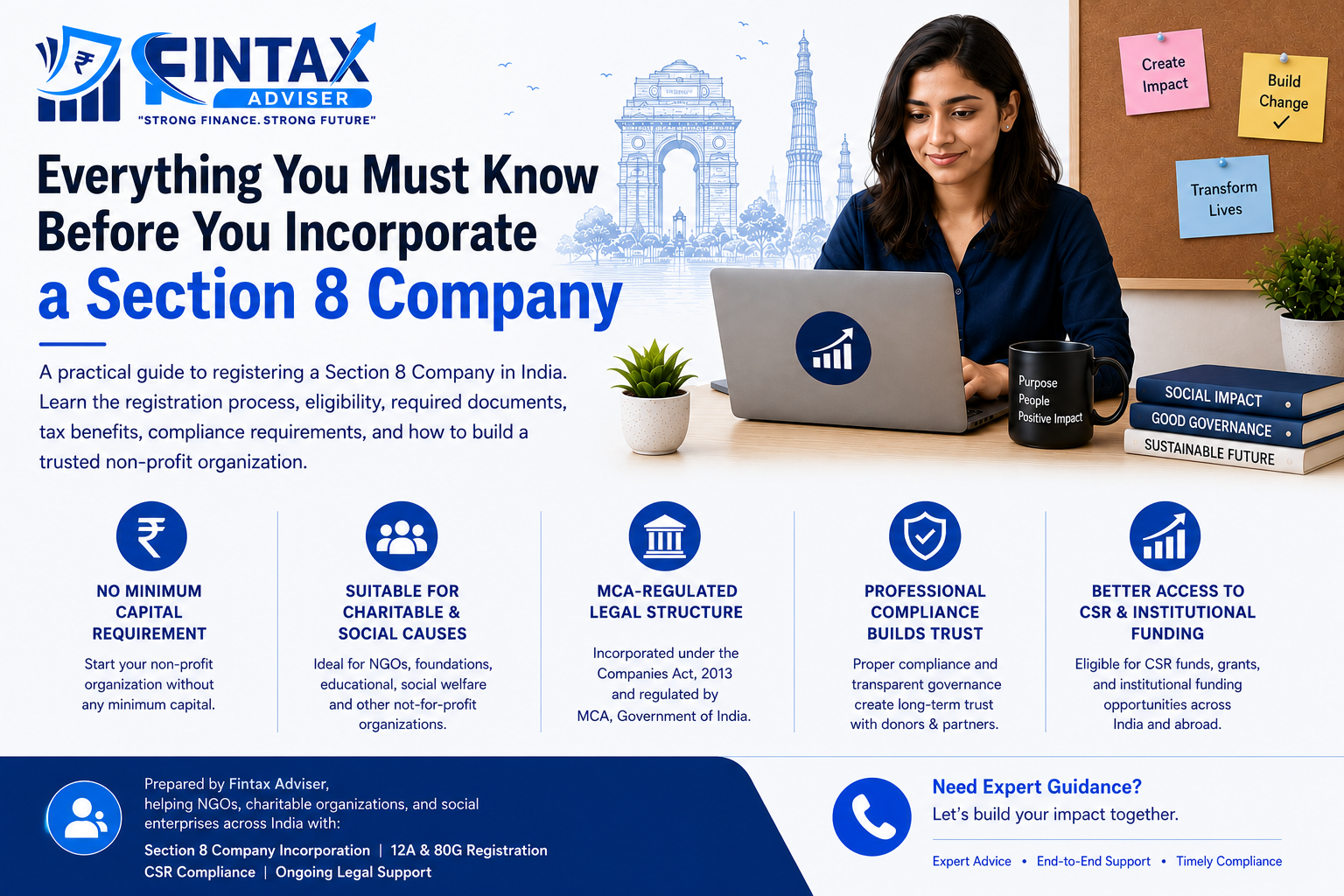
Starting a non-profit is about creating lasting social impact, but choosing the right legal structure is equally important for long-term credibility and compliance.
If you're looking for the Best Section 8 Company (NGO) Registration in Delhi, understanding the registration process is the first step toward building a trusted organization.
A Section 8 Company offers benefits such as legal recognition, eligibility for CSR funding, tax exemptions, and greater donor confidence. This guide explains the 2026 registration process, required documents, costs, compliance requirements, and key factors to consider before selecting a professional registration partner. Fintax Adviser, a Delhi-based CA firm, has helped NGOs across India with Section 8 incorporation, 12A/80G registration, and ongoing compliance.
What Exactly Is a Section 8 Company?
A Section 8 company is a non-profit entity incorporated under Section 8 of the Companies Act, 2013. It is the corporate cousin of a trust or a society, but it is regulated by the Ministry of Corporate Affairs (MCA) rather than a state registrar, which is why it enjoys a different—and generally higher—level of institutional credibility.
The defining feature of a Section 8 Company is simple: any profit or income the company earns must be used only to promote its stated objectives, and it cannot be distributed as dividends to members. Objectives recognized under this structure typically include:
- Promotion of commerce, art, science, sports, education, or research
- Social welfare and charitable activities
- Religion, environmental protection, or heritage conservation
- Poverty alleviation and rural development
Because it operates under a formal corporate framework, a Section 8 Company must maintain the same statutory discipline as a private limited company — board meetings, resolutions, audited financials, and annual ROC filings — but without the profit-distribution rights of a regular company.
Why Delhi Founders Prefer the Section 8 Structure
Delhi has one of the highest concentrations of NGOs, foundations, and social enterprises in India, largely because it is home to central ministries, embassies, CSR desks of large corporates, and international donor agencies. For founders operating in this ecosystem, credibility is currency — and a Section 8 Company signals a level of regulatory seriousness that a Trust deed or a Society bye-law often cannot match on its own.
If your long-term plan includes any of the following, a Section 8 structure is usually the more defensible choice:
- Applying for CSR-1 registration to receive corporate CSR funds
- Seeking grants from FCRA-regulated foreign donors
- Building partnerships with government departments or multilateral agencies
- Scaling operations across multiple states under one legal entity
Section 8 Company vs Trust vs Society: A Straight Comparison
Many first-time founders get stuck comparing these three structures. Here is a direct, side-by-side view.
| Feature | Section 8 Company | Trust | Society |
| Governing Law | Companies Act, 2013 | Indian Trusts Act, 1882 | Societies Registration Act, 1860 |
| Regulator | MCA (Central) | State Registrar | State Registrar |
| Credibility with Donors/CSR | Very High | Moderate | Moderate |
| Minimum Members | 2 (Private) / 3 (Public) | 2 Trustees | 7 Members |
| Compliance Burden | High (ROC + audit) | Low | Moderate |
| Name Protection | Yes, MCA-approved unique name | No | Limited |
| Transferability of Management | Structured (Board/AGM) | Trustee-based | Governing body-based |
| Best Suited For | CSR-focused, funding-heavy NGOs | Small family-run charities | Local community groups |
For organizations that plan to raise institutional funding or apply for CSR-1, a Section 8 Company generally outperforms both alternatives on credibility, even though it demands more paperwork.
Eligibility Criteria for Section 8 Company Registration
Before you begin, confirm you meet these baseline requirements:
- Minimum two directors (at least one must be an Indian resident)
- A registered office address in India (rented or owned, with proof)
- Clear, non-commercial objectives aligned with Section 8 purposes
- No intention to distribute profits to members or directors
- DSC (Digital Signature Certificate) for all proposed directors
- DIN (Director Identification Number) for all proposed directors
There is no minimum capital requirement to start a Section 8 Company, which makes it accessible even for founders with limited initial funding.
Step-by-Step Registration Process (2026 Procedure)
The MCA has consolidated most incorporation filings into the SPICe+ (INC-32) integrated form, which now covers name reservation, incorporation, DIN allotment, PAN, TAN, and even EPFO/ESIC registration in a single window. Here is how the process typically unfolds:
Step 1: Consultation and Objective Mapping
A qualified advisor evaluates your proposed charitable objectives, structure (public vs private limited Section 8), and funding roadmap before drafting begins.
Step 2: DSC and DIN Application
Digital Signature Certificates are issued for all proposed directors, followed by DIN allotment through the SPICe+ form itself.
Step 3: Name Reservation
Two proposed names are submitted through the RUN (Reserve Unique Name) service or directly via SPICe+ Part A. MCA typically requires names ending with words like "Foundation," "Forum," "Association," "Federation," or "Council" rather than "Limited."
Step 4: Drafting MOA (INC-13) and AOA
The Memorandum of Association and Articles of Association are drafted to reflect the non-profit's specific objectives — this is one of the most scrutinized parts of the application, since vague objectives are a common cause of resubmission.
Step 5: Filing INC-12 for Section 8 License
A formal application is made to the Registrar of Companies (RoC) seeking a license under Section 8, along with a declaration (INC-14/INC-15) confirming compliance with the section's requirements.
Step 6: SPICe+ Incorporation Filing
Once the license is approved, the complete incorporation package — MOA, AOA, address proof, identity proof, and declarations — is filed through SPICe+.
Step 7: Certificate of Incorporation
On approval, the RoC issues the Certificate of Incorporation along with PAN and TAN, and your Section 8 Company legally comes into existence.
Step 8: Post-Incorporation Tax Registrations
Immediately after incorporation, you should apply for:
- 12A registration — exempts the NGO's income from tax
- 80G registration — allows donors to claim tax deduction on donations
- CSR-1 filing — makes the NGO eligible to receive corporate CSR funds
Most established consultants bundle 12A and 80G filing into the same engagement as incorporation, since an NGO without these two registrations struggles to attract serious donors in its first year of operation.
A Realistic Timeline Walkthrough
To make the process less abstract, here's how a typical engagement plays out for a founder starting from scratch:
- Week 1: Initial consultation, objective mapping, and document collection begin. DSC applications are filed for all proposed directors.
- Week 2: DIN allotment is completed, and two proposed names are submitted for MCA approval.
- Week 3–4: Once the name is approved, MOA and AOA drafting begins alongside the INC-12 license application.
- Week 5–6: The RoC reviews the Section 8 license application; clarifications, if any, are addressed during this window.
- Week 6–7: SPICe+ incorporation filing is submitted, and the Certificate of Incorporation, PAN, and TAN are issued.
- Week 8 onward: 12A and 80G applications are filed with the Income Tax Department, and the bank account is opened using the incorporation documents.
Founders who prepare their documents in advance and respond quickly to RoC queries typically move through this timeline without delay; the most common slippage happens during name approval and MOA/AOA drafting, where vague objectives lead to resubmissions.
Documents Required for Section 8 Company Registration
| Category | Documents Needed |
| Identity Proof of Directors | PAN Card, Aadhaar Card, Passport (mandatory for foreign nationals) |
| Address Proof of Directors | Voter ID, Driving License, recent Bank Statement, or Utility Bill |
| Registered Office Proof | Electricity Bill / Property Tax Receipt + Rent Agreement or NOC from owner |
| Objective Documents | Vision statement, mission statement, proposed activities, target beneficiaries |
| Photographs | Passport-size photos of all directors |
Keeping these documents ready before you approach a consultant typically shortens the process by one to two weeks.
Public Limited vs Private Limited Section 8 Company
A detail many founders overlook is that a Section 8 Company can be incorporated as either a private limited or a public limited entity, and this choice shapes your future governance structure.
| Factor | Private Section 8 Company | Public Section 8 Company |
| Minimum Members | 2 | 3 (minimum 7 for a full public structure) |
| Minimum Directors | 2 | 3 |
| Suitable For | Family-run or small founding teams | Large-scale NGOs planning wide public participation |
| Share Transfer Restrictions | Yes | No |
| Compliance Load | Comparatively lighter | Comparatively heavier |
Most founders searching for the Best Section 8 Company (NGO) in Delhi start with a private structure, since it's easier to manage in the early years and can later be converted if the organization scales significantly.
FCRA Registration: What Foreign-Funded NGOs Must Know
If your Section 8 Company expects to receive donations from foreign individuals, foundations, or agencies, incorporation and 12A/80G registration alone are not enough — you will also need clearance under the Foreign Contribution (Regulation) Act (FCRA), 2010.
Key points founders should know:
- FCRA registration is generally available only after the NGO has been active for a minimum period and has a demonstrable track record of activity in its stated field.
- Newer NGOs can apply for prior permission to receive a specific foreign contribution for a specific project, rather than waiting for full FCRA registration.
- FCRA funds must be routed through a designated FCRA bank account at SBI's specified branch, and cannot be mixed with domestic donation accounts.
- Non-compliance with FCRA reporting requirements is one of the most common reasons NGOs lose their foreign-funding eligibility altogether.
Founders planning to work with international donors should factor FCRA timelines into their fundraising roadmap from day one, rather than treating it as an afterthought once foreign interest appears.
Opening a Bank Account and Managing NGO Finances
Once your Certificate of Incorporation, PAN, and TAN are issued, opening a current account in the NGO's name is one of the first operational steps. Banks typically require:
- Certificate of Incorporation and MOA/AOA copies
- Board resolution authorizing account opening and signatories
- PAN card of the entity
- KYC documents of authorized signatories
Maintaining a clean, well-documented banking trail from the very first transaction matters enormously later, since auditors and CSR due-diligence teams routinely review fund utilization records during 12A/80G renewal and CSR fund audits.
Timeline: How Long Does It Actually Take?
On average, Section 8 Company incorporation in Delhi takes 20 to 30 working days, broken down roughly as:
- DSC & DIN processing: 2–3 days
- Name approval: 3–5 days
- Section 8 license (INC-12) approval: 10–15 days
- Final SPICe+ incorporation: 5–7 days
12A and 80G registrations, when filed after incorporation, generally add another 30 to 45 days, since these applications go through a separate review by the Income Tax Department's exemption division.
Tax Benefits: Understanding 12A and 80G in Detail
A common misconception is that Section 8 incorporation itself grants tax exemption — it does not. Incorporation only creates the legal entity; 12A registration is what exempts the NGO's own income from income tax, and 80G registration is what allows your donors to claim a deduction on their contributions.
Under the current regime, both registrations are typically granted provisionally for a period before requiring renewal, and NGOs must maintain proper books of accounts, conduct annual audits, and file Form 10B/10BB to retain exemption status. Losing 12A/80G status due to non-compliance is one of the most damaging setbacks an NGO can face, since it directly affects donor confidence.
CSR Eligibility: Why Section 8 Companies Attract Corporate Funding
Under the Companies Act, companies meeting certain net worth, turnover, or profit thresholds are mandated to spend a percentage of profits on CSR activities. To receive such funds, an implementing NGO must:
- Be registered as a Section 8 Company, Trust, or Society for at least three years (with some exceptions for newer entities under government-approved schemes)
- Hold valid 12A and 80G registration
- File Form CSR-1 with the MCA to get a unique CSR registration number
Because CSR desks at large corporates prefer working with entities that carry MCA-level regulatory oversight, a Section 8 Company generally finds it easier to pass corporate due-diligence checks compared to a Trust or Society.
Post-Incorporation Compliance Checklist
Registering the company is only the beginning. Ongoing compliance keeps your NGO in good legal standing:
- Annual filing of financial statements (AOC-4) and annual return (MGT-7) with the RoC
- Board meetings — minimum number as prescribed under the Act
- Statutory audit of accounts every financial year
- Income tax return filing, even if income is exempt under 12A
- FCRA compliance, if receiving foreign contributions
- CSR-1 renewal and utilization reporting, if applicable
Non-compliance can lead to penalties, director disqualification, or in severe cases, cancellation of the Section 8 license itself.
Common Mistakes Founders Make During NGO Registration
- Choosing vague objectives in the MOA that don't clearly map to Section 8 purposes, causing RoC rejection
- Delaying 12A/80G filing, which slows down fundraising in the first critical year
- Ignoring FCRA requirements before accepting the first foreign donation
- Underestimating ongoing compliance costs, assuming non-profits are exempt from filing obligations
- Picking a name too similar to an existing entity, leading to repeated name-approval rejections
- Mixing personal and organizational finances, which raises red flags during 12A/80G renewal audits
- Skipping board meeting minutes and resolutions, which are frequently requested during CSR due diligence checks
- Assuming FCRA and domestic donations can share a bank account, which is a direct compliance violation once foreign funds are involved
How to Choose the Best Section 8 Company (NGO) in Delhi, India
With dozens of consultants advertising NGO registration services online, founders often struggle to separate genuine expertise from templated marketing. Here's a practical checklist:
- Ask about post-incorporation support. Anyone claiming to be the Best Section 8 Company (NGO) in Delhi should offer 12A/80G and CSR-1 filing as part of the engagement, not as a separate upsell discovered later.
- Check their track record with actual case volume, not just years in business.
- Confirm they draft custom MOA/AOA objectives rather than reusing generic templates that trigger RoC objections.
- Ask who handles your compliance after incorporation — a firm that disappears after the certificate is issued leaves you exposed during your first ROC filing cycle.
- Verify they are led by qualified Chartered Accountants or Company Secretaries, since NGO structuring involves both company law and tax law expertise.
Firms like Fintax Adviser, which combine CA-led drafting with end-to-end tax exemption support, are typically better positioned to guide founders through the full lifecycle — not just the incorporation certificate.
Cost Considerations
While exact pricing varies by consultant, government fees for Section 8 incorporation are relatively low compared to the professional fees charged for drafting, filing, and follow-up with the RoC. Founders should be cautious of unusually low quotes that exclude 12A/80G filing, DSC costs, or stamp duty — these are frequently added later as "extras," inflating the final bill well beyond the initial quote.
Broadly, the cost heads involved in a full engagement include:
| Cost Head | What It Covers |
| Government/RoC Fees | Name reservation, INC-12 license, SPICe+ filing charges |
| DSC & DIN Charges | Digital certificates for each proposed director |
| Professional Drafting Fees | Custom MOA/AOA, INC-13/14/15 declarations |
| Stamp Duty | State-specific stamp duty on incorporation documents |
| 12A & 80G Filing Fees | Separate professional fees for post-incorporation tax exemption |
| CSR-1 Filing | Optional add-on once the NGO is eligible to apply |
Ask any consultant for a line-item quote covering every stage above rather than a single lump-sum figure — this is the single easiest way to avoid billing surprises later in the engagement.
Who Prepared This Guide
This guide draws on incorporation and tax-exemption filings handled by the Chartered Accountants and company secretarial team at Fintax Adviser, who work directly with founders across Delhi NCR on Section 8 Company registration, 12A/80G exemption, and CSR-1 filings. Because non-profit structuring sits at the intersection of company law, income tax law, and CSR regulation, founders evaluating any provider — including one claiming to be the Best Section 8 Company (NGO) in Delhi — should confirm the team advising them holds relevant CA or CS qualifications rather than relying purely on a filing agent with no post-registration accountability.
Frequently Asked Questions
1. What is a Section 8 Company in simple terms?
It's a non-profit company registered under the Companies Act, 2013, formed to promote charitable objectives without distributing profits to its members.
2. How many directors are required to register a Section 8 Company?
A minimum of two directors is required for a private Section 8 Company, and at least one must be an Indian resident.
3. Is there a minimum capital requirement?
No. Section 8 Companies can be incorporated without any mandatory minimum paid-up capital.
4. How long does Section 8 Company registration take?
Typically 20 to 30 working days for incorporation, with 12A and 80G registrations taking an additional 30 to 45 days.
5. Can a Section 8 Company earn profit?
Yes, it can generate income, but that income must be reinvested into the organization's charitable objectives, not distributed to members.
6. What is the difference between 12A and 80G registration?
12A exempts the NGO's own income from tax, while 80G allows donors to claim a tax deduction on their donations.
7. Is a Section 8 Company better than a Trust or Society?
For founders seeking CSR funding, institutional credibility, or multi-state operations, a Section 8 Company generally offers stronger regulatory recognition than a Trust or Society.
8. Can a Section 8 Company receive CSR funds directly after incorporation?
Generally no — most CSR rules require the NGO to be registered for at least three years and to have completed CSR-1 filing, with certain exceptions for government-backed programs.
9. What documents are needed for registration? PAN, Aadhaar, address proof of directors, registered office proof, and a clear statement of the NGO's objectives.
10. Can a Section 8 Company be converted into a private limited company later?
Yes, but the conversion process requires RoC approval and is generally complex, since it involves surrendering the Section 8 license.
11. Do Section 8 Companies need to file annual returns?
Yes. They must file AOC-4 and MGT-7 annually with the RoC, along with maintaining audited financial statements.
12. Can foreign nationals be directors in an Indian Section 8 Company?
Yes, foreign nationals can be directors, provided a valid passport is submitted and at least one director on the board is an Indian resident.
Conclusion
Registering a Section 8 Company is one of the strongest foundational decisions a founder can make for a non-profit that intends to grow, raise CSR funds, or work with institutional donors — but the process only pays off if it's done correctly the first time, from objective drafting to post-incorporation tax registrations. Whether you handle it yourself or bring in professional support, understanding each stage — DSC/DIN, name approval, MOA/AOA drafting, RoC filing, and 12A/80G exemption — puts you in a far stronger position to evaluate any consultant claiming to be the Best Section 8 Company (NGO) in Delhi,. If you'd rather not navigate this alone, Fintax Adviser's CA-led team can walk you through consultation, incorporation, and compliance as a single continuous process.