
TDS Compliance Complete Guide for Businesses and Professionals
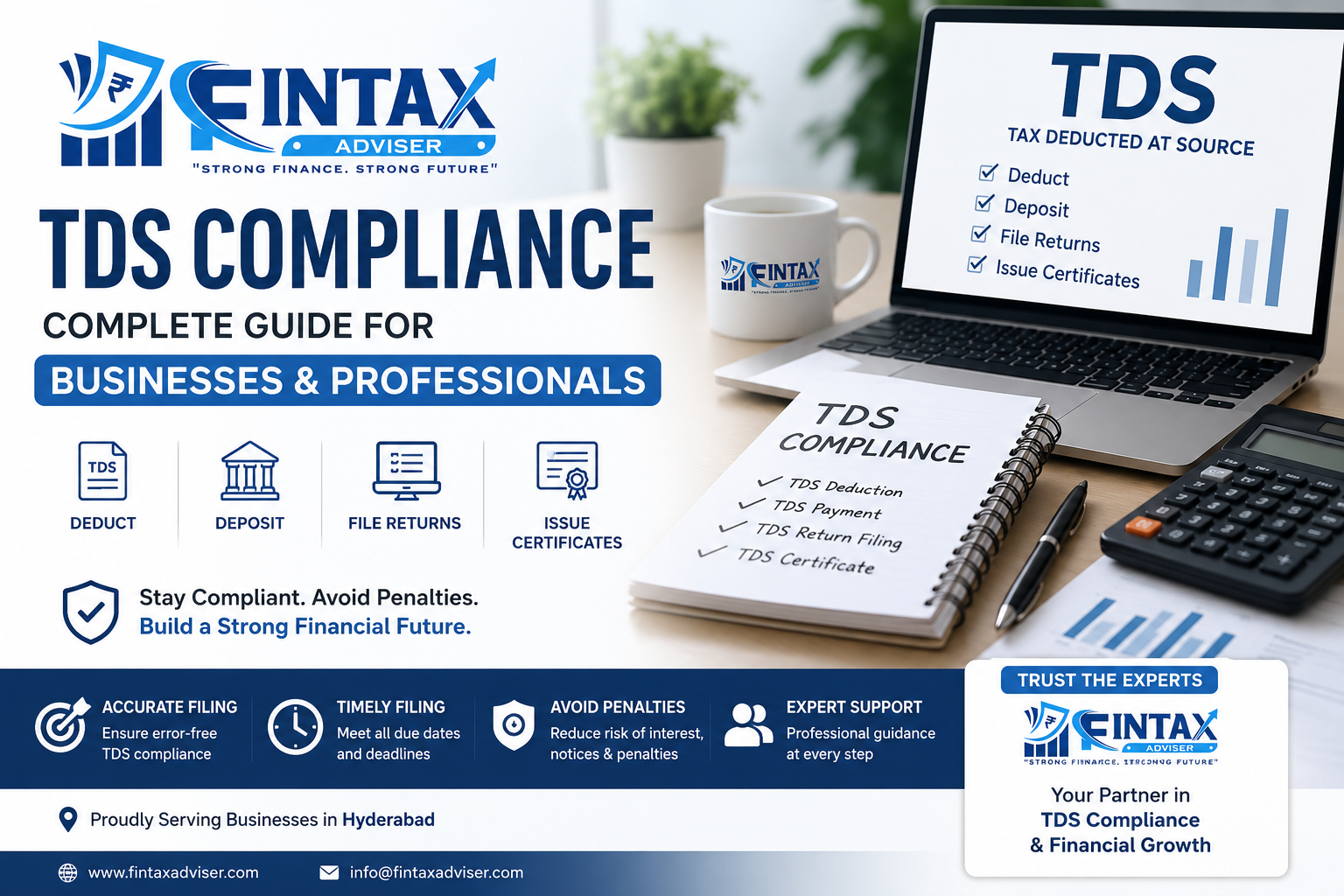
Managing taxes correctly is an essential responsibility for every business owner, employer, and working professional. TDS Compliance refers to the process of deducting, depositing, reporting, and maintaining records of Tax Deducted at Source in accordance with the Income Tax Act. Timely compliance helps organizations avoid penalties, maintain financial transparency, and meet statutory obligations. Businesses seeking the Best TDS Compliance in Hyderabad often benefit from professional guidance that ensures accurate and hassle-free compliance with the latest tax regulations.
With the government's increasing focus on digital tax administration, online filing and timely reporting have become integral parts of effective TDS management. Whether you operate a startup, a growing enterprise, or work as an independent professional, understanding TDS obligations is crucial for smooth financial operations and regulatory compliance. This comprehensive guide explains the fundamentals of TDS Compliance, who is required to deduct tax, applicable rules, filing procedures, due dates, common mistakes to avoid, and practical best practices to help businesses and professionals remain fully compliant.
What Is TDS Compliance
Understanding Tax Deducted at Source
TDS Compliance is the process of fulfilling all legal responsibilities related to Tax Deducted at Source, including deducting tax, depositing it with the government, filing periodic returns, and issuing the prescribed certificates to taxpayers. The primary objective of TDS is to collect income tax at the point where certain payments are made, ensuring a steady flow of revenue to the government while reducing the possibility of tax evasion. Following the applicable TDS Rules helps businesses and professionals maintain accurate financial records and remain compliant with statutory requirements.
How the TDS System Works
Under the TDS system, the person or organization making specified payments—such as salaries, professional fees, rent, interest, or contractor payments—is responsible for deducting the applicable tax before releasing the balance amount to the recipient. The deducted tax is then deposited with the Income Tax Department, and the recipient receives credit for the amount while filing their income tax return. Since TDS Compliance is a legal obligation under the Income Tax Act, timely and accurate adherence is mandatory to avoid interest, penalties, and unnecessary compliance issues.
Why TDS Compliance Is Important for Businesses and Professionals
Maintaining proper Business Tax Compliance is essential for organizations and professionals to meet their statutory obligations under the Income Tax Act. Timely deduction, deposit, and reporting of TDS help businesses comply with legal requirements while minimizing the risk of interest, penalties, and regulatory notices. Consistent Income Tax Compliance also supports efficient financial management by ensuring accurate bookkeeping, improving cash flow planning, and simplifying annual tax assessments. Organizations that follow the prescribed compliance procedures are better prepared for audits and regulatory reviews.
Benefits of Timely TDS Compliance
Proper TDS management enhances transparency between taxpayers and government authorities by ensuring that taxes are collected and reported accurately. It also strengthens a company's credibility among employees, vendors, clients, and financial institutions by demonstrating responsible financial practices and regulatory discipline. Accurate tax reporting reduces the likelihood of filing errors, avoids unnecessary disputes, and promotes smooth business operations. Seeking guidance from an experienced TDS Consultant can further help businesses stay updated with changing tax provisions, improve compliance efficiency, and maintain long-term financial stability.
Who Is Required to Deduct TDS
The responsibility for TDS Deduction is not limited to large corporations; it also extends to various business entities, employers, and certain individuals as specified under the Income Tax Act. Any person or organization making payments that attract TDS must deduct the applicable tax before releasing the payment to the recipient. Proper compliance is particularly important for businesses managing Payroll TDS and TDS on Salary, as timely deduction and reporting help ensure legal compliance while avoiding interest and penalties.
Entities Required to Deduct TDS
- Companies operating in the private or public sector.
- Partnership firms making payments covered under TDS provisions.
- Limited Liability Partnerships (LLPs) liable to deduct tax on eligible payments.
- Proprietorship businesses covered under applicable tax provisions.
- Employers responsible for deducting TDS on Salary from employees' taxable income.
- Central and State Government departments making specified payments.
- Professionals and business entities paying fees for professional or technical services.
- Individuals and Hindu Undivided Families (HUFs) whose accounts are subject to tax audit under the Income Tax Act and who make payments attracting TDS Deduction.
Types of Payments Covered Under TDS
The Income Tax Act requires tax to be deducted at source on several specified payments to ensure timely tax collection and improved compliance. The applicable TDS rate depends on the nature of the transaction, the recipient's status, and the relevant provisions of the law. Making accurate TDS Payment on these transactions helps businesses and professionals meet statutory obligations while reducing the risk of non-compliance and financial penalties.
Common Payments Subject to TDS
- Salary: Employers must deduct TDS on Salary based on the employee's estimated taxable income.
- Contractor Payments: Payments made to contractors and subcontractors generally attract TDS on Contractor Payments under applicable tax provisions.
- Professional Fees: Fees paid to consultants, doctors, lawyers, architects, and other professionals.
- Rent: Rent paid for land, buildings, machinery, or equipment above the prescribed threshold.
- Commission and Brokerage: Payments made as commission or brokerage for business transactions.
- Interest: Interest paid by banks, financial institutions, or other specified entities.
- Dividend: Certain dividend payments may be subject to TDS as per applicable tax provisions.
- Purchase of Property: Tax deduction may apply on eligible immovable property transactions.
- Technical Services: Fees paid for technical, consultancy, or specialized professional services.
TDS Compliance Process Step by Step
Following a systematic TDS process helps businesses and professionals remain compliant with tax regulations while ensuring timely reporting and accurate documentation. From deducting tax to issuing certificates, every stage must be completed within the prescribed timelines to avoid interest and penalties. Maintaining a valid Tax Deduction and Collection Account Number (TAN), meeting filing deadlines, and keeping proper records are essential for smooth TDS Return Filing and hassle-free tax compliance.
Step One Deduct TDS
Before making eligible payments, the deductor must calculate and deduct tax at the applicable rate. The deduction should be made using a valid TAN and in accordance with the relevant provisions of the Income Tax Act.
Step Two Deposit the TDS
After deduction, the tax must be deposited with the government through the prescribed challan payment system within the applicable due date. Timely payment helps prevent interest and late-payment charges.
Step Three File TDS Returns
Businesses are required to complete TDS Return Filing by submitting quarterly returns before the specified filing deadlines. Depending on the nature of the payment, deductors may file Form 24Q for salaries, Form 26Q for domestic non-salary payments, or Form 27Q for payments made to non-residents. Today, Online TDS Filing has simplified the return submission process and improved compliance efficiency.
Step Four Issue TDS Certificates
Once the returns are processed, deductors must provide the applicable TDS Certificate to the payee. Form 16 is issued for salary payments, while Form 16A is provided for most non-salary transactions, enabling recipients to claim TDS credit while filing their income tax returns.
Important TDS Due Dates
Meeting TDS Due Dates is essential for businesses and professionals to maintain statutory compliance and avoid interest, late fees, or penalties. After deducting tax, the applicable TDS Payment should generally be deposited within the prescribed monthly timeline notified under the Income Tax Act. In addition, deductors are required to submit quarterly TDS returns within the specified deadlines and issue TDS certificates to deductees within the prescribed period after return filing. Timely completion of these obligations ensures smooth tax reporting, accurate credit for taxpayers, and reduced compliance risks. Many organizations also rely on professional TDS Filing Services to monitor due dates, maintain documentation, and ensure every compliance requirement is completed accurately and on time.
Common TDS Compliance Mistakes to Avoid
Even a small error in TDS management can result in notices, additional costs, and unnecessary compliance challenges. Following the applicable TDS Rules and maintaining proper records help businesses strengthen Income Tax Compliance while minimizing the risk of a TDS Penalty. Paying close attention to deductions, reporting, and filing timelines can significantly reduce avoidable mistakes.
Common Errors to Watch For
- Quoting an incorrect or invalid PAN of the deductee.
- Delaying TDS deposits beyond the prescribed due dates.
- Deducting tax at the wrong rate or making an incorrect deduction.
- Missing statutory filing deadlines for quarterly TDS returns.
- Using the wrong return form, such as filing an incorrect TDS statement.
- Submitting inaccurate or incomplete details in TDS reports.
- Ignoring notices or failing to rectify filing errors promptly, which may lead to interest charges and TDS Penalty under the applicable provisions.
Benefits of Professional TDS Compliance Services
Managing TDS obligations can be time-consuming, especially when businesses need to monitor changing tax regulations, filing deadlines, and documentation requirements. Choosing professional Tax Compliance Services helps organizations ensure accurate tax deductions, timely return filing, and complete statutory compliance. Businesses seeking the Best TDS Compliance in Hyderabad often rely on experienced professionals to streamline compliance processes, minimize errors, and maintain proper financial records through secure digital systems.
Why Professional Assistance Matters
Professional TDS experts provide accurate filing, reducing the likelihood of mistakes that may result in notices or penalties. They save valuable time by handling calculations, return preparation, and compliance documentation efficiently. An experienced Chartered Accountant for TDS stays updated with the latest tax provisions and procedural changes, offering reliable guidance for complex transactions. In addition, digital documentation, continuous compliance support, and expert advice help businesses improve operational efficiency while ensuring long-term compliance with Income Tax regulations.
When Should You Consult a TDS Expert
Consulting a qualified TDS Consultant is advisable whenever your business encounters situations that require accurate tax deduction and timely regulatory compliance. Professional assistance becomes especially valuable when starting a new business, hiring employees, making contractor or professional payments, filing quarterly TDS returns, responding to Income Tax notices, handling complex TDS deductions, or correcting filing errors. Businesses looking for the Best TDS Compliance in Hyderabad can benefit from expert guidance that minimizes compliance risks and ensures accurate documentation.
Why Choose FinTax Adviser
FinTax Adviser is a private consultancy firm providing professional financial and taxation assistance and is not affiliated with any Government authority or agency. Guided by the vision of Demystifying Finance. Empowering Innovation., the firm combines regulatory expertise with digital solutions to help businesses build strong financial systems and maintain reliable tax compliance. Backed by 12+ years of financial excellence, 200+ startups served, 98% client satisfaction, and over ₹20 million in managed tax savings, the team is committed to integrity, client-focused growth, and forward-thinking strategies. Under the leadership of Founder Anchal Tiwari and Co-Founder (CFO) Mohit Gauhan, FinTax Adviser supports startups and enterprises with practical, compliant, and growth-oriented financial solutions.
Frequently Asked Questions
1. What is TDS Compliance?
TDS Compliance is the process of deducting tax at source, depositing it with the government, filing prescribed returns, and issuing TDS certificates in accordance with the Income Tax Act.
2. Who is required to deduct TDS?
Companies, partnership firms, LLPs, employers, government departments, certain professionals, and individuals covered under tax audit provisions are required to deduct TDS on specified payments.
3. What is the purpose of TDS?
The primary purpose of TDS is to collect income tax at the source of income, improve tax compliance, and ensure a steady flow of revenue to the government.
4. What are the TDS due dates?
TDS must be deposited and quarterly returns filed within the timelines prescribed by the Income Tax Department. Due dates vary depending on the type of payment and the applicable return quarter.
5. What is TAN?
TAN (Tax Deduction and Collection Account Number) is a unique identification number that every person responsible for deducting or collecting tax at source must obtain before undertaking TDS-related activities.
6. What are Form 24Q and Form 26Q?
Form 24Q is used for reporting TDS deducted from salary payments, while Form 26Q is used for reporting TDS on most domestic non-salary payments.
7. What happens if TDS is not deposited on time?
Delayed deposit of TDS may result in interest, late fees, penalties, and possible notices from the Income Tax Department.
8. Can TDS returns be revised?
Yes. If errors are identified after filing, a revised TDS return can be submitted to correct details such as PAN, challan information, or deductee records.
9. How can I check my TDS status?
Taxpayers can verify their TDS details through Form 26AS or the Annual Information Statement (AIS) available on the Income Tax e-filing portal.
10. What is Form 16 and Form 16A?
Form 16 is the TDS certificate issued for salary income, whereas Form 16A is issued for eligible non-salary payments where tax has been deducted at source.
11. What are the penalties for late TDS filing?
Late filing may attract statutory late fees, interest on delayed payments, and other penalties depending on the nature and duration of the default under applicable tax provisions.
12. When should I consult the Best TDS Compliance in Hyderabad?
You should consider professional assistance when starting a business, managing employee payroll, making contractor payments, filing quarterly returns, responding to tax notices, or handling complex TDS-related transactions to ensure accurate compliance.
Conclusion
TDS Compliance plays a vital role in helping businesses and professionals meet their statutory tax obligations while maintaining financial transparency and regulatory discipline. Timely tax deduction, prompt deposit, and accurate TDS Return Filing significantly reduce the risk of interest, penalties, and compliance-related issues. Maintaining proper documentation and adopting digital filing methods further improve efficiency, record management, and reporting accuracy. Since tax laws and compliance requirements continue to evolve, staying informed is essential for effective Business Tax Compliance. For organizations dealing with complex transactions or growing compliance responsibilities, seeking guidance from experts offering the Best TDS Compliance in Hyderabad can help ensure accurate, efficient, and hassle-free tax management.