
Why Every Indian Business Needs a Trusted GST Registration Consultant Before Filing Anything
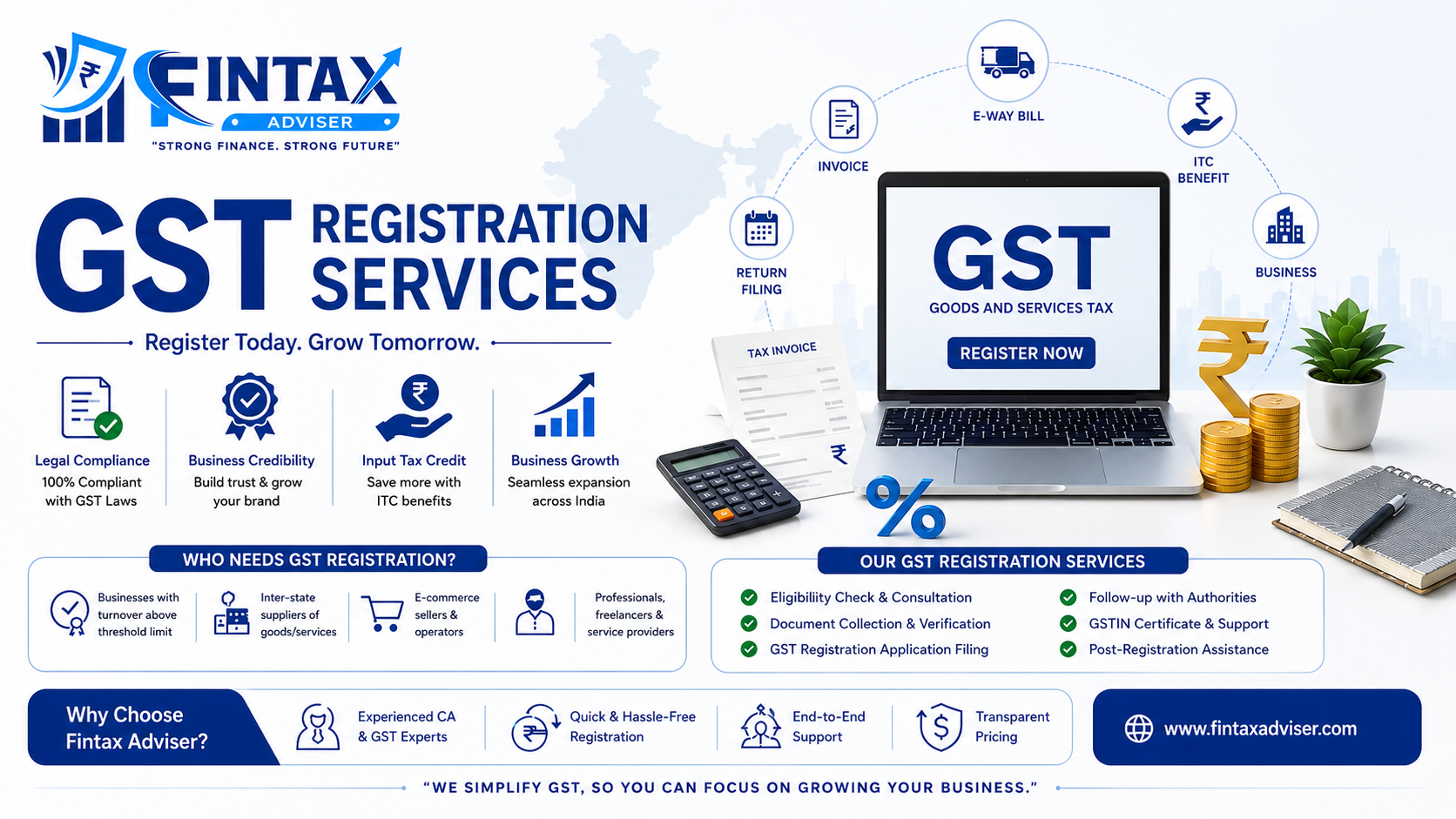
What Is GST and Why Does It Matter for Indian Businesses?
The Goods and Services Tax is India's unified indirect taxation system, which replaced over a dozen overlapping central and state taxes—including VAT, service tax, excise duty, and entry tax—when it was launched on 1 July 2017. Under the principle of "One Nation, One Tax," GST simplified the tax structure across the entire supply chain, from the manufacturer to the end consumer.
For businesses, GST is not just a compliance checkbox. It is the foundation of commercial credibility. A business with a valid GSTIN (GST Identification Number) can:
- Legally issue tax invoices to clients and customers
- Claim Input Tax Credit (ITC) on purchases and reduce overall tax outflow
- Participate in government tenders and large corporate supply chains
- Sell across state lines without facing double taxation barriers
- List products on major e-commerce platforms like Amazon, Flipkart, and Meesho
Without GST registration, a business is effectively invisible to the formal economy. And in an era where digital invoicing, e-way bills, and automated return matching are the norm, operating without a GSTIN is not just risky — it's unsustainable.
Understanding Who Needs GST Registration in India
One of the most common questions a GST registration consultant handles every day is, "Do I actually need to register?" The answer depends on several factors laid out in the CGST Act, 2017.
Mandatory Registration Based on Turnover
The aggregate annual turnover threshold for mandatory GST registration is:
- ₹40 lakhs for businesses involved in the supply of goods (₹20 lakhs for special category states)
- ₹20 lakhs for service providers (₹10 lakhs for special category states)
If your annual turnover crosses these limits, GST registration is not optional — it is a legal obligation.
Mandatory Registration Regardless of Turnover
Certain categories of businesses must register for GST even if their turnover is below the threshold. These include:
- Inter-state suppliers of goods or services
- E-commerce operators and sellers on platforms like Amazon, Flipkart, or Meesho
- Casual taxable persons who occasionally supply goods or services
- Non-resident taxable persons conducting business in India
- Agents supplying goods or services on behalf of principals
- Businesses liable to pay tax under the reverse charge mechanism
- Persons required to deduct TDS under Section 51 of the CGST Act
This is where expert advice from a GST registration consultant becomes critical. Misidentifying your category or missing a mandatory registration can lead to interest charges of 18% per annum on tax due, plus heavy penalties.
Voluntary Registration
Even if you are below the threshold, voluntary GST registration is often a smart business decision. Registered businesses look more credible to corporate clients, can claim ITC, and are better positioned for growth. Many startups and freelancers choose voluntary registration from day one.
The Role of a Professional GST Registration Consultant
A qualified GST registration consultant does far more than just fill out forms on the GST portal. Their role spans the entire compliance lifecycle of a business.
Pre-Registration Advisory
Before the application is even filed, an experienced GST registration consultant will:
- Assess your business structure—proprietorship, partnership, LLP, private limited, or other—and determine the correct GST category
- Evaluate your turnover and advise whether standard registration, composition scheme, or voluntary registration is most appropriate
- Review your supply chain to identify inter-state transactions that may trigger mandatory registration
- Advise on the HSN/SAC codes applicable to your goods or services, which affect the applicable GST rate slab (0%, 5%, 12%, 18%, or 28%)
- Identify Input Tax Credit opportunities that can significantly reduce your tax outgo
Document Preparation and Verification
The GST portal requires a precise set of documents, and errors here cause most rejections. A professional GST registration consultant will verify every document for accuracy before submission—PAN details, Aadhaar-linked mobile number, address proofs, bank statements, and business registration certificates.
Application Filing and Follow-Up
Once documents are in order, the consultant files the application on the GST Common Portal, tracks its status, and responds promptly to any queries raised by the GST officer within the stipulated 7-day response window. Delayed responses can result in the application being rejected.
Post-Registration Guidance
After GSTIN issuance, a good consultant doesn't disappear. They provide guidance on:
- Setting up your invoice format as per GST rules
- Understanding the GST return filing calendar (GSTR-1, GSTR-3B, GSTR-9)
- Claiming and reconciling Input Tax Credit
- Managing e-way bill requirements for goods movement
- Understanding reverse charge obligations
This is why choosing the right GST registration consultant is one of the most important business decisions you will make in your first year.
GST Registration Services: What Fintax Adviser Offers
Fintax Adviser has built a comprehensive ecosystem of GST registration services designed to serve every type of business—from solo freelancers to large manufacturing units.
New GST Registration
The core service: end-to-end handling of your new GSTIN application. This covers business type assessment, document collection, portal filing, ARN (Application Reference Number) tracking, officer query response, and final GSTIN certificate delivery. Fintax Adviser targets completion within 3 to 7 working days, significantly faster than the typical self-filed timeline.
GST Registration for Multiple States
If your business operates in multiple states — which is common for distributors, manufacturers, and service companies with pan-India operations — you need a separate GSTIN for each state where you have a fixed place of business. Fintax Adviser manages multi-state registrations efficiently with consistent documentation standards.
Composition Scheme Registration
Small businesses with turnover up to ₹1.5 crores (for goods) or ₹50 lakhs (for services) can opt for the Composition Scheme, which offers a lower flat rate of tax and simplified quarterly filing. However, composition dealers cannot issue tax invoices or claim ITC. A skilled GST Registration Consultant will help you weigh the pros and cons before you opt in.
GST Amendment and Update Services
Business details change — addresses shift, partners change, bank accounts are updated, additional business verticals are added. All such changes require timely amendments on the GST portal. Fintax Adviser handles these amendments accurately to keep your records compliant and up to date.
GST Cancellation and Surrender
When a business closes, drops below the threshold, or restructures, GST registration needs to be formally cancelled. Improper cancellation leads to continued filing obligations and penalties. Fintax Adviser manages the cancellation process cleanly and completely.
GST Filing Services: Your Ongoing Compliance Partner
Getting a GSTIN is only the beginning. The real compliance commitment starts with GST Filing Services — the regular return filing that keeps your registration active and your business penalty-free.
India's GST filing regime involves multiple return types, each with specific due dates:
GSTR-1 — Details of outward supplies. Filed monthly (by the 11th) or quarterly (by the 13th of the month following the quarter) under the QRMP scheme.
GSTR-3B — Summary return of outward liabilities, ITC claimed, and tax paid. Filed monthly (by the 20th) or quarterly under QRMP.
GSTR-9 — Annual return summarizing the entire year's transactions. Filed by December 31 of the following financial year.
GSTR-9C — Reconciliation statement and audit report, required for businesses with turnover above ₹5 crores.
Missing return due dates triggers late fees of ₹50 per day (₹20 per day for nil returns), plus 18% interest on unpaid tax. Over a financial year, these costs can add up to tens of thousands of rupees—easily avoidable with professional GST filing services.
Fintax Adviser's GST Filing Services include the following:
- Monthly and quarterly GSTR-1 preparation and filing based on your sales invoices
- GSTR-3B computation, ITC reconciliation, and tax payment coordination
- Annual GSTR-9 compilation from the year's transaction data
- 2A/2B reconciliation to match your purchase register with supplier-filed data and maximize legitimate ITC claims
- E-way bill assistance for consignments above ₹50,000 in value
- GST notice response and departmental query handling
With Fintax Adviser managing your GST filing services, your finance team can focus on business operations rather than tax deadlines.
Why Professional GST Filing Services Matter More Than Ever
The GST department has progressively tightened the compliance ecosystem. Several developments in recent years make professional GST filing services not just convenient but strategically essential:
ITC Matching Under GSTR-2B: Input Tax Credit can now only be claimed if it is reflected in your GSTR-2B, which is auto-populated based on your suppliers' filings. If your vendor hasn't filed their GSTR-1, you lose the ITC even if you paid the GST. A professional GST registration consultant and filer monitors your 2B data every month and follows up with non-compliant vendors.
Scrutiny of Returns Under Section 61: The department increasingly issues scrutiny notices when there are discrepancies between GSTR-1 and GSTR-3B, or between the returns filed and the annual return in GSTR-9. Professional filing with proper reconciliation dramatically reduces the risk of such notices.
E-Invoicing for Eligible Businesses: Businesses above ₹5 crores turnover must generate e-invoices through the Invoice Registration Portal (IRP), which are then automatically populated in GSTR-1. This integration means errors in your invoicing system flow directly into your GST returns. Expert oversight is essential.
QRMP Scheme Management: The Quarterly Return Monthly Payment (QRMP) scheme allows eligible businesses to file returns quarterly but pay tax monthly. Managing the monthly challan payment and then the quarterly return filing requires careful cash flow planning—something an experienced GST Registration Consultant does as a matter of routine.
Documents Required for GST Registration: A Complete Checklist
One of the most practical questions businesses ask is about documentation. Here is a comprehensive list organized by business type:
For Sole Proprietorship
- PAN Card of the proprietor
- Aadhaar Card (linked to mobile number for OTP)
- Recent passport-size photograph of proprietor
- Bank account statement or cancelled check (showing account number and IFSC)
- Proof of place of business — electricity bill, rent agreement, or property tax receipt (not older than 2 months)
For a private limited company or LLP
- PAN Card of the company/LLP
- Certificate of Incorporation from MCA
- Memorandum and Articles of Association (for companies) or LLP Agreement (for LLPs)
- PAN and Aadhaar of all directors/designated partners
- Board resolution authorizing the signatory
- Proof of registered office — ownership deed or rent agreement plus NOC from owner
- Electricity/water bill for the business premises
For Partnership Firm
- Partnership Deed (duly stamped)
- PAN Card of the firm
- PAN and Aadhaar of all partners
- Photograph of authorized signatory
- Proof of principal place of business
For Hindu Undivided Family (HUF)
- PAN Card of HUF
- Aadhaar Card of Karta
- Bank account statement in the name of HUF
Having these documents pre-organized and verified before approaching the portal is one of the key advantages of working with a GST registration consultant—it eliminates back-and-forth and gets your application filed right the first time.
Common GST Registration Mistakes That a Consultant Prevents
Even well-intentioned business owners make costly errors when filing on their own. A professional GST registration consultant is trained to prevent exactly these issues:
Incorrect HSN/SAC Code Selection: Choosing the wrong code means you may be charging the wrong GST rate — either under-charging (creating a tax liability) or over-charging (harming your competitive pricing). Consultants have deep familiarity with the HSN/SAC master list.
Wrong Business Constitution: Registering as a proprietorship when you are actually operating as a partnership, or vice versa, creates downstream legal and tax complications that are expensive to fix.
Using Incorrect Address Proof: Many applicants use older utility bills or documents that don't match the current address on record with the municipal authority. This leads to officer queries and delays.
Aadhaar OTP Failures: GST registration now requires Aadhaar authentication for most taxpayers. If your Aadhaar is not linked to an active mobile number, the OTP process fails. Consultants know the workaround (office verification route) and can guide you through it.
Missing the Principal Place of Business vs. Additional Place of Business Distinction: If you have a godown, warehouse, or branch different from your main office, all such locations need to be declared. Missing this creates compliance gaps for e-way bills and audit trails.
GST Notice Handling: What Happens When the Department Comes Calling
Even compliant businesses occasionally receive GST notices. The most common types include:
- ASMT-10: Scrutiny notice pointing out discrepancies between filed returns
- RFD notices: Seeking additional information during a GST refund claim
- DRC-01: Summary of demand raised by the department
- SCN (Show Cause Notice): Issued before cancellation of registration or imposition of penalty
Responding incorrectly — or not responding at all — to these notices can escalate a minor discrepancy into a major legal proceeding with significant penalties. Fintax Adviser's team of GST Registration Consultants and tax advocates handles the entire notice response process, from reviewing the original notice and gathering relevant evidence to drafting a legally sound response and representing you before the GST officer.
Sector-Specific GST Considerations
GST treatment is not uniform across all industries. Understanding sector-specific rules is a hallmark of an experienced GST Registration Consultant.
E-commerce Sellers: Must register regardless of turnover. Platforms like Amazon and Flipkart deduct TCS (Tax Collected at Source) at 1% from the net value of taxable supplies, which the seller then claims as credit.
Real Estate Developers: Post-April 2019, under-construction property attracts GST at 5% (affordable housing: 1%) without ITC. Completed/ready-to-move properties are exempt. Developer registration and ITC reversal calculations are complex.
Exporters: Exports are zero-rated under GST. Exporters can either claim a refund of IGST paid on exports or export under a Letter of Undertaking (LUT) without payment of IGST and claim a refund of unutilized ITC.
Healthcare and Education: Most healthcare and educational services are exempt from GST. However, certain ancillary services — like those provided by hospitals that are not directly medical — may attract GST. Expert advice prevents misclassification.
Restaurants and Food Service: Standard GST rate is 5% without ITC for restaurants not in hotels with room tariff above ₹7,500. Fine dining in premium hotels attracts 18% with ITC. Understanding which applies to your establishment is critical.
GST Filing Services: Monthly Compliance Calendar
For businesses using Fintax Adviser's GST Filing Services, here is a simplified compliance calendar:
11th of every month: GSTR-1 filing (for monthly filers) — outward supply details
13th of every month: GSTR-1 for quarterly filers (final month of quarter only)
20th of every month: GSTR-3B filing (for monthly filers) with tax payment
25th of every month: Monthly tax payment for QRMP scheme taxpayers
31st December: GSTR-9 annual return (for eligible businesses)
31st December: GSTR-9C audit return (for businesses above ₹5 crore turnover)
Fintax Adviser uses a systematic reminder and review process to ensure none of these deadlines are ever missed for their clients.
Why Fintax Adviser Is Delhi's Most Trusted GST Registration Consultant
In a city with hundreds of tax practitioners, Fintax Adviser has established a distinctive reputation built on three core values: accuracy, transparency, and long-term client relationships.
Here is what sets them apart:
Over a Decade of Tax Expertise: With 12+ years of experience specifically in Indian taxation, Fintax Adviser's team understands the nuances that trip up newer practitioners — from transitional credit issues to sector-specific GST notifications.
A Multidisciplinary Team: Unlike solo practitioners, Fintax Adviser operates with a team of Chartered Accountants, tax consultants, legal advisors, and compliance specialists. This means complex cases — involving multiple states, export obligations, or ITC disputes — are handled with the right expertise.
Transparent, Affordable Pricing: GST services are priced clearly with no hidden costs. Clients know exactly what they are paying for before any engagement begins.
End-to-End Compliance Management: From registration to annual return filing, from notice response to GST refund claims, Fintax Adviser manages the complete GST compliance lifecycle. Clients never need to piece together services from multiple providers.
Pan-India Service Delivery: While headquartered in Delhi, Fintax Adviser serves businesses across India through a fully digital engagement model. Documents are collected online, applications filed digitally, and all communication is handled through dedicated support channels.
Proven Track Record: With 200+ satisfied clients across sectors including manufacturing, retail, e-commerce, services, and real estate, Fintax Adviser brings real-world experience from diverse GST scenarios to every new engagement.
12 Frequently Asked Questions About GST Registration and Filing
Q1. What is the full form of GSTIN and what does it contain?
GSTIN stands for Goods and Services Tax Identification Number. It is a 15-digit alphanumeric code — the first two digits represent the state code, the next ten are the PAN of the taxpayer, the 13th digit indicates the number of registrations under that PAN in the same state, the 14th is always "Z," and the 15th is a check digit.
Q2. How long does GST registration take in Delhi?
With all documents correct and complete, GST registration is typically completed within 3 to 7 working days. However, if the officer raises queries, it can extend to 15 to 30 days. Working with a professional GST Registration Consultant minimizes the chance of queries and delays.
Q3. Can I have multiple GSTINs?
Yes. If you operate in multiple states, you need a separate GSTIN for each state. You can also have multiple GSTINs within the same state if you have distinct business verticals that you choose to register separately.
Q4. What happens if I do not file GST returns on time?
Late filing attracts a late fee of ₹50 per day (₹25 CGST + ₹25 SGST), subject to a maximum cap. For nil return filers, the fee is ₹20 per day. Additionally, 18% annual interest applies to any outstanding tax liability. Consistent non-filing can lead to GST registration suspension or cancellation.
Q5. Is GST registration mandatory for freelancers?
Freelancers whose annual income from services exceeds ₹20 lakhs (₹10 lakhs in special category states) must register for GST. Those providing services inter-state must register regardless of turnover. Even below these limits, voluntary registration can enhance professional credibility.
Q6. What is Input Tax Credit and how does it benefit my business?
Input Tax Credit (ITC) allows a registered business to reduce the GST payable on its output by the GST already paid on its inputs (purchases, raw materials, services). For example, if you paid ₹18,000 GST on raw materials and your output tax liability is ₹25,000, you pay only ₹7,000 in cash. This mechanism prevents the cascading effect of taxes and directly improves margins.
Q7. Can I cancel GST registration voluntarily?
Yes. If your turnover falls below the threshold or your business closes, you can apply for voluntary cancellation of GST registration. However, you must file all pending returns and pay all outstanding tax, interest, and fees before the application will be processed.
Q8. What is the Composition Scheme under GST?
The Composition Scheme is a simplified tax option for small businesses with annual turnover up to ₹1.5 crores (goods) or ₹50 lakhs (services). Under this scheme, businesses pay a flat percentage of turnover as GST (1% for traders, 5% for restaurant services, 6% for service providers) and file quarterly returns. The key trade-off is that they cannot issue tax invoices or claim Input Tax Credit.
Q9. What are the GST rates applicable in India?
GST rates in India fall into five primary slabs: 0% (essential goods and services like food grains, healthcare), 5% (basic necessities), 12% (standard goods and some services), 18% (most services and manufactured goods), and 28% (luxury and demerit goods like automobiles, tobacco, and aerated beverages). Certain goods also attract a GST Compensation Cess on top of the applicable rate.
Q10. What is GSTR-2B and why is it important?
GSTR-2B is an auto-drafted monthly statement that shows the Input Tax Credit available to you based on the returns filed by your suppliers. As of recent GST council decisions, ITC can only be claimed to the extent it appears in GSTR-2B. Monitoring your 2B data and reconciling it with your purchase register is a critical part of professional GST Filing Services.
Q11. Is Aadhaar authentication mandatory for GST registration?
Yes, for most new GST registrations, Aadhaar authentication is mandatory and must be completed through an OTP sent to the Aadhaar-linked mobile number. If Aadhaar authentication is not completed, the application is not processed and instead referred for physical office verification, which takes significantly longer.
Q12. What is the penalty for not registering for GST when required?
The penalty for not obtaining mandatory GST registration is 100% of the tax due or ₹10,000, whichever is higher. Additionally, you will be liable to pay the entire tax amount with 18% interest from the date it was due. This makes timely registration — guided by a qualified GST Registration Consultant — far more cost-effective than the alternative.
Conclusion
GST compliance is not a one-time event — it is an ongoing commitment that shapes the legal, financial, and reputational standing of your business in the Indian market. From the day you obtain your GSTIN to the filing of your annual return, every step carries both obligation and opportunity.
Fintax Adviser is your dedicated partner through this entire journey. Whether you are a first-generation entrepreneur registering for GST for the first time, an e-commerce seller navigating platform compliance, a service professional managing inter-state clients, or an established manufacturer optimizing Input Tax Credit—Fintax Adviser's team of expert GST Registration Consultants and GST Filing Services professionals is equipped to handle it all with precision, speed, and total transparency.
In a compliance landscape that grows more complex and digitally integrated every year, working with a trusted GST registration consultant is not an expense—it is an investment in the long-term security and growth of your business. Choose expertise. Choose accuracy. Choose Fintax Adviser.